

Supplementing Vitamins and Minerals to Beef Heifers During Gestation: Impacts on Mineral Status in the Dam and Offspring, and Growth and Physiological Responses of Female Offspring from Birth to Puberty
Thursday, June 26, 2025
Research has shown that during gestation in beef cattle, maternal nutritional status has the potential to impact developmental programming outcomes of the calf, which may include alterations to fetal growth and development, placental function, gene expression, and long-term productivity of the offspring.1, 2, 3 During pregnancy, the fetus relies on the nutritional status of the dam for the transfer of nutrients, including vitamins and minerals, across the placenta.4, 5 However, the impact of vitamin and mineral supplementation throughout gestation in beef cattle and its long-term effects on the offspring remains insufficiently discussed.6
Thus, North Dakota State University research aimed to mimic a spring-calving cow-calf production system in which supplemental vitamins/minerals were provided (or not) to investigate the effects of vitamin and mineral supplementation during gestation in beef heifers and its long-term impact on female offspring.6 Thus, the objectives of this study were to evaluate the effects of feeding a vitamin and mineral supplement to heifers throughout gestation on concentrations of minerals in the liver of the dam and calf, mineral accumulation in the placenta and colostrum, colostrum yield, calving characteristics, offspring growth performance and feeding behavior, postweaning physiological responses, metabolic and endocrine profiles, and puberty attainment status in female offspring raised as replacement heifers.
Angus-based heifers (31 head, initial body weight = 910 lb) were adapted to an individual feeding system for 14 days, estrus synchronized and bred with female-sexed semen. Heifers were ranked by body weight (BW) and randomly assigned to receive either a basal diet (CON; 14 head) or the basal diet plus 4 oz/heifer/day of a vitamin and mineral supplement (VTM; 17 head). The vitamin and mineral supplement was a loose product (Purina Wind & Rain Storm All-Season 7.5 Complete, Land O’ Lakes, Inc., Arden Hills, MN). Targeted BW gains for both treatments were 1 lb/head/day. Liver biopsies were obtained from dams at breeding, days 84 and 180 of gestation. At calving, liver biopsies were taken from dams and calves; colostrum, placenta, and blood samples were collected; and calf body measurements were recorded. After calving, all cow-calf pairs received a common diet through weaning, and heifer calves were managed similarly after weaning. Offspring growth performance, feeding behavior, blood metabolites, and hormones were evaluated from birth through 15 months of age.
These researchers reported that calf liver concentrations of selenium (Se), copper (Cu), zinc (Zn), and cobalt (Co) at birth were greater for VTM than CON (P ≤ 0.05), but calf birth BW and body measurements were not different (P = 0.45). In addition, placental Se, colostrum quantity, total Se, Cu, Zn, and Mn in colostrum were greater (P ≤ 0.04) in VTM dams than CON dams. Gestation length did not differ between treatments (CON = 274.3 days and VTM = 274.8 days) and all calves were born during a 16-day period.
The effect of the vitamin/mineral treatments on BW of the calves from birth to weaning and the 209-day post-weaning development period are shown in Figure 1. Postnatal evaluations of the female offspring revealed enhanced BW performance in VTM offspring marked by a 36.4 lb difference in BW at weaning and an average of a 38.6 lb advantage in BW throughout the postweaning development phase (15 months of age).
These researchers concluded that “maternal gestational vitamin and mineral supplementation throughout pregnancy is critical for establishing postnatal mineral reserves in neonates and for modulating offspring postnatal growth”. They hypothesized that fetal programming outcomes on the offspring in this experiment may have the potential to affect the subsequent generation of beef calves.
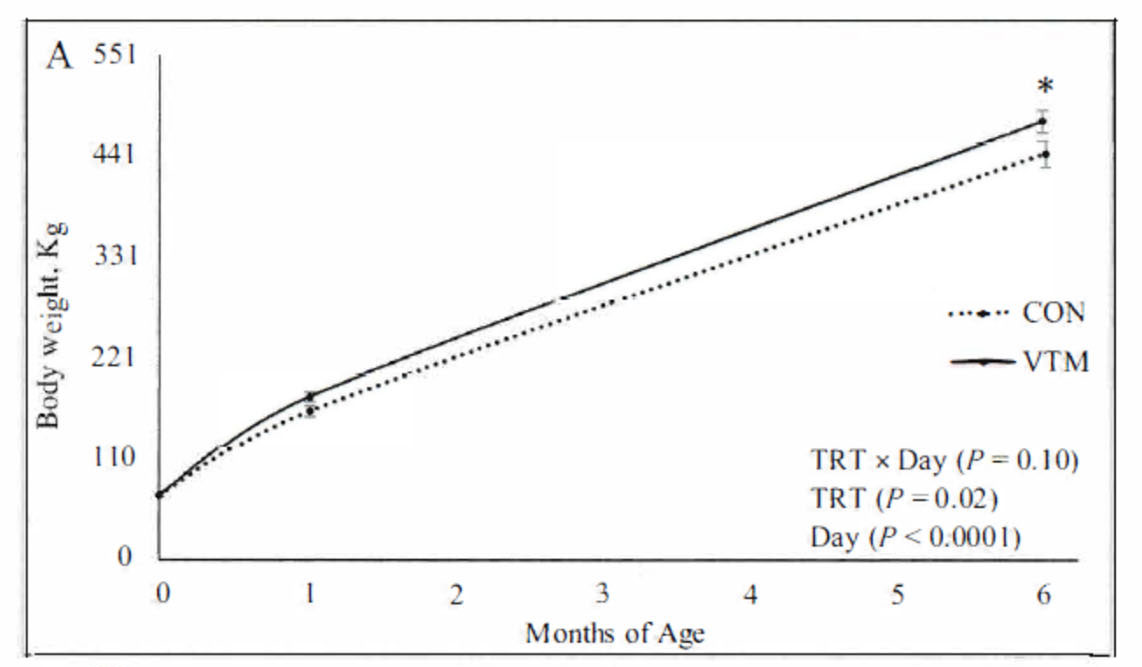
Figure 1 Panel A.
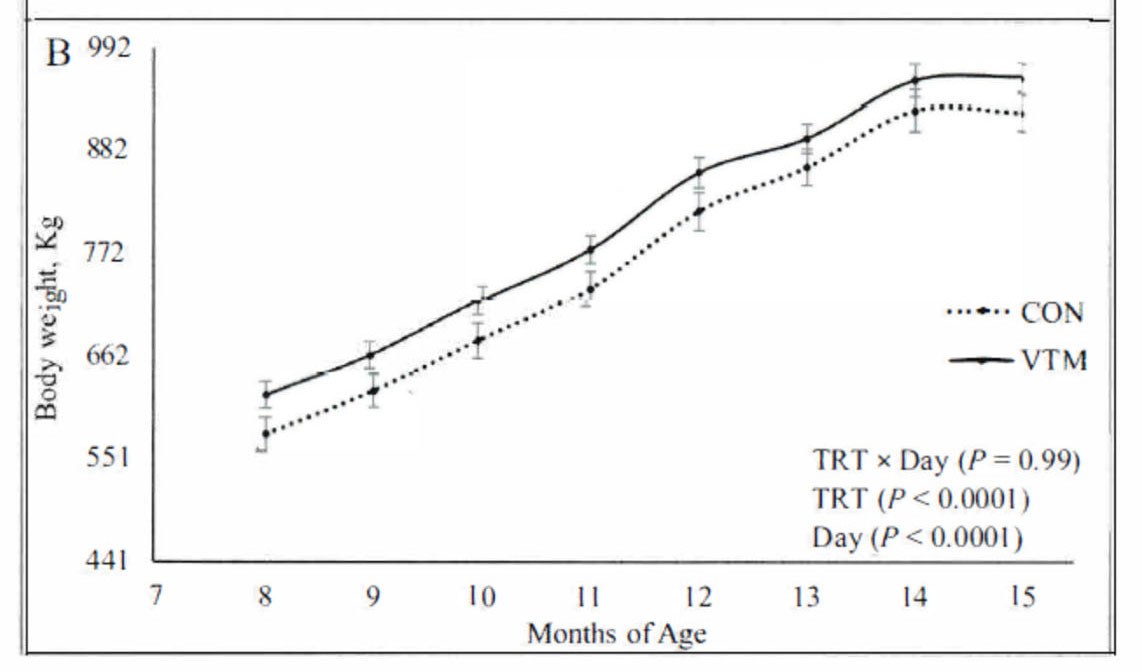
Figure 1 Panal B. Body weight of female calves born to dams provided with a vitamin and mineral supplement (VTM) at a rate of 4 oz/heifer/day or not provided a vitamin and mineral supplement (CON) during gestation. Performance was summarized into 2 growth periods, including birth to weaning (Panel A), and the 209-d post-weaning development period through 15 months of age (Panel B). Performance of each heifer was averaged by month across the 209-day development evaluation period. Body weight measurements within day marked with (*) were considered significant (P ≤ 0.05). Adapted from Hurlbert et al, 2024.
1 Caton, J. S., M. S. Crouse, L. P. Reynolds, T. L. Neville, C. R. Dahlen, A. K. Ward, and K. C. Swanson. 2019. Maternal nutrition and programming of offspring energy requirements. Transl. Anim. Sci. 3:976–990. Available at: https://doi.org/10.1093/tas/txy127.
2 Cushman, R. A., and G. A. Perry. 2019. Developmental programming of fertility in livestock. Vet. Clin. North Am. Food Anim. Pract. 35:321–330. Available at: https://doi.org/10.1016/j.cvfa.2019.02.003.
3 Reynolds, L. P., W. J. S. Diniz B, M. S. Crouse, J. S. Caton, C. R. Dahlen, P. P. Borowicz, and A. K. Ward. 2023. Maternal nutrition and developmental programming of offspring. Reprod. Fertil. Dev. 35:19–26. Available at: https://doi.org/10.1071/RD22234.
4 Abdelrahman, M. M., and R. L. Kincaid. 1993. Deposition of copper, manganese, zinc, and selenium in bovine fetal tissue at different stages of gestation. J. Dairy Sci. 76:3588–3593. Available at: 10.3168/jds.S0022-0302(93)77698-5
5 Hostetler, C. E., R. L. Kincaid, and M. A. Mirando. 2003. The role of essential trace elements in embryonic and fetal development in livestock. Vet. J. 166:125–139. Available at: https://doi.org/10.1016/S1090-0233(02)00310-6
6 Hurlbert, J. L., F. Baumgaertner, A. C. B. Menezes, K. A. Bochantin, W. J. S. Diniz, S. R. Underdahl, S. T. Dorsam, J. D. Kirsch, K. K. Sedivec, and C. R. Dahlen. 2024. Supplementing vitamins and minerals to beef heifers during gestation: impacts on mineral status in the dam and offspring, and growth and physiological responses of female offspring from birth to puberty. Journal of Animal Science. Available at: https://doi.org/10.1093/jas/skae002.