

Fall Webworms
 Scientific Name
Hyphantria cunea
Hosts
The fall webworm has been recorded on at least 88 species of shade, fruit, and ornamental trees in the United States. The preferred hosts vary from one area to another. In Oklahoma, persimmon and pecan are most commonly infested and black walnut and hickory are also common hosts. Sycamore, birch, and redbud are often attacked in years of heavy infestations. Infestations on cottonwood, American elm, and bald cypress have been reported a few times.
Symptoms
 Damage is caused by the larvae feeding on the leaves. They rarely are heavy enough to defoliate trees except for young pecans and persimmons. On most forest and shade trees, the insect is detrimental mainly to the beauty of the host and is thus more of a nuisance than a threat to the health of the tree. Actual damage can occur on pecan as defoliation affects tree vigor, yield, and nut quality. The earlier the defoliation, the more harmful the damage.
Life Cycle
Adults of the overwintering generation emerge during May or occasionally in late April. 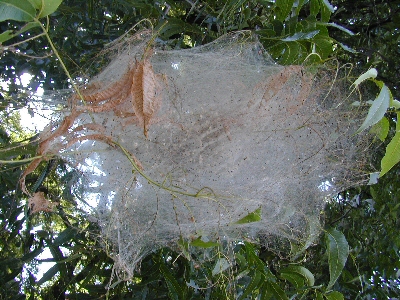 Egg laying occurs in late May and early June. Each female can lay 400 to 500 eggs in masses on the undersides of leaves. The egg masses are covered with white hairs from the abdomen. Larvae begin hatching in early June and immediately begin to spin the web in which they feed. The web is extended as the larvae grow. The larvae mature and leave the trees to pupate in late July. First generation adults emerge during August and second generation larvae are present from late August into early October. Second generation pupae are the overwintering stage. There are two generations per year.
Description
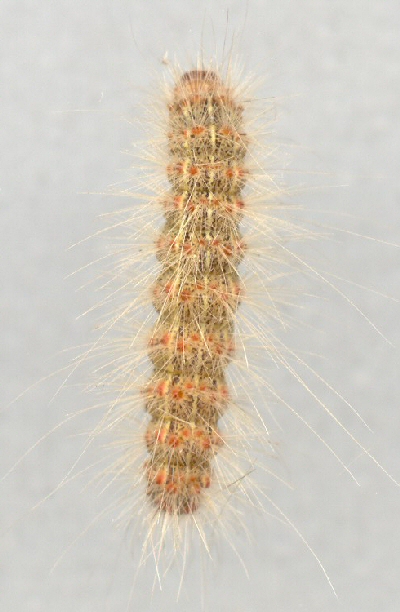
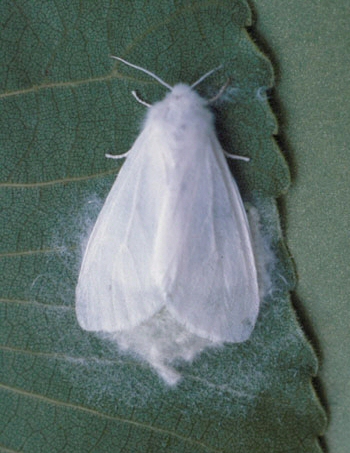
The adult moths are almost pure white and have a wing-spread of about 1 1/4 inches. Some specimens have the front wings more or less heavily marked with small black spots. Larvae may be pale yellow, yellowish green, greenish, or orange but most have two rows of black spots down the back. The head may be red or black. The body is rather sparsely covered with long white hairs. They are found in webs on the host tree.
Control
Please contact your local county extension office for current information.