

Black Flies or Buffalo Gnats
 Host
Host
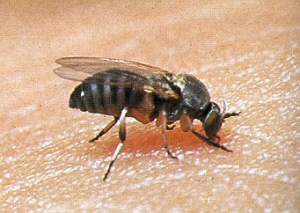
Simuliidae is a small family of blood sucking flies commonly known as black flies or buffalo gnats. Over 100 species are known from North America and new ones are still being described. Recent studies have shown the existence of species groups in which two or more species can be distinguished only by studying the giant chromosomes of the salivary glands of the larvae. These species are known as cytospecies or sibling species. Even though they may appear to be identical, they often live in different habitats and do not interbreed. Black flies have not been studied in Oklahoma, but it appears we should have perhaps a dozen species. Most of these are in the genus Simulium, but one species of Cnephia (C. pecuarum) has been reported here.
Symptoms
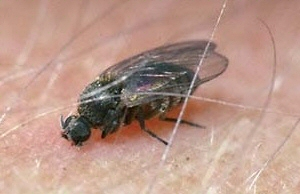 Humans as well as domestic animals may be viciously attacked. The eyes, ears, nostrils, wrists, and all exposed parts of the body of man are subject to attack. The extreme pain, itching, and the resultant local swellings, together with occasional severe complications, indicate the presence of an active allergin. In some individuals, the face, arms, and other exposed parts may be greatly swollen as a result of the bites; in others, effects other than blood loss may scarcely be noticeable. Livestock and poultry are sometimes killed by large numbers of black flies. Death seems, in most cases, to be the consequence of a toxemia caused by the bites or the result of an anaphylactic shock; although debility resulting from blood loss and suffocation brought about by inhalation of the flies is apparently a contributing cause. In addition, certain species are known to transmit leucocytozoon, microfilaria, and trypanosome infections in poultry.
Life Cycle
 Egg laying habits vary with the species, but all lay their eggs in running water. Some lay in masses on plants trailing in the water, others drop the eggs singly into streams, while others lay their eggs in long strings. Each female will lay from 150-450 eggs. The eggs are white to orange when laid and darken before hatching. Hatching in species with several generations per year can take from 4 to 30 days depending on species and temperature. Species with one generation per year often enter diapause in the egg stage, so hatching can take as long as 7 months.
Larvae occur only in running water. Some species are found in clear mountain streams, some in temporary streams, some in rivers, and some only around springs or reservoir outlets. Some species breed successfully in irrigation ditches. Larvae are usually brown, gray, or black in color with a light brown head. They are somewhat club shaped and have a prominent pair of mouth brushes with which they gather food. They feed on small organisms and detritus found in the water. Larvae attach to stones, vegetation, and other objects by means of a sucker-like disc at the end of the abdomen. The larval period may be as short as 2 weeks in late spring or may extend from October into early spring in species that overwinter as larvae, but larvae development only occurs when there is running water or sufficient movement to accelerate oxygenation of the water.
Pupation takes place on rocks or other objects in the water. Each larva spins a basket-shaped cocoon open at the downstream end in which to change to an adult. The pupal period lasts only 2-6 days in some species and up to 3 or 4 weeks in others.
When the adult emerges, it floats to the surface in a bubble of air and quickly flies away. Mating occurs in swarms in many species but on the ground near the emergence site in others. Both males and females feed on nectar and the females of most species also require a blood meal for development of the eggs. Some species feed mostly on birds while others prefer to feed on mammals.
Adults are often found several miles from the nearest known breeding area. They are commonly reported to move 7-15 miles and wind-aided migration of 90-150 miles have been reported in some cases.
The most common species in Oklahoma appears to have two generations per year. One generation begins in October, the larvae overwinter, and the adults emerge in the spring. The other generation occurs in April and May. Numbers depend on the availability of running water and on water temperature. Larval numbers are known to decline sharply when water temperatures reach 75-80 degrees F.
Description
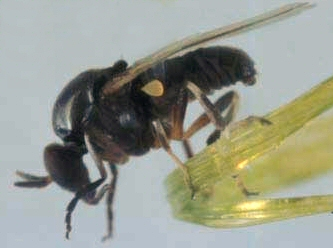
Adult black flies are small insects that measure 2 to 5 mm in length, and possess a shiny thorax which is strongly convex, giving them a humpbacked, gnat-like appearance. Color ranges from black to various shades of gray or yellow. Adults also have broad clear wings without hairs or scales, heavy veins near the anterior wing margin, a short 11 segmented antennae, and large round eyes (no simple eyes).
Control
Please contact your local county extension office for current information.