

Cow-Calf Corner | October 5, 2026
Drought Conditions Improve; Stocker Considerations
Derrell S. Peel, Oklahoma State University Extension Livestock Marketing Specialist
All of Oklahoma has received some rain in the past two weeks, with some spots receiving just about one inch of moisture and a couple of spots receiving six to ten inches of rain. Though the rain is very helpful, most of the state remains below normal for the year, with a large region of central and western Oklahoma still eight to thirteen inches down for the year (Figure 1).
Improved current conditions may provide for limited forage growth despite being so late in the growing season. The rain is especially timely for wheat planting, which accelerated sharply last week. Though a bit later than usual, decent wheat pasture prospects are possible depending on weather conditions in the next few weeks.
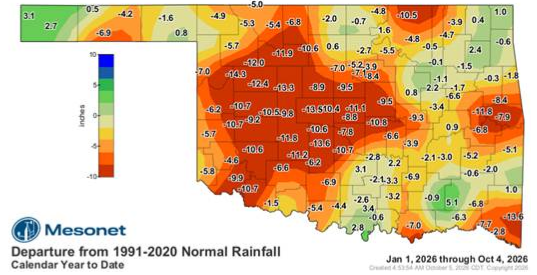
Figure 1: Departure from 1991-2020 Normal Rainfall, Oklahoma, Jan. 1-Oct. 4, 2026.
The possibility of wheat pasture raises the question of winter stocker prospects in the current cattle market situation. Cattle prices dropped sharply from July through early September, as a result of a futures-led correction initially and subsequent pummeling
from external headlines and industry news. Feeder cattle prices are down significantly from the record highs earlier this year and are currently lower than one year ago (Figure 2).
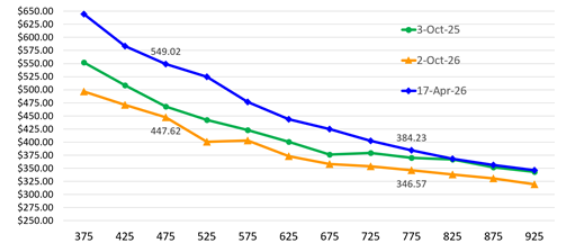
Figure 2: Steer Price by Weight
In general, the high cattle price environment is not favorable for stocker margins, or indeed, all margin sectors downstream from cow-calf production. However, the recent price decreases, more severe for calf prices relative to heavy feeder cattle, have improved
stocker margins temporarily compared to record prices in the spring. Table 1 shows the current value of gain for a stocker program that starts with a 475-pound steer and adds 300 pounds of gain for a final weight of 775 pounds. In this example, the value of gain in today’s market is $1.87/pound. This compares to a value of 300 pounds of gain in April of this year of $1.23/pound. I expect recovery in calf prices in the coming months with corresponding deterioration of stocker margins, similar to the April market. However, the current lower market may be a relative buying opportunity.
| Transaction | Lbs. | $/Cwt. | $/Head |
|---|---|---|---|
| Purchase | 475 | 447.62 | 2,126.19 |
| Sell | 775 | 346.57 | 2,685.92 |
| Gain | 300 | 559.72 | |
| Value of Gain | $1.87/lb. |
| Transaction | Lbs. | $/Cwt. | $/Head |
|---|---|---|---|
| Purchase | 475 | 549.02 | 2607.85 |
| Sell | 775 | 384.23 | 2977.78 |
| Gain | 300 | 369.93 | |
| Value of Gain | $1.23/lb. |
Even the current improvement in value of gain may not offer profitable stocker production possibilities. It depends on costs of production, including animal gains, grazing cost, animal health, interest costs, etc. The market incentives for stocker production remain relatively low. Consider the stocker gain relative to initial cattle cost in Table 1. The total margin per head currently is 26.3 percent of the first cost of cattle ($559.72/$2,126.19). In April, this percentage was just 14.2 percent ($369.93/$2,607.85). By contrast, in October 2021, when the price of 475-pound steers was $172.41/cwt., the 300-pound stocker margin was 47.1 percent of the initial cattle cost. Stocker production may be economically feasible, but it will require careful budgeting.
Estimating Hay Needs
Mark Z. Johnson, Oklahoma State University Extension Beef Cattle Breeding Specialist
Some basic rules of thumb to follow when determining the hay supplies you will need to sustain your cow herd over the next few months.
- Determine your average mature cow size. This can be done by weighing your 4 – 7 year old cows and calculating the average weight. From mature cow size, we can approximate the amount of forage dry matter cows will need to consume per year or per day. For example: a 1,000 pound cow will consume about 26 pounds of forage dry matter per day. A 1,400 pound cow will consume about 36.4 pounds of forage dry matter per day.
- Determine your cow inventory
- Estimate the amount of time you expect to be feeding cows.
From this information you can calculate the total amount of hay needed. For example: 100 cows weighing 1,400 pounds will consume about 3640 pounds of hay per day. We should take into account that a certain amount of the hay fed will be wasted and there will be a certain amount of spoilage of each bale fed that won’t be consumed. With this in mind we will add another 10% to the daily total to bump it up to about 4000 pounds (2 tons) per day. Remember the amount of hay wasted or spoiled could be higher. If we are feeding hay from last year expect a higher percentage spoiled in each bale.
If we are expecting to feed hay from mid-October to mid-May, that is approximately 200 days of hay feeding. 4000 pounds of hay needed per day x 200 days equals a total of 800,000 pounds (400 ton) of forage dry matter that cows will consume over this time. If
we are feeding or buying large rounds with an average weight of 1,250 pounds that equates to 640 (800,000 divided by 1,250) big bales needed to sustain the 100 cows.
If possible, purchase hay by the ton. It leads to less error in securing the amount of hay you will need to purchase or have on inventory. If buying hay by the bale is your only option, make sure to weigh enough of the bales to have an accurate representation of bale weight. Also, take into account the amount of spoilage of each bale. One of the upsides of hay baled this summer (and the drought over the past few months) is less spoilage.
Other factors such as weather, stage of gestation or lactating versus dry cows will obviously impact nutritional requirements of cows from day to day. Provide hay and other nutritional supplementation accordingly.
Number to Know – Contribution Margin
Scott Clawson, Area Ag Economics Specialist
One of the most useful numbers to know on a cow-calf operation is a cow’s Contribution Margin (CM). It is a number that most producers have a feel for but may not always formally calculate. While attending the King Ranch Institute for Ranch Management’s Managing the Cow-Calf Business program in March, this concept was discussed illustrating how it can help make practical decisions on the ranch. Decisions such as how much can I invest to keep a cow through drought? Or, what is the impact of increasing my numbers by a certain number of head?
The calculation is simple, but an understanding of different cost types is necessary. Calculating CM focuses only on direct variable costs. Costs that would immediately stop if a cow was removed (culled, sold, dies). Specifically, we would think about feed, hay, and vet expenses. Also, things that may be slightly more difficult to quantify like the depreciation of the cow, etc. There is a long list of other costs associated with running the ranch like machinery, equipment, fuel, and land, but those items won’t change much, if at all, in the production year based on the addition or subtraction of a cow in the operation. A revenue history or projection completes the other side of the equation.
The numbers used below won’t reflect your specific operation. Yet for discussion’s sake, let’s assume that we typically have an 89% weaning rate, 500-pound weaning weight, and expect our average calf price to be $3.49 per pound next year. The ranch records show that we have had direct variable costs of $500 per cow.
500 lbs * $3.49 per lb * .89 = $1,553/cow = Expected Revenue Feed + Hay + Vet Med + Cow Depreciation + Others = $500/cow = Variable Costs
Expected Revenue - Variable Costs = Contribution Margin (CM)
$1,553 - $500 = $1,053/cow = CM
- What will a single cow contribute to the fixed costs of the operation? $1,053
- What extra could we pay to keep a cow in times such as drought? $1,053
- What does adding a cow to the herd contribute? $1,053
This number may seem alarming right now. The cause of alarm is likely because of historic calf prices. Refiguring this calculation with a calf price average of $1.85 changes the CM to $323 per cow. In times of drought where hay supplies tighten and the market price of hay increases, $323 does not go very far. Sustained high calf prices can- and have- altered what the math says about our decision making. High calf prices usually encourage expansion, but it also provides incentive to keep the existing herd intact.
Forage conditions in OK have suffered and could lead to tough decisions. From a 10,000 ft view on a spring calving herd, we need to have the working capital (or access to it) to support the investment until the next calf crop is ready to be sold. We might want to consider a form of price protection as well, like LRP. Go to work on your numbers and figure out what your contribution margin is on your operation and evaluate the ranch’s capacity to fund this through 2027.