

Cow-Calf Corner | March 9, 2026
Seasonal Beef Demand
Derrell S. Peel, Oklahoma State University Extension Livestock Marketing Specialist
Wholesale beef prices have moved higher thus far in 2026, reflecting both strong beef demand and typical seasonal patterns. Choice boxed beef prices averaged $386.41/cwt. the first week of March, up 9.1 percent from the beginning of the year, and up 23.0 percent year over year.
Boxed beef prices normally increase through the first half of the year, peaking in June before declining to the end of the year (Figure 1). Boxed beef prices usually begin to increase more sharply in April as retailers build inventories for the coming summer demand that begins in late May. The average seasonal price index indicates that boxed beef prices typically increase by over eleven percent in the first half of the year. This year, boxed beef prices have already increased over nine percent, earlier than usual. It is not clear if boxed beef prices will increase more than seasonally this year or simply move to seasonal peaks sooner than usual. Both are possible.
Choice, 2019-2024 Index
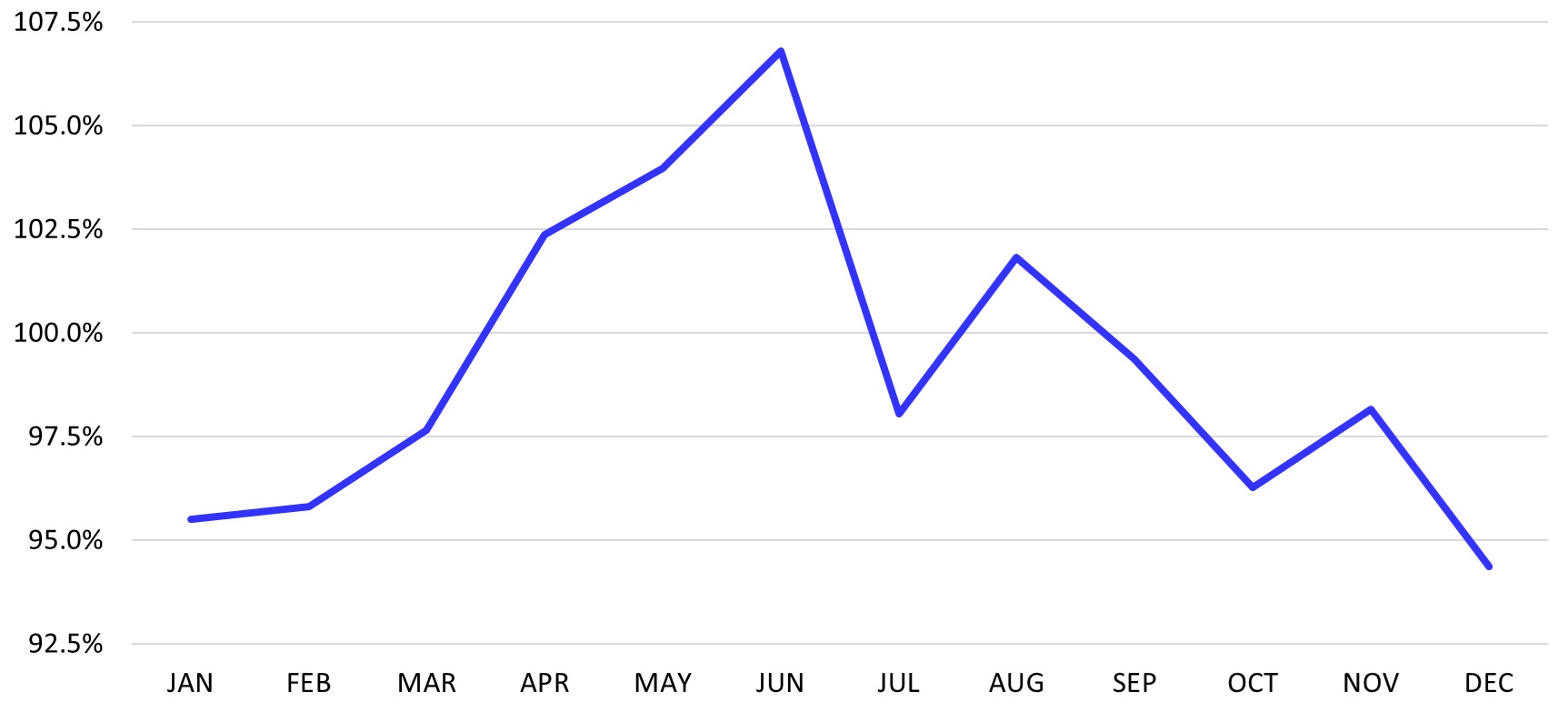
Figure 1: Boxed Beef Seasonality
The boxed beef seasonal price pattern in Figure 1 is the net effect of many beef products included in the composite boxed beef measure. Across many beef products from the various carcass primals, different beef products have varied and unique seasonal price patterns reflecting different seasonal demands. While many beef product prices are increasing in the first half of the year, some products have lower prices early in the year and higher prices later in the year.
Figure 2 shows the seasonal price pattern for three middle meat cuts. High-valued middle meats drive much of the seasonal increase in cutout values. Strip loins lead the seasonal increase with the most variable seasonal pattern of any wholesale beef product, increasing an average of thirty percent from January to May. Strips are a popular summer grilling item as well as for restaurant menus. Ribeye prices also increase modestly in the first half of the year due to seasonal retail along with food service demand. Tenderloins are more popular for food service menus and the seasonal bump in the second quarter may be largely due to Mother’s Day demand. Prices of these steak items drop in the heat of summer with Ribeye and Tenderloin demand rebounding to seasonal peaks in the fourth quarter due to restaurant and holiday demand.
Choice, 2019-2024 Index
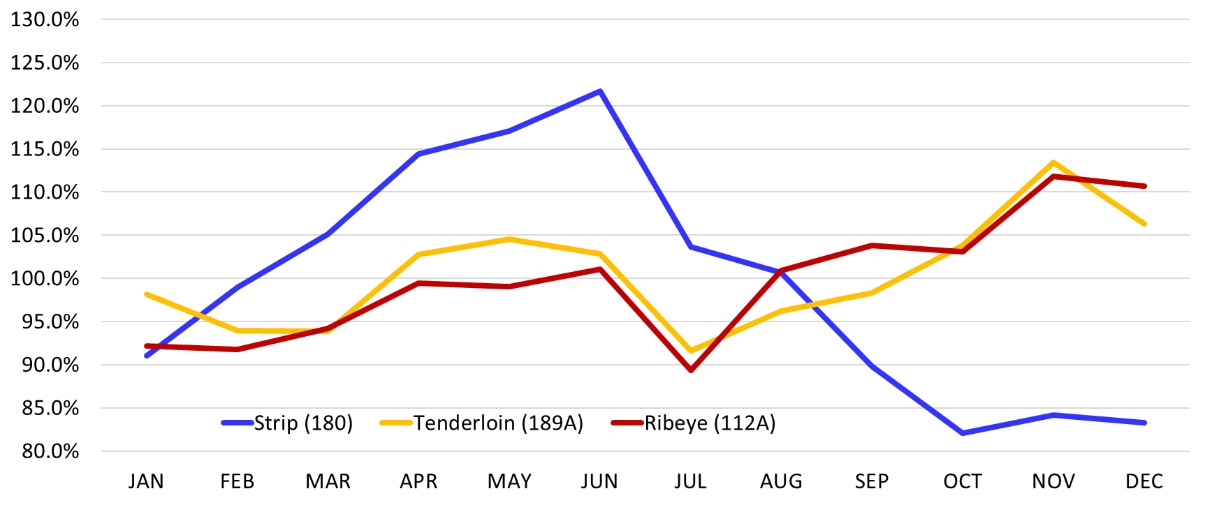 Figure 2: Steak Cuts Seasonality
Figure 3 shows the seasonal price patterns for some end cuts and briskets. Brisket prices typically increase and peak in the second quarter with stronger summer demand. Round values have been very strong the last two years as a result of declining nonfed beef production and demand for additional lean. Round prices are typically strong from the second quarter through the third quarter as a result of seasonal ground beef demand. Prices for chuck rolls usually decrease into warmer weather. Chuck products have higher demand for roasts and crock pot cooking in cooler weather with prices reaching a seasonal peak in the fall. Chucks are also popular export items.
Choice, 2019-2024 Index
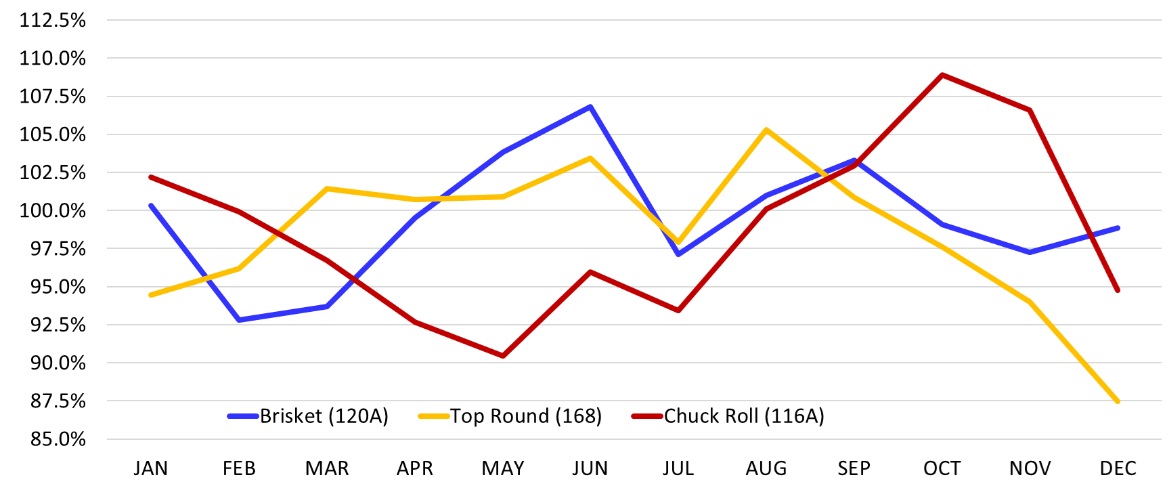 Figure 3: End Cuts Seasonality
All wholesale beef cuts are higher year over year with most following seasonal patterns thus far in the year. The boxed beef cutout has increased faster than seasonally normal and suggests that beef demand remains strong in the face of tightening beef supplies.
Temperature Variation and Baby Calf Health
Mark Z. Johnson, Oklahoma State University Extension Beef Cattle Breeding Specialist
After the extremely cold temperatures across Oklahoma a few weeks ago, we are now seeing daytime highs of 70 degrees F (or higher). It is important to remember that the calves born in single digit temperatures need to be monitored closely as the weather becomes dramatically warmer. A calf’s health is significantly impacted by ambient temperature. The most comfortable range for young calves being between 55 and 70 degrees F. This range is considered the thermoneutral zone for young calves where a calf can maintain its body temperature without expending extra energy. Heat or cold stress results in direct economic losses because of increased calf mortality and morbidity, as well as indirect costs caused by reduced weight gain, performance, and long-term survival.
Thermic stress in calves is observed not only with extremely high or low temperatures, but also extreme temperature variations. Variables such as relative humidity and wind speed can also contribute to thermic stress. Heat stress is actually harder on young calves than cold stress. When calves are heat stressed they lose appetite, eat less and are quicker to become dehydrated. Thermoregulation in calves is similar to that of adult cattle, but new born calves have an immature “thermostat” and accordingly have more problems regulating body temperature during weather extremes. Thermoregulation is the ability of homeothermic animals to keep their body temperature within a certain range despite being exposed to different ambient temperatures. A physiological core temperature is maintained by generating metabolic heat as well as exchanging heat with the environment. Cattle are able to adjust to adverse climate by means of acclimatization and adaptation. Extreme climatic conditions that cannot be compensated by thermoregulatory mechanisms result in thermic stress.
As the weather becomes more pleasant and day time highs exceed 70 degrees F, keep an eye on your young claves soaking up the sun. The signs of overheating may not be as dramatic as the signs of cold stress but can be just as damaging to a calf’s health.
Bull Fertility
Barry Whitworth, DVM, MPH, OSU Cooperative Extension Senior Extension Specialist
The development of sperm cells in bulls depends on several factors. A key factor is temperature regulation of the testes. Bovine testes must be maintained at a temperature around 90° Fahrenheit (F). This means that bull testes are kept around 7° to 11°F below normal body temperature. Any insult to the scrotum that damages the testes and/or impairs their ability to move freely within the scrotum will disrupt temperature regulation of the testes. This will result in improper development of the sperm cells.
Damage to the bull’s scrotum may occur in a variety of ways. One way is frostbite. In a study performed in Canada, severe frostbite was associated with reduced satisfactory bull breeding soundness exams (BBSE). The authors of the study suggest that frostbite resulted in inflammation to the testes, which increases testicular temperature. Frostbite is not a common problem with bulls in Oklahoma; however, Oklahoma cattle are not accustomed to the extreme temperatures seen during the winter storm in late January. Without proper protection, bulls may have suffered damage to their scrotums or testes. Damage to these tissues may result in poor semen quality.
The wildfires that burned over 300,000 acres in northwest Oklahoma may have resulted in some hidden reproductive consequences for bulls. Minor thermal injury or burns to the scrotum might be severe enough to interfere with scrotal temperature regulation. Again, this may result in nonmotile sperm and/or abnormal sperm.
With this information in mind, cattle producers need to have their bulls evaluated before spring turnout. A BBSE performed by a veterinarian should alleviate any concerns about infertility. The exam has three parts. Part one is a physical examination to ensure that the bull is in good health. Bulls impacted by wildfires may have sustained injuries to their feet which would impair their ability to breed. Part two is the examination of the internal and external reproductive organs. During this part of the process, the scrotum will be measured and evaluated for any abnormalities such as frostbite or burns. Lastly, the semen will be evaluated for motility and morphology (normal and abnormal sperm). Any abnormalities in any part of the exam are cause for concern.
Bulls meeting the minimal standards for each part of the BBSE will be classified as a “satisfactory potential breeder”. Any issues discovered will result in a bull being classified as “deferred” or “unsatisfactory potential breeder”. Bulls with signs of frostbite or burn damage to their scrotum and with poor semen will most likely be classified as “deferred”. The evaluator will probably suggest a recheck in a few weeks. One study indicated that most problems improve after 6 weeks of rest; however, according to the study in Canada, the fertility of some bulls with frostbite damage never improves.
A BBSE does not detect infectious diseases that might be present in the bull. These diseases may cause infertility or other reproductive problems. Testing for diseases such as Trichomoniasis or Persistently Infected Bovine Virus Diarrhea might prevent unwanted infections in the cow herd. If bulls were commingled with other cattle during the wildfire, producers may want to test for these diseases.
A BBSE is just one step in preparing for the spring breeding season. Hopefully, it will prevent any unwanted surprises during pregnancy testing this fall. For more information about Bull Breeding Soundness Exams and issues associated with frostbite and burn injuries, producers should consult their local veterinarian and/or Oklahoma State University County Agriculture Educator.
References:
- Barth AD, Waldner CL. Factors affecting breeding soundness classification of beef bulls examined at the Western College of Veterinary Medicine. Can Vet J. 2002;43(4):274-284.
- Kastelic JP, Rizzoto G, Thundathil J. Review: Testicular vascular cone development and its association with scrotal thermoregulation, semen quality and sperm production in bulls. Animal. 2018;12(s1):s133-s141.
OSU Extension Hosting Cow-Calf Bootcamp in Ada, OK April 20-22
Michael Trammel and Brian Freking, OSU Cooperative Extension SE Area Forage and Livestock Specialists
We are excited to announce that enrollment for the "2026 Cow-Calf Bootcamp" is now open! This three-day, hands-on program is designed for both new and experienced cattle producers who want to strengthen their management skills and improve their bottom line.
The Bootcamp will be held April 20–22, 2026 in Ada, Oklahoma. Each day will begin at 8:00 AM and run until approximately 7:00PM, with the final day concluding around 5:00 PM.
Registration Details:
- Capacity: Limited to 50 participants.
- Registration Fee: $150 per person. This includes educational materials and meals.
- Registration is confirmed by email once payment is received
- No refunds for cancellations after 5:00 PM on April 10, 2026
About the Program:
The Cow-Calf Bootcamp covers a wide range of topics related to cow-calf production. Participants should come prepared to work hard, learn a lot, and connect with fellow producers. A tentative agenda will be shared soon.
What to Bring:
- Clothing suitable for working cattle and walking in tall grass
- Closed-toe shoes
- Sun protection
- Bug spray
- Additional details will be provided as the event approaches
Hotel Options:
Participants are welcome to book lodging at any of the several hotel options available in Ada.
Register Here:
Extension: 2026 OSU Cow Calf Boot Camp
Persons with disabilities who require alternative means for communication or program information or reasonable accommodation need to contact Erin Hubbard at (580) 332-2153 at least two weeks prior to the event.
We look forward to seeing you in April for another great Bootcamp!