

Cow-Calf Corner | March 23, 2026
Beef Imports: Markets versus Politics
Derrell S. Peel, Oklahoma State University Extension Livestock Marketing Specialist
Beef imports increased 18.0 percent year over year in 2025 and are up 61.4 percent since 2022, the year of record U.S. beef production and when the current market run began. Total beef production in 2025 was down 3.6 percent year over year and is down 8.1 percent since 2022. More important relative to beef imports, production of nonfed beef (from cull cows and bulls) was down 8.0 percent last year and is down 24.8 percent since 2022. In fact, nonfed beef production in 2025 was the smallest total since 2005.
Increased beef imports are the market response to declining lean beef supplies due to decreased nonfed beef production since most beef imports are lean processing beef. Higher prices of lean beef in the U.S. prompts increased imports from any of several potential beef import sources. The amount of beef imports from various sources depends on several factors including: the country’s ability to produce and export; other export markets for the country; and relative price competitiveness of the country (which depends on exchange rates and tariffs the country faces).
Since 2022, Australia has been the largest source of beef imports (up 251.1 percent since 2022); Canada is number two (up 4.3 percent); Brazil is number three (up 99.9 percent); Mexico, number four (down 4.0 percent); number five New Zealand (up 37.2 percent); and Uruguay, number six (up 158.8 percent). Several smaller sources contributed another nine percent to total beef imports in 2025 (up 79.3 percent since 2022) (Figure 1).
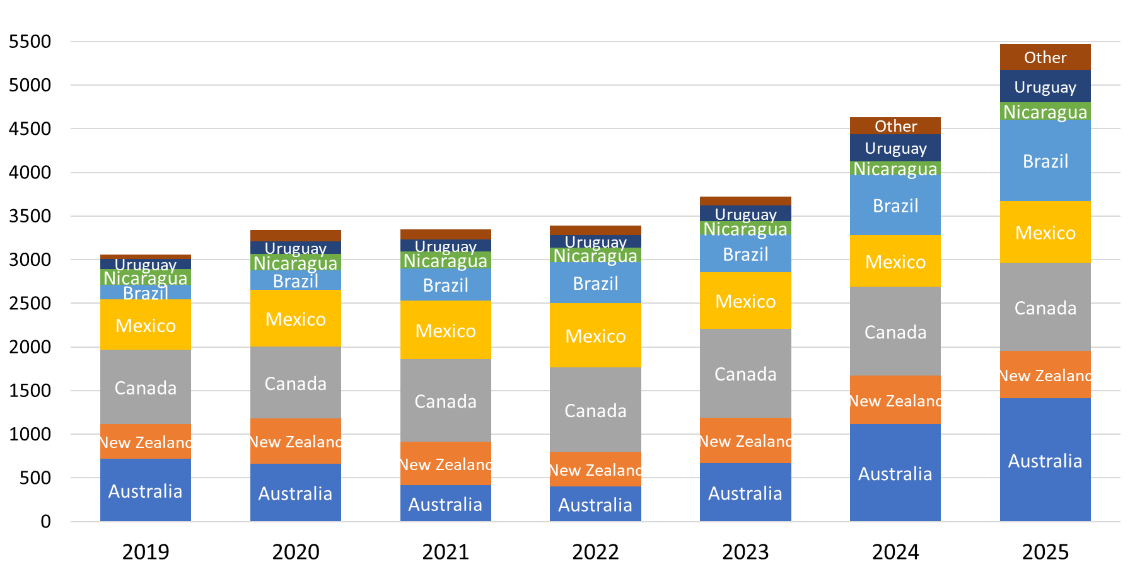
Figure 1. U.S. Beef Import, 2019-2025, Million Pounds, Carcass Weight
Record high U.S. ground beef prices continue to be the focus of political discussion along with the possibility of increased beef imports to address unprecedented lean beef prices. It is important to remember that beef imports are limited only by market forces that determine the total quantity and the mix of sources supplying beef to the U.S. market. The latest data for January show some interesting changes in beef imports. Total January beef imports were up 7.7 percent year over year and up 86.0 percent compared to January 2022 (Figure 2).
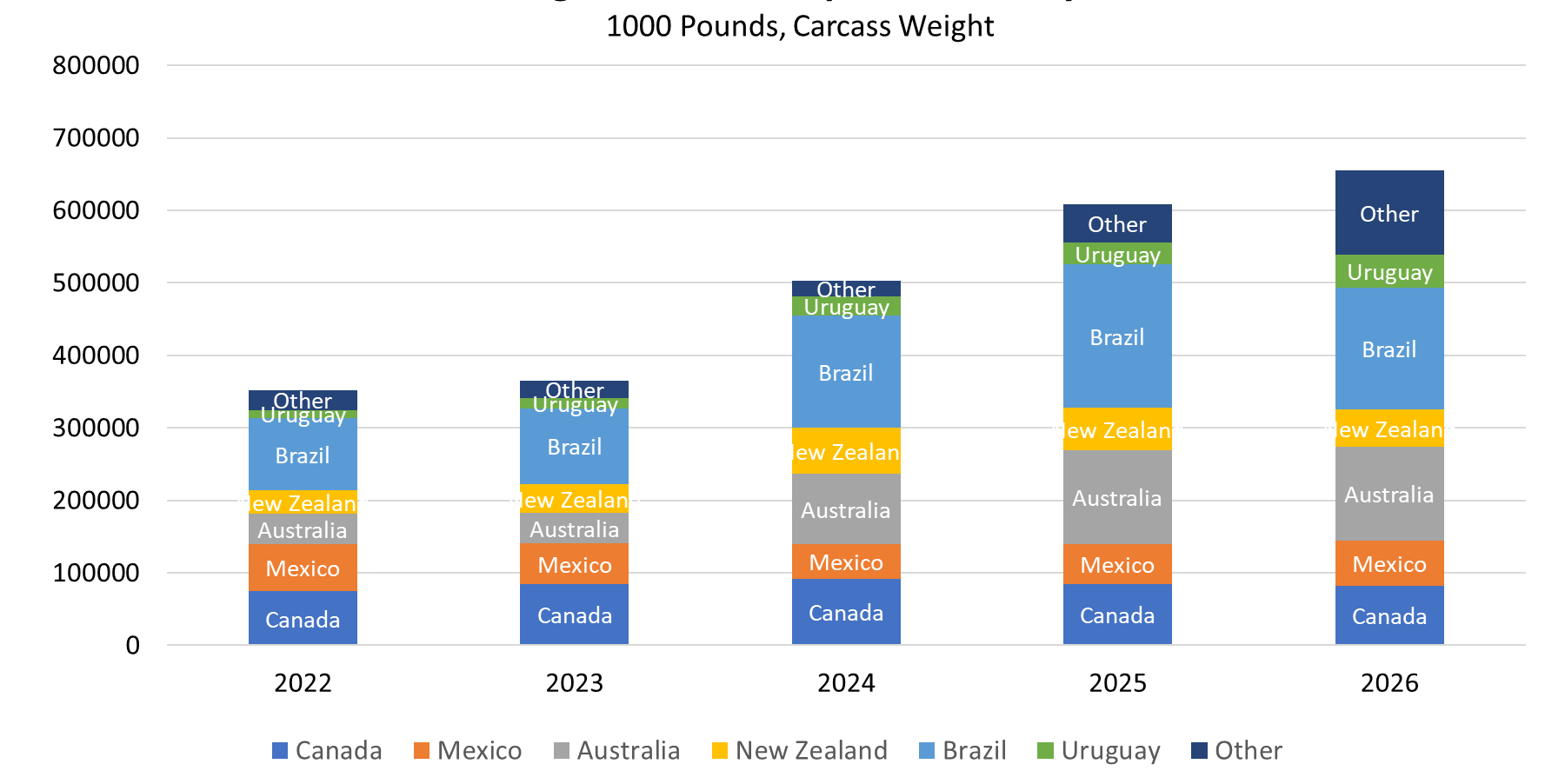 Figure 2. Beef Import, January
Most noticeable in Figure 2 is the jump in the other category, up 119.0 percent from one year ago. The biggest part of these other sources is Paraguay, a new player in the beef import market. January beef imports from Paraguay were up 147.4 percent year over year and accounted for 61.1 percent of the other category and 10.8 percent of total monthly beef imports. Paraguay has only been exporting to the U.S. since 2024. For January, Paraguay was able to capture a significant portion of the “Other Country” quota that Brazil has dominated the past four years. January beef imports from Brazil were down 15.1 percent year over year. Combined January imports from Brazil and Paraguay were up 5.3 percent year over year. This illustrates that markets are determining the total level of imports and also the distribution of sources of beef imports.
Argentina has been the focus of much of the political discussion about beef imports. Argentina represented 26.1 percent of the other category and 2.3 percent of total beef imports in 2025 (Figure 1). Argentina has been granted an expanded tariff rate quota (TRQ) in 2026. Total beef imports from Argentina in 2025 were more than double the previous quota and were limited by market conditions rather than the quota. In January 2026, imports of Argentina were up 122.5 percent year over year but still represented just 16.1 percent of other country imports and 2.8 percent of total January imports (Figure 2). It’s not clear whether Argentina will be able to fill the additional quota this year. The increase would be at the expense of domestic consumption and/or other export markets in Argentina. Moreover, the previous discussion highlights the fact the any increase in beef imports from Argentina would likely displace some imports from other sources. Expected growth in beef imports in 2026 will continue to be determined by market forces and may include some relative increase in imports from Argentina.
Selection Pressure is a Precious Commodity
Mark Z. Johnson, Oklahoma State University Extension Beef Cattle Breeding Specialist
Selection and mating decisions in cow-calf herds need to be made with a clear objective in mind. There are more trait specific expected progeny differences and bio-economic indices available to cattle breeders than ever before. These are powerful tools which can be used to improve calving ease, growth rates and carcass quality. Perhaps of even greater long-term impact, genetic values can be used to improve the next generation of cows with regard to milk production, mature size, fertility, foot soundness, environmental fit and longevity. With this in mind, why is it more important than ever to be intentional when making selection and mating decisions? Because selection pressure is a precious commodity. It should not be squandered.
As you make decisions this spring in preparation for breeding season, answer the following questions to determine where selection pressure should be applied:
- Will your bulls be terminal sires or will daughters be retained as your next generation of cows.
- Do you intend to use the bulls on virgin heifers or mature cows?
- What is your intended marketing endpoint of the calves sired? Weaning, yearlings or as fed cattle
- What do your past production records indicate with regard to mature cow size, percent calf crop weaned, weaning weights, yearling weights and carcass merit?
It can be challenging to sort through each and every genetic value available to consider in bull selection. That being said, answering the questions above will help you identify the trait (or traits) of primary economic importance to your operation on which selection pressure should be prioritized. Selection pressure applied to improving the genetic potential of a few prioritized traits can improve the profit potential of your next calf crop and will optimize your return on investment in bulls purchased.
Dr. Mark Johnson explains the risks of focusing too heavily on specific traits and how it can impact overall herd performance on SunUpTV from March 21, 2026.
Cowherd Management’s Role in Driving Carcass Weight
Paul Beck, Oklahoma State University Extension Beef Cattle Nutrition Specialist
In the past few weeks, I have discussed observations on the increase in cow mature body weight and in relation to increasing carcass weights. This week I will look at the effects of other cowherd and pre-finishing factors that impact the recent increases in carcass weight.
We compiled a dataset from calf carcass outcomes connected to mature cow bodyweight (n = 4,917 records) from cowherds in Texas, Oklahoma, and Louisiana to look at cowherd management’s effect on hot carcass weight of their offspring. In this analysis, steer and heifer calves were from fall and spring calving herds and were finished either directly after weaning as calf-feds or as yearlings following pasture-based backgrounding systems.
We found that for every 100-pound increase in cow mature bodyweight, carcass adjusted calf final BW increased by 28 pounds and hot carcass weight increased by 18 pounds. The efficiency of carcass per 100 lbs. of cow weight declined by 4.1% (Table 1) as cow mature weight increases. Fall born calves had 35 lbs. lower HCW than spring born calves, heifers had 53 lbs. reduced HCW than steers, and calf-feds had 53 lbs. lower HCW than yearlings.
| Item | Carcass Adjusted BW | HCW | HCW/100 lbs cow BW |
|---|---|---|---|
| Base weight, lbs | 1,390 | 888 | 74.1 |
| Fall vs Spring calving | -54.3 | -34.9 | -2.9 |
| Heifer vs Steer | -83.7 | -52.8 | -4.4 |
| Yearling vs Calf-fed | +85.5 | +52.9 | +4.6 |
| 32% vs 28% body fat | +128 | +87 | +7.1 |
| 36% vs 28% body fat | +269 | +185 | +15.1 |
| 38% vs 28% body fat | +340 | +247 | +20.1 |
| Change/100 lbs cow BW | +28 | +18 | -0.042 |
| Items | Scenario 1 | Scenario 2 | Change |
|---|---|---|---|
| Cow mature BW | 1,200 | 1,500 | |
| HCW | 888 | 942 | +54.0 |
| Sex | Steer | Steer | 0 |
| Calving season | Spring | Spring | 0 |
| Feeding system | Yearling | Calf-fed | -52.9 |
| Body fat composition | 32% | 32% | 0 |
| Total HCW | 1,028 | 1,029 | +1 |
| HCW/100 lbs cow BW | 85,7 | 68.6 | -17.1 |
We calculated the impact of feeding calves for longer days on feed, similar to current feeding practices, resulting in higher fat composition of cattle at slaughter. At 28% fat, we consider cattle to be at a low Choice quality grade, increasing to 32, 36, and 38% improves the quality grade potential and increases HCW by 87, 185, and 247 lbs., respectively.
This analysis suggests that the majority of the increase in HCW observed in the last two years is likely from feeding cattle to higher fat endpoints with longer days on feed. Also, it seems logical that it is more biologically efficient to feed yearlings following a stocker grazing program out of lighter BW cows than feeding calves out of heavier dams directly after weaning. To highlight this, we created 2 scenarios with spring born steer calves. In scenario 1 we used 1,200 lb BW cows (average of our dataset) with calves fed as yearlings to 32% body fat. In scenario 2 we used 1,500-pound dams with calf-fed steers finished to 32% body fat Even though the cows were 300 pounds lighter, feeding the offspring of the lighter BW cows in scenario 1 as yearlings offset any advantage production advantage of the larger cows.
Increasing mature cow size increases absolute calf and carcass weights but reduces efficiency when expressed relative to cow maintenance requirements. These results suggest that increasing cow mature weight is the least efficient path to heavier carcasses. Instead, matching cow size and calving season to the production environment improves system productivity and resilience. Efficiency of the entire beef production system will be optimized by matching cow size and calving seasons to ranch environmental conditions, increasing productivity of heifers to match steers, and utilizing pasture-based stocker/backgrounding programs pre-finishing.
Is bigger always better? Dr. Paul Beck, Oklahoma State University Extension Beef Cattle Nutrition Specialist, discussed cow size and carcass weights in the beef industry for the March 19, 2026 installment of the Ranchers Thursday Lunchtime webinar "Tug of War in the Cattle Industry" series