

Cow-Calf Corner |June 15, 2026
The Mexican Beef Market
Derrell S. Peel, Oklahoma State University Extension Livestock Marketing Specialist
New World Screwworm (NWS) issues and the closure of the Mexican border for livestock have focused much attention on the Mexican beef industry. Questions have continued about if and how the Mexican industry could handle the one million plus head of cattle that are typically exported to the U.S. The Mexican beef industry has evolved significantly in the past two decades, rendering many older views of the industry outdated and incorrect.
For the past 15 years, the total Mexican cattle inventory has averaged between 17 and 18 million head, with a total cow herd of roughly 11.5 million head. Cows make up a larger percentage of total cattle inventories (about 65 percent) compared to the U.S, where the total cow herd is 43 percent of total cattle. This is because cattle flow through the Mexican industry faster than in the U.S. More young cattle are typically included in the total U.S. inventory because calves remain on pasture and in feedlots, whereas 14 to 16 percent of the Mexican calf crop is usually exported and cattle do not remain in feedlots as long compared to the U.S.
The Mexican calf crop has averaged just over eight million head in recent years, with a calf crop percentage of roughly 71 percent, up from about 65 percent 25 years ago. Mexican cattle exports have averaged 1.2 million head over the last 25 years and typically represent 14 to 16 percent of the calf crop.
Beef production in Mexico has increased an average of two percent per year in the last decade. This is the result of increased cattle slaughter, about 1.6 percent annually, and increasing carcass weights. Average cattle carcass weights have increased from about 600 pounds twenty-five years ago to roughly 710 pounds currently. The Mexican beef industry evolved from predominantly grass-fed production to current production where most cattle are fed in feedlots. This, along with improved cattle genetics and management, has led to increased carcass weights (Figure 1).
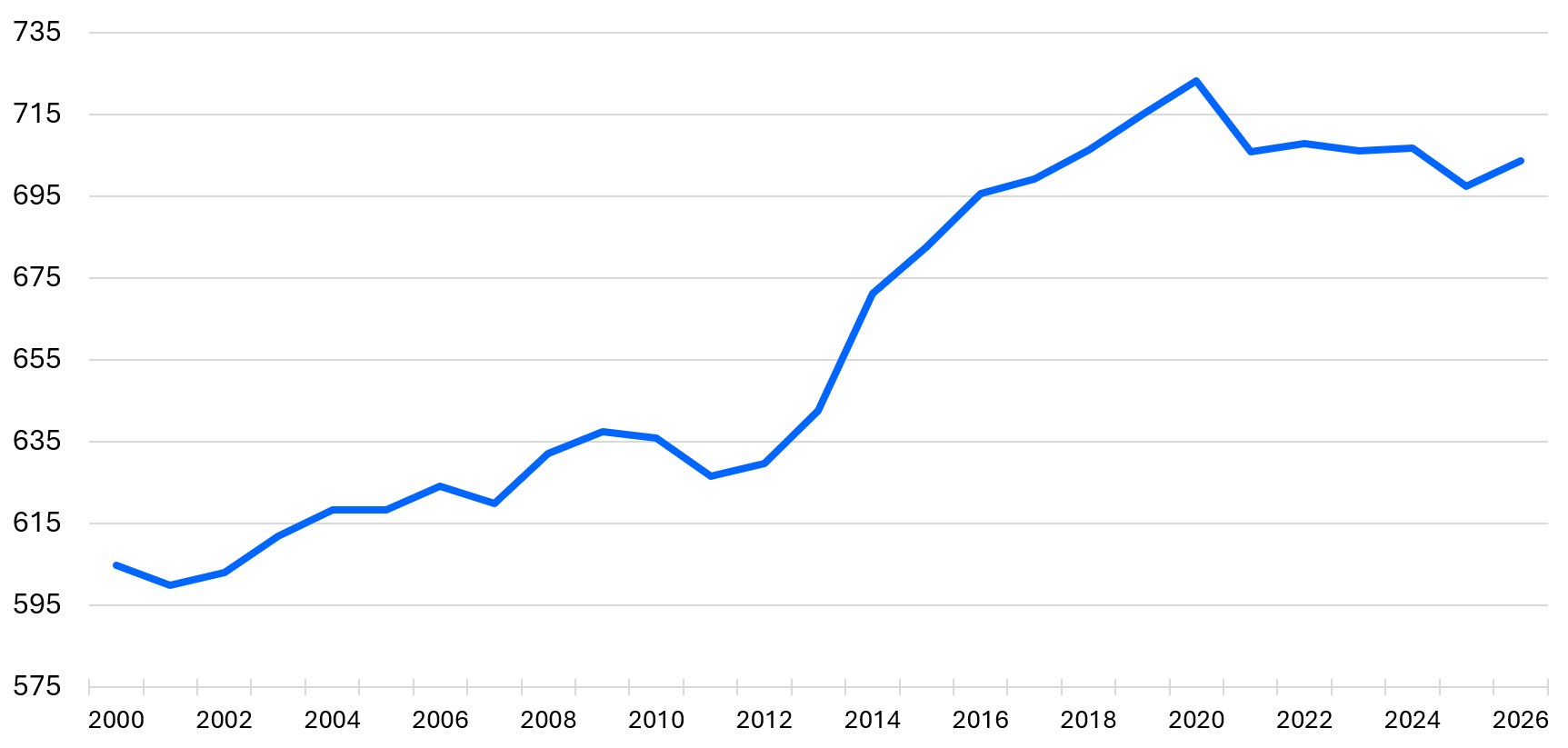 Figure 1. Mexico Cattle Carcass Weight
Beef consumption in Mexico averages about 24 pounds per year, retail weight. Beef imports in Mexico are equivalent to roughly ten percent of production in recent years but down from about 22 percent of production two decades ago. Moreover, Mexico has become a significant beef exporter and has been a net exporter the past ten years. (Figure 2). Mexico is currently the number eleven beef exporting country.
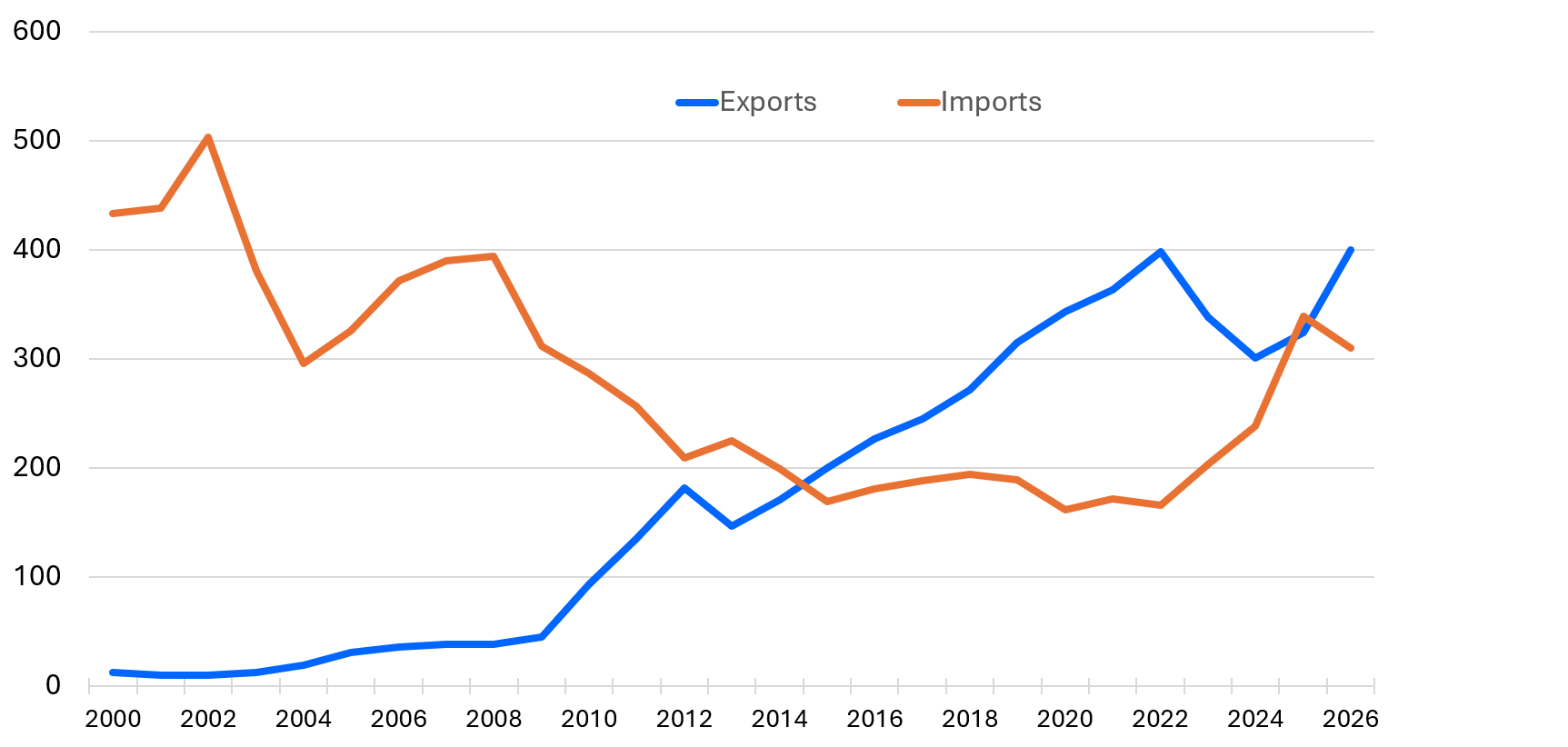 Figure 2. Mexico Beef Exports and Imports
The Mexican beef industry has modernized and developed significant infrastructure the past two-plus decades. Cattle and beef trade between Mexico and the U.S. has evolved from a long history of cattle exports to the U.S. to include Mexico becoming a major beef export destination for the U.S., and recently with Mexico becoming a significant source of U.S. beef imports. The increasingly integrated trade relationship adds value to the beef industries in both countries.
Not exporting feeder cattle to the U.S. means that more cattle are staying in Mexico to be finished for beef production. It also likely means that fewer cattle are being imported from Central America, which has been a source of supplemental cattle supply in recent years. Mexican beef imports will likely decrease, and beef exports will increase in the absence of cattle exports. Production systems and supply chains will continue to evolve in Mexico.
Derrell Peel discusses how the latest New World screwworm news is influencing cattle markets and what producers should watch moving forward on SunUpTV from June 13, 2026.
New World Screwworm Update
Jonathan A. Cammack, Oklahoma State University Extension Livestock Entomology Specialist
Disclaimer: The information contained below is current as of 8:00 AM on Monday, June 15th.
On Wednesday June 3rd, 2026, USDA confirmed that New World screwworms, Cochliomyia hominivorax (Coquerel), were found infesting the umbilicus of a calf in Zavala County in Texas. This marked the first time since 1982 that New World screwworms have been found in Texas, and was the first domestic case resulting from the current outbreak that began in 2023. Since that initial case in Zavala County, infested animals have now been found in five additional counties in Texas and one county in New Mexico. Impacted species include cattle, goats, sheep, and a dog (Figure 1). The current total number of cases is 12.
At this time, New World screwworms are not present in Oklahoma.
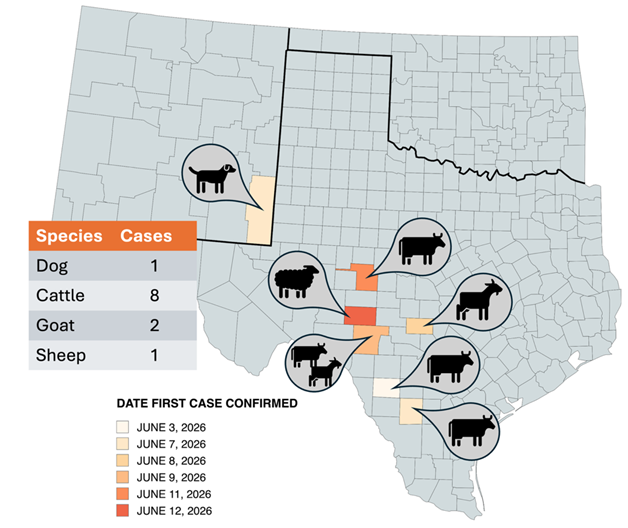 Figure 1. New World screwworm detections in the United States, including county, species impacted, and number of cases per species. Data are current as of 8:00AM on Monday, June 15th, 2026. Data from the USDA New World screwworm Detections Dashboard. Map created using Map Chart.
Although Oklahoma cattle (and other livestock, pets, and wildlife in the state) are currently not impacted by New World screwworms, being prepared, and knowing what factors can contribute to an infestation are critical. The most important step in this process is wound prevention and management on animals. New World screwworms require an infected natural body opening or an open wound on an animal around which to lay their eggs; this wound can be as small as a horn fly or tick bite, as large as a cut or scrape, or the unhealed umbilicus of a newborn/young animal. Reducing the number of fly and tick bites can be achieved through proper pest management (see the March 3rd, 2025 Cow-Calf Corner Newsletter article for information on horn fly management); it’s not too late to implement a horn fly management plan. The management of larger wounds can be achieved through regular and frequent monitoring and inspection of animals. Daily monitoring and inspection of livestock is preferred, but animals should be inspected at least twice weekly. As I say in many of my Extension presentations: Our cows aren’t walking around with Neosporin and Band-Aids, so it’s up to us to provide that wound treatment for them. Noticing a wound early, and providing treatment so that it heals quickly, will help reduce the risk of a New World screwworm infestation. Additionally, if you notice multiple animals within your herd with the same wound in the same location: identify the source. Rusted and/or broken hay rings, feed troughs, creep feeders, and other items and equipment in your pastures can all cause scrapes and cuts if animals rub up against them.
Regular and frequent monitoring of animals, and subsequent wound care, will become increasingly more important as New World screwworms continue to move northward. Getting into practice now of frequently checking your animals for wounds and treating those wounds will go a long way to help stop the spread of screwworms. However, if during your monitoring, you notice a living animal with a wound infested with fly larvae (maggots), contact your county Extension office or veterinarian immediately. For additional resources, and the most up-to-date information, visit New World Screwworm.
Dr. Jonathan Cammack explains the biology of the New World screwworm, how the fly moves across regions, and the parasitology behind infestations in livestock and other animals, and how the USDA is working to address the issue on SunUpTV from June 9, 2026.
Selection for Foot Soundness in Beef Cattle
Mark Z. Johnson, Oklahoma State University Extension Beef Cattle Breeding Specialist
Bovine foot conformation and structure are impacted by several factors such as infection, trauma, age, nutrition, weather and genetics. This article addresses the genetic component of foot soundness in cattle. Both the Foot Angle (Angle) and Foot Claw Set (Claw) traits are critical to structural soundness of cattle. These traits equate to longevity and productivity in beef herds, thereby having long-term economic impact. While several beef breeds are developing EPDs for feet and leg structure, the American Angus Association (AAA) has developed EPDs for Angle and Claw. The information in this article is based on the AAA guidelines.
Foot Score Guidelines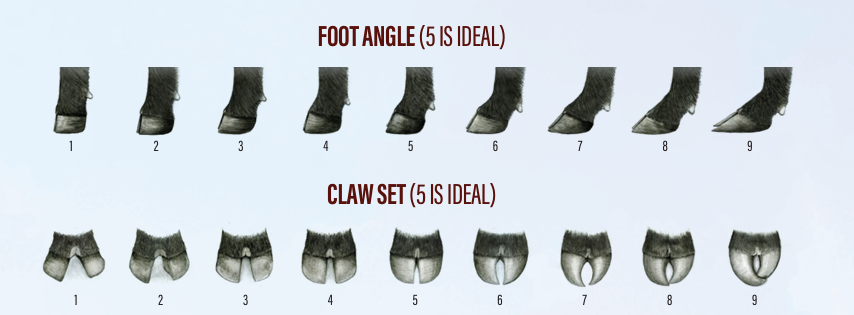
Guidelines:
- Animals must be scored prior to hoof trimming.
- When there is variation among an animal's feet, score the worst foot for both traits combined.
Where to Score:
- Score yearling bulls and heifers
(Bulls and heifers must be at least 320 days of age at scoring time) - Females can be scored annually
(Foot structure changes as animals age. Scores will be adjusted for age as part of the analysis. Scores should describe animals as they are at the time of scoring, without consideration of age.)
Currently, lower EPD values for Claw and Angle indicate phenotypes closer to the ideal of 5. The EPDs generated are based on breeder submitted phenotypes, pedigrees and genomics. Additional guidelines for collection of scores are as follows:
- phenotypes should be collected on a hard, flat surface where feet can be easily evaluated.
- scores should be collected outside of a chute so that cattle are standing naturally.
- scores should be collected by the same person during the entire duration of scoring to minimize bias.
The scoring system and EPDs generated can be used to improve foot soundness by both commercial cattlemen and purebred breeders. Both of these traits are moderate in heritability (Foot Claw Set = .25, Foot Angle = .26) with a positive genetic correlation of .38 between the two traits. Accordingly, selection pressure applied to Claw and Angle EPDs will lead to genetic improvement in the structural soundness in beef cattle.
Monitoring for New World Screwworm: Supplementing with Intent
Chris Johnson, USDA-ARS Beef Nutrition ORISE Fellow
A confirmed case of New World Screwworm (NWS) has been confirmed June 3, 2026, by USDA-APHIS officials in Zavala County Texas. While immediate actions have been taken to limit the spread of the pest, producers should remain vigilant and increase monitoring efforts within their herds.
As producers increase herd checks for new or suspicious lesions, using cubes or supplemental feed to gather cattle in one location can be an effective strategy for improving visibility and making routine observation easier. Bringing cattle in periodically may improve opportunities to identify wounds, abnormal behaviors, or lesions that warrant closer evaluation.
However, as monitoring efforts increase, supplementation should be approached with intent. While feed can be an effective management tool for gathering cattle, increasing supplementation frequency without considering forage quality and animal nutrient requirements may unintentionally oversupply nutrients and increase production cost.
Native range conditions in Oklahoma during June are often capable of supplying adequate nutrients for many cow-calf operations. Standing native forages may contain approximately 14% crude protein (CP), 70% total digestible nutrients (TDN), and 30% dry matter (DM), although nutrient composition will vary depending on rainfall, maturity, and forage species composition. Additional forages and seasonal standing forage nutrient composition information can be found in the Nutritive Value of Feeds fact sheet ANSI-3018.
For many spring-calving herds, cows are currently in late lactation. During this stage, maintaining adequate maternal nutrition remains important for fetal development and long-term calf performance. However, when forage quality is sufficient to meet cow requirements, additional supplementation may provide limited benefits while increasing feed costs.
| Nutrient Requirement | CP, lbs | TDN, lbs |
|---|---|---|
| Cow Requirement | 2.51 | 14.6 |
| Native range supply | 29.4 x 8.9% = 2.61 | 29.4 x 63.3% = 18.6 |
| Deficient/Surplus | 2.51 - 2.61 = 0.10 | 14.6 - 18.6 = 4.0 |
Under these conditions, native forage alone may already meet or exceed nutrient requirements for a mid-to-late gestation cow. This does not suggest supplementation should be avoided, but rather supplementation should match a management objective.
If cubes or other supplements are being used primarily to gather cattle for observation, feeding rate and frequency matter. For example, feeding a pound of a high-protein or energy-dense supplement, such as dried distiller’s grains, multiple times per week may significantly exceed animal nutrient requirements if forage quality is already adequate. Each pound of a distiller’s grains cube supplement provides 0.3 pounds of crude protein and 0.7 pounds of TDN (Table 2), resulting in a greater surplus in protein and energy over the cow’s needs (Table 3).
| Supplement | CP | TDN | DMI |
|---|---|---|---|
| DDG Cubes | 0.30 lbs | 0.7 lbs | 1 lbs |
| Nutrient Source | CP, lbs | TDN, lbs |
|---|---|---|
| Native Range | 2.61 | 18.6 |
| DDGS Cubes | 0.30 | 0.70 |
| Total Supplied | 2.91 | 19.3 |
| Cow Requirement | 2.51 | 14.6 |
| Surplus | 2.91 - 2.51 = 0.4 | 14.6 - 19.3 = 4.7 |
Below is a screenshot of the results of a nutrition analysis of a late lactation beef cow grazing mid-summer native range using the Cowculator 2025 ration balancer program. Notice that providing just a single pound of supplement can lead to large increases in average daily gains and increasing the cow’s BCS by a score every 77 days. Protein will be overfed by 14%, if supplementation occurs at this rate.
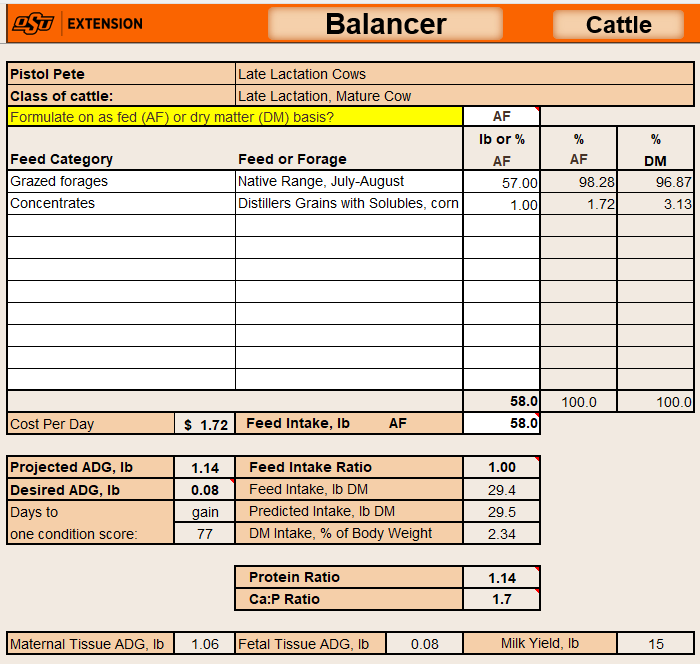
The objective is not to discourage supplementation, particularly when it serves as a practical method for gathering and observing cattle during periods of increased disease monitoring. Rather, supplementation should be intentional. When forage quality is already meeting cow requirements, producers may consider whether smaller feeding rates, less nutrient dense supplements, or reduced feeding frequency can accomplish the same management goal without unnecessarily increasing nutrient intake or feed expense.
As producers increase herd observations for New World Screwworm, maintaining awareness of both herd health and nutritional management can help support cattle performance while protecting operational efficiency.