

Cow-Calf Corner | February 9, 2026
February Cattle Market News
Derrell S. Peel, Oklahoma State University Extension Livestock Marketing Specialist
Cattle markets are strong in early February but are challenged to absorb and digest a wide range of news. A few of the diverse issues are summarized below.
Inventory Data
The Cattle report released in late January provides lots of data for market participants and analysts to digest over many days. The beef cow herd was down another one percent, extending the cattle cycle to at least a twelfth year. A 0.9 percent increase in beef replacement heifers may indicate that the herd is stabilizing. However, little or no growth in the cow herd is possible in 2026 and not much in 2027. Seven of the top ten beef cow states saw a herd decrease in 2025 indicating that lingering drought and drought threats, along with financial challenges, continue to delay herd rebuilding.
Weather Issues
A variety of weather concerns are part of the cattle market discussion. The drought map continues to deteriorate with growing concerns about the upcoming growing season.
The late January storms impacted beef cattle operations across a wide swath of the country and will have lingering impacts in the coming weeks. Strom impacts on feedlot cattle are likely to show up in carcass weights for a few weeks going forward. The delay in market-ready cattle has stimulated fed cattle markets into February. Some cow-calf producers were already calving during the storms, so longer term impacts on the calf crop are unknown at this time.
New World Screwworm (NWS) and the Mexican Border
The cattle industry continues to nervously anticipate another shoe (or maybe two shoes) to fall in awaiting a reopening of the Mexican border and the continuing threat of NWS arriving in the U.S. The market implications of both events are probably not as severe as the fear and uncertainty suggest, but both possibilities inject considerable potential volatility into cattle markets.
(Other) International Trade
The latest release of monthly trade data catches up to the normal two-month delay with the release of data for November 2025. For the first eleven months of last year, beef exports were down 13.8 percent, mostly the result of exports to China down 95.8 percent year over year for November and down 64.8 percent for the year to date. Beef imports through November were up 18.3 percent.
Last week, a presidential executive order increased the TRQ for Argentina from 20,000 to 100,000 metric tons of beef. This could allow imports of Argentine beef to about double from 2025. Imports from Argentina were already exceeding the 20,000 ton limit. It’s not clear how much additional Argentine beef might actually be imported this year. Argentina consumes nearly three-quarters of beef production domestically. Of the roughly 24 percent of beef exported, exports to the U.S. are only about seven percent of Argentine beef exports. Increased exports of beef to the U.S. will compete with domestic demand in Argentina as well as exports to other markets. The impact in the U.S. is likely to be minimal. Beef imports from Argentina would only be about four percent of U.S. imports if the new quota is filled and mostly likely an increase in imports from Argentina will simply displace imports from another country, not changing the total much, if any.
Derrell breaks down key data from the report, discusses long-term trends affecting herd size, and outlines what these changes could mean for cattle markets moving forward. Get expert insight into current conditions shaping the U.S. cattle industry on SunUpTV from February 7, 2026.
Cattle Branding in Oklahoma
Mark Z. Johnson, Oklahoma State University Extension Beef Cattle Breeding Specialist
Branding today is still the most recognized and accepted means of indicating ownership of cattle in North America. Eventually, other methods such as electronic ear tags may become the standard for identification, but for now, cattle producers continue to utilize the time-tested, permanent and universal method of branding. Branding, is an effective method of permanent identification, a deterrent to cattle thieves and an important tool to assist in the recovery of stolen cattle.
Summary of Oklahoma Brand Laws
Those applying for state brand registration must complete and file the Application for Registration of Brands and Marks with the Oklahoma Cattlemen’s Association Brand Division, P.O. Box 82395, Oklahoma City, Oklahoma 73148. The application must be accompanied by a $60.00 registration fee. Upon approval, a brand certificate will be mailed to the applicant indicating the brand registered. All brands approved by the Oklahoma Cattlemen’s Association (OCA) will appear in the following brand book or supplement printed.
All brands must be renewed at the beginning of each five year registration period in years ending in 0 and 5, regardless of when the brand was registered. State registered brand owners will be notified by mail before the five year registration period ends. At this time, brands are renewed prior to publication of the newest Oklahoma Brand Book.
- A brand is defined as a permanent mark not less than three inches in length or diameter and burned into the hide with a hot iron. “Freeze branding” is also a form of identifying animal ownership. Acid brands are not recognized as state registration.
- Single unit brands including one initial, number, bar, slash or quarter circle are not accepted as forms of state registration.
- Each brand registration must be confined to one location on the animal. When the same brand is used on two sites, two applications must be filed. Brands must be registered in the following eight positions ONLY: left neck, left shoulder, left rib, left hip, right neck, right shoulder, right rib and right hip. However, previously registered Oklahoma brand positions are not affected (O.S. 2, Sections 405). The left jaw is reserved for the use of B and T brands, identifying cattle having a detectable antibody titer for Brucellosis and Tuberculosis.
- Applicants are required by law to list, in order of preference, three distinct brands and three positions on the animal for application of the brand.
- State registration of your brand is not required by law. Recorded brands, however, take precedence over similar unrecorded brands when questions of ownership arise, placing the burden of proof on unregistered brand users in the event of controversy. Registered brands are prima facie evidence of ownership in a court of law.
Brand books are furnished to county sheriffs, county extension agents, vocational agricultural instructors, and libraries without charge. They can be purchased by the public from OCA at a price equal to the cost of preparation, printing, and delivery.
Where, When and How to Brand
When ownership brands are applied it is best to use hot brands. The clarity of the application can be determined shortly after branding, and animal-to-animal variation does not affect the end results as greatly as with freeze branding. A good hot brand is recognizable because it destroys hair follicles located under several layers of skin and leaves a permanent bald scar on the hide of the animal.
Identification and ownership brands can be applied at any time during the year, but this procedure is usually performed in combination with one or more practices such as weaning, castration and vaccination. Calves are usually branded before or during weaning because the probability of a calf straying is greater after weaning.
Good brands can be achieved by properly heating the irons until they appear a silvery-gray (similar to the color of ashes) in the daylight, but glow a cherry-red color when held in a dark area. Clipping excessive hair growth or mud from the hide area to be branded, and keeping irons clean at all times with a steel brush to remove hair, dirt and other debris are management practices which should be utilized. The irons can be heated in a wood fire (bed of coals) or a propane (bottled) gas fire. An electric branding iron can be used successfully after a certain amount of experience is gained. The size of the iron is important. Each character should be (in outside measurements) 4 inches by 3 inches for calves less than one year old and 6 inches by 3 1/2 inches for older cattle. The face width of the branding iron should be 1/4 inch to 1/2 inch wide, with the surface edges slightly rounded.
Mark discusses common theft risks, prevention strategies, and management practices producers can use to reduce losses and safeguard their operations. Learn what steps you can take to improve security and protect your livestock investment on SunUpTV from February 7, 2026.
References
Birth, Branding or Belated? Earlier is Better When It Comes to Castration
Kellie Curry Raper, Professor and Livestock Marketing Extension Specialist
In many parts of the country, calving season is upon us! That means it is also time for another discussion about castrating those male calves – and doing it early.
Auction data collected at selected fall sales in Oklahoma indicate that the percentage of male feeder cattle (300-950 pounds) sold as bulls relative to all male feeder cattle (steers plus bulls) increased from 2019 to 2024. Figure 1 illustrates those changes, with the line representing increase in the percent by head (scale on right axis) and the bars representing the increase in the percent by number of lots (scale on left axis). Both numbers trend upward.
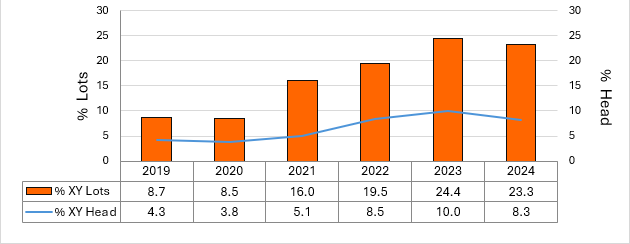 Figure 1. Percent of Male (XY) Feeder Calves Sold as Bulls, By Lot and By Head, Selected Fall Oklahoma Sales, 2019-2024
From a handling standpoint on the ranch and in the feedlot, steers are generally easier to handle than bulls. Castration helps minimize aggressive behavior which eases handling stress and injury potential for people, as well as lessening the potential for damage to pens and facilities. From a performance standpoint, while bulls may produce marginally higher yield in pounds, they also produce lower quality carcasses. On the plate, most consumers prefer the flavor and tenderness of beef from steers over beef from bulls. Steers deposit intramuscular fat earlier and more evenly than bulls and that is particularly true in areas like the loin, where higher value cuts are sourced.
Since 2019, the same Oklahoma data indicates that the percentage of bull lots relative to steer lots has grown across all weight classes (see Figure 2), more than doubling in every weight class. For lots averaging 800 pounds or more, the numbers are still relatively small. However, the increase in bull lots in the mid-range weight classes is particularly concerning.
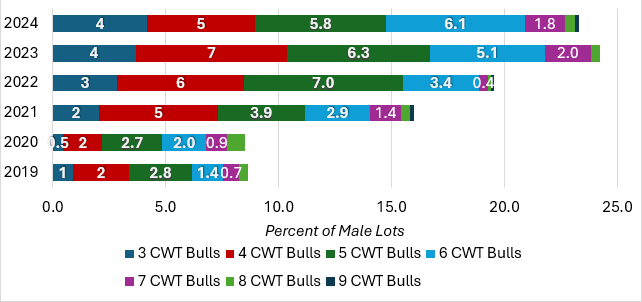 Figure 2. Bull Lots by Weight as Percent of All Male Feeder Calf Lots Selected Fall Oklahoma Sales, 2019-2024
Beef Quality Assurance guidelines recommend castration as early in life as possible (at birth) and preferably by 90 days of age. The earlier in a calf’s life that castration is done, the less stressful it is for the animal and the faster their recovery from any lost production performance. Early castration also leads to healthier cattle as they move from the ranch to stocker operations and feedlots. These are all positives, from both a production perspective and an animal welfare perspective. Hilton (2009) points out that the negative performance impacts of castration after 6 months of age never goes away.
Late castration can also be more time and labor intensive on the ranch and carries higher injury risks for both cattle and cattlemen. Younger, smaller calves are easier to handle, and castration can often be done at birth or implemented alongside other management practices, like branding, tagging or vaccinations. Later castration not only carries higher infection risks, but it also impacts carcass quality down the road.
As you move into calving season, consider your castration strategy if you haven’t already. The most recent Oklahoma custom rates survey of producers reported the average cost of castration to be approximately $5 per head (Sahs, 2021/2022). Based on the most recent analysis of the bull discount in Oklahoma auction data across those same years, there was an $11.69 per hundredweight price difference between bulls and steers of the same weight with all other differences in animal or management characteristics accounted for. That adds up to additional revenue to the tune of $35.07 per head for a 300-pound steer calf or $70.14 per head for a 600-pound steer calf. That’s a pretty good return on your investment.
So, back to the question of birth, branding, or belated? Belated birthday wishes are generally still appreciated. Belated castration, maybe not so much. That per head market value difference between a bull and a steer that are otherwise the same AND that gets larger as the calf gets larger? That is the buyer asking you to castrate those bull calves - and castrate them earlier.
Hilton, W.M. “Castration of beef calves: What does the science say about timing and technique?”. Available at: https://www.dvm360.com/view/castration-beef-calves-what-does-science-say-about-timing-and-technique-proceedings. August 1, 2009.
Sahs, R. “Oklahoma Farm and Ranch Custom Rates, 2021-2022.” CR-205, Oklahoma Cooperative Extension Service. https://extension.okstate.edu/fact-sheets/oklahoma-farm-and-ranch-custom-rates-2021-2022.html. March 2022.
Mark Johnson provides information on preconditioning programs that can add value to calves on SunUp TV from July 3, 2021 and further details about adding value to calves from July 10, 2021.