

Cow-Calf Corner |April 20, 2026
Global Beef Consumption and Imports
Derrell S. Peel, Oklahoma State University Extension Livestock Marketing Specialist
Global beef consumption in 2026 is projected at 59.5 million metric tons (mmt), down 1.4 percent year over year, largely due to decreased beef consumption in China. Global beef consumption has increased an average of 0.8 percent annually in the last 46 years, from the 1980 level of 42.4 mmt. The U.S. is the largest beef consuming nation, accounting for 22.4 percent of total global beef consumption in 2026. The U.S. has averaged 23.3 percent of global beef consumption since 1980.
2026 Forecast, Carcass Weight
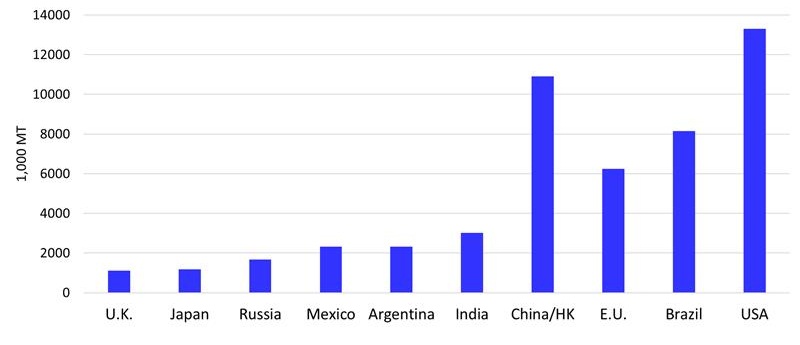
Figure 1. Beef Consumption
China/HK is the second largest beef consuming country, with total consumption more than doubling in the past 25 years. Brazil is the number three beef consuming country, followed by the E.U. at number four. Typically, large beef producing countries are also large beef consuming countries.
2026 Forecast, Carcass Weight
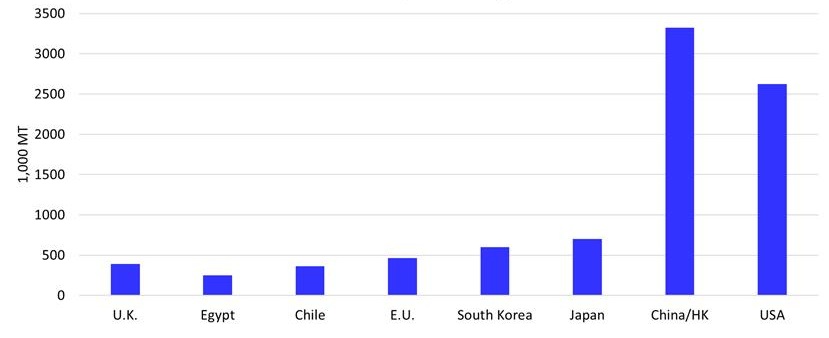 Figure 2. Beef Imports
Chin/HK is the largest beef importing country, having moved ahead of the U.S. in in 2017 (Figure 2). Beef imports in China/HK have increased sharply since 2013, and especially after 2018, with beef imports supplementing domestic beef production to rapidly increase beef consumption in China/HK (Figure 3). The next three beef importing countries: Japan, South Korea and the E.U. combined are less than the U.S. (Figure 2).
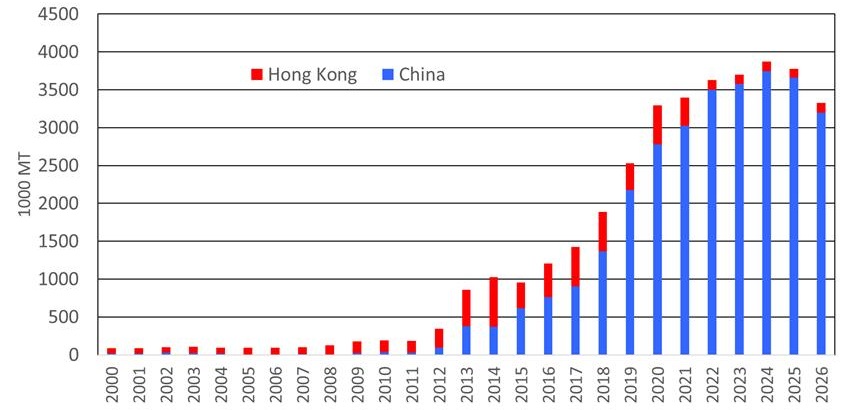 Figure 3. China/Hong Kong Beef Imports
Figure 4 shows the rapid increase China/HK beef imports as a share of global total imports, pushing China/HK ahead of the U.S. since 2017. The U.S. share of global beef imports has remained relatively steady for many years.
% of Global Total
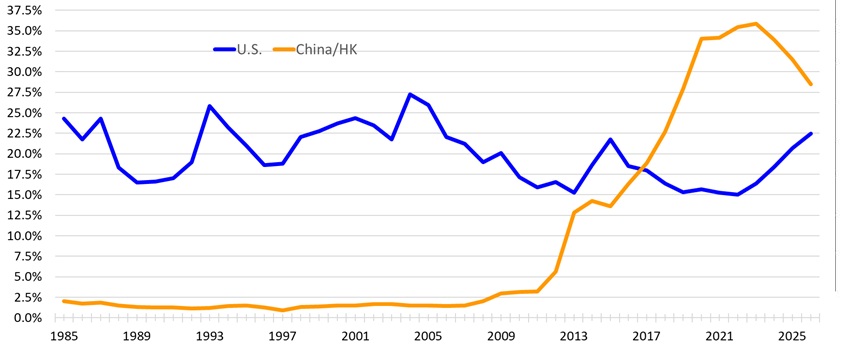 Figure 4. U.S. and China/HK Beef Import Share
China/HK is certainly the major driver of global beef trade. Recent tariff rate quotas (TRQ) announced by China will have ripple effects on all global beef markets.
Controlling Flies in Cow-Calf Operations
Mark Z. Johnson, Oklahoma State University Extension Beef Cattle Breeding Specialist
One of the realities of beef production in Oklahoma is dealing with significant fly populations. The Oklahoma beef cattle industry loses millions of dollars each year due to external parasites. Blood loss, irritation and annoyance lead to reduced levels of performance due to flies. Horn flies, Stable Flies, house flies or horse flies must be controlled. With an abundance of early spring warmth, recent rains, humidity and warmer temperatures most of Oklahoma now serves as an ideal breeding ground for these annoying pests that rob profit potential from beef operations.
Stable flies are usually a problem in cattle from March through early May and typically decrease with higher temperatures from June through August (with consistent temperatures above 90°F.) In a typical year, there are two distinct peaks of stable fly populations with one occurring in early April and another one occurring in late September. The stable fly preferably feeds on the front legs of cattle and occasionally on the belly. Their bite is very painful to cattle causing significant behavioral reactions such as leg stomping, bunching and standing in water for long periods to avoid the bites. One of the preferred breeding sites for stable flies are old hay feeding areas that never dry out and retain moisture for several months. A typical ring/round bale feeding area can provide sufficient habitat for approximately 60,000 stable flies per week. Treatment thresholds for stable flies are 10 flies per animal when observing just the front legs of animals. These numbers will cause significant stress to cows and calves.
Horn flies and stable flies are on cattle herds across Oklahoma. This means cattle are dealing with both fly pests and that rely on blood meals as their main food resource. Cattle will need some relief from the biting activity from these fly pests now and the quickest method are insecticides applied directly to the animals.
For stable flies, it is best to find their breeding habitats (hay feeding areas) and clean them up or pull some type of implement through those areas so they can dry out. Consider that a hay feeding area may not look conducive for fly development but if you walk on that area and there is moisture seen beneath your feet then it can support stable fly development. For an insecticide application, the best method is to spray the legs, brisket and belly areas with a product that is labeled for on-animal use. Since cattle will get their legs wet from laying in pastures or walking through water then applying the insecticide with a diesel oil as the carrier will persist a little longer than one applied with water. Cattle producers will have to use a product that can be mixed with diesel and utilize a sprayer with pumps designed for diesel not water.
For horn flies, there are many different options to control this pest. One of the most popular applications for horn fly control are pour-on products. If using a pyrethroid pour-on be sure that it is synergized with piperonyl butoxide (PBO). The synergist inhibits enzymes that insecticide resistant flies can develop to detoxify the insecticidal compound. Insecticide impregnated ear tags are still a viable option for longer horn fly control but operators will need to rotate the type of product used every year to limit insecticide resistance. Rotating products is not based on trade names but by the chemical class the product belongs in. For instance, a product can be in three broad chemical classes based on its mode of action (the manner in how it kills the fly based on target site) and products labeled for on-animal applications are either pyrethroids, organophosphates, or macrocylic lactones. Veterinarians or country extension personnel can help identify which chemical class a product belongs based on the active ingredient listed on the product label if assistance is needed to identify the chemical class. Sprays are still a good option to provide some relief to cattle with heavy horn fly infestations and the spray should be applied as a course spray that is directed at the backs, sides and belly of the animal.
Insect growth regulators (IGR) that are fed through mineral are a very good option when combined with other control applications whether it be ear tags, pour-ons or sprays but producers will need to monitor consumption to be sure that the herd is averaging ~4 oz. / hd/ day to prevent flies from developing from the manure pats. Self-application devices such as oilers can be effective if you make it a force use system or put multiple oilers out to ensure the whole herd is treated properly. A typical force use system is setting it up where cattle have to go under the oiler to get to water or a feed area. Regardless of the type of insecticide application chosen it is important to get cattle treated to provide some relief and reduce stress from biting flies.
2026 Payne County Pasture Tour Coming This June
Jennifer Patterson, OSU Payne County Cooperative Extension Service
The Payne County OSU Extension Office will host its annual Pasture Tour on Wednesday, June 3, offering local producers an opportunity to learn about current pasture management strategies and emerging research impacting cattle operations.
The registration deadline is Thursday, May 28, and lunch will be provided.
To register, visit: 2026 Payne County Pasture Tour Registration – Fill out form
This year’s tour will feature 3 stops on the west side of the county, including locations along Highway 51 West and areas west and north of Lake Carl Blackwell. A detailed map and specific location information will be shared closer to the event date.
The tour will include multiple stops highlighting practical, research-based approaches to pasture improvement and livestock efficiency. Topics will include prescribed fire and herbicide integration for post-fire weed control, bermudagrass pasture reclamation and fertility management, and the use of aerial drone technology for woody plant control.
Participants will also receive an update on ongoing cattle forage efficiency research, with insights into cow performance and grazing system efficiency. Interactive learning opportunities, including a Producer Cattle Contest and Plant ID Contest, will be incorporated throughout the tour to encourage hands-on engagement.
The Pasture Tour is designed for cattle producers, landowners, and anyone interested in improving pasture productivity and the sustainability of the livestock industry. Continuing education units (CEUs) for pesticide applicators will be available for select sessions.
This program is generously sponsored by OK AgCredit, Cimarron Valley Co-op, Stillwater Milling Company, and Cushing Veterinary Clinic.
For registration information or questions, contact Jennifer Patterson, Payne County Extension Educator, at jennifer.k.patterson@okstate.edu