

Cow-Calf Corner | December 22, 2025
Feedlot Production Dropping Fast
Derrell S. Peel, Oklahoma State University Extension Livestock Marketing Specialist
The December Cattle on Feed report showed a feedlot inventory of 11.727 million head, down 2.1 percent year over year and the smallest December feedlot inventory since 2017 (Figure 1). Feedlot inventories have declined year over year for 13 consecutive months, leading to a 12-month moving average total the lowest since October 2018. Average feedlot inventories have declined 3.6 percent from the peak in September 2022.

Figure 1. Cattle on Feed. US Total, Monthly
The rather slow decline in feedlot inventories masks a sharper drop in feedlot placements and marketings. Feedlot placements in November were down 11.2 percent year over year and have decreased 8.6 percent in the last six months. Marketings in November were down 11.8 percent from one year ago and have decreased 7.9 percent in the last six months compared to last year. Figure 2 shows the 12-month moving average annual trends for both placements and marketings. As of November, average of feedlot placements the past year are at the lowest level since April 2016 and average marketings are the lowest since August 2016. Average feedlot placements and marketings have decreased more dramatically in 2025 as tightening feeder supplies were exacerbated by the lack of Mexican cattle imports.
The regional changes are significant. Feedlot inventories in Texas have been smaller than Nebraska the past two months, which has only happened a few times since 1971. Table 1 shows the current on-feed inventories and feedlot placement totals the past six months for the top eight cattle feeding states. Placements have decreased 16.2 percent year over year in Texas compared to 7.2 percent in Nebraska. December feedlot inventories are down 9.4 percent in Texas but actually up 2.7 percent year over year in Nebraska. Colorado, the number four cattle feeding state, has also dropped sharply with the six-month total of placements down 21.8 percent and the on-feed total for December down 14.2 percent compared to last year.
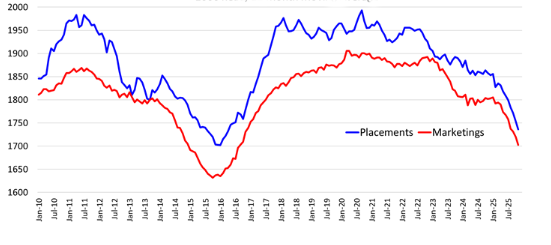
Figure 2. Feedlot Placements and Marketings. 1000 head, 12 Month Moving Average
| State | COF December 1000 Head | % Change YOY | Jun-Nov Placements 1000 Head | % Change YOY |
|---|---|---|---|---|
| Nebraska | 2670 | +2.7 | 2880 | -7.2 |
| Texas | 2610 | -9.4 | 2015 | -16.2 |
| Kansas | 2440 | +0.8 | 2510 | -5.6 |
| Colorado | 910 | -14.2 | 755 | -21.8 |
| Iowa | 700 | +6.1 | 454 | +4.1 |
| California | 495 | -2.9 | 345 | +1.2 |
| Idaho | 345 | +4.5 | 278 | +1.5 |
| Oklahoma | 340 | -6.8 | 275 | -11.6 |
| U.S. | 11727 | -2.1 | 10475 | -8.6 |
Heritability and Heterosis
Build Back Better – Replacement Heifer Series – Article 7
Mark Z. Johnson, Oklahoma State University Extension Beef Cattle Breeding Specialist
In the genetic model: Phenotype = Genotype + Environment. Genotype represents the genetic potential of an animal to reach a level of performance and can be split into two components. The component of Breeding Value (additive genetic merit) and Gene Combination Value (GCV) which can also be thought of as the non-additive part. We use selection decisions to build Breeding Value (BV). Mating decisions influence GCV. Based on your breeding objectives and what traits you consider to be of primary importance to unlocking profit potential in your commercial cow-calf operation, selection and mating are tools in your tool box to build better genotypes.
Heritability can be thought of as the amount of phenotypic variation which is explained by additive genetic variation. As such, heritability serves as an indicator of how easily traits can be changed through selection. When traits are highly heritable (40% or more), less of phenotypic variation is explained by GCV or environmental influences. On the other hand, low heritability traits are influenced to a greater degree by the GCV part of genotype and the environment. For example: if the trait of Heifer Pregnancy is estimated to have a heritability of 7%, it follows that 93% of the variation we see in phenotypes for Heifer Pregnancy are influenced by GCV and environment.
The biological phenomenon of heterosis (or hybrid vigor) is the result of GCV from the mating decision to crossbreed. The following table shows the inverse relationship between heritability and heterosis relative to categories of traits.
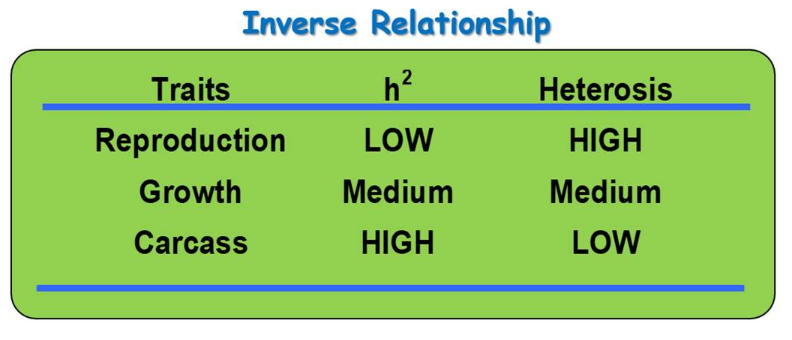
The table shows that low heritability traits show a higher level of heterosis. High heritability traits are influenced more by additive genetic merit and to a lesser extent due to GCV. Highly heritable (carcass) traits are most effectively improved through selection programs to improve additive genetic potential. We can impact low heritability traits more quickly through crossbreeding to capitalize on heterosis.
In regard to building back a better cowherd through sound, intentional selection and mating decisions, the single strongest argument for crossbreeding is the advantage in reproductive fitness and longevity of crossbred cows. If crossbreeding, remember that heterosis does not substitute for additive genetic merit, it builds off of it. Selection of breeds (and breeding stock within those breeds) should be based on EPDs, indicating the BV for traits most economically important in your production system. Analysis of all the components of your production system including your intended use and marketing endpoint for each calf crop should dictate the selection and mating decisions you make.
Supplementing Bred Heifers and Calving Difficulty
Paul Beck, OSU Cooperative Extension Beef Cattle Nutrition Specialist
Producers are often told that supplementing bred heifers with protein prior to calving increases calf birth weight and leads to greater calving difficulty. Nutrition of bred heifers during gestation does have lasting consequences for both the calf and the future productivity of the cow. Decades of research clearly demonstrate that maternal undernutrition during pregnancy negatively influences not only the cow’s reproductive performance, but also immune transfer, calf survival, weaning weight, and post-weaning performance.
Research conducted in the 1970s at Oklahoma State University compared productivity of heifers managed to achieve either “adequate” or “obese” body condition from 12 months of age through 5 years of age. At first calving, 58% of the obese heifers required calving assistance, compared with only 8% of heifers managed to maintain adequate body condition. These data are the basis for current recommendations that heifers calve at a body condition score (BCS) of approximately 6, but not reach a “fleshy” (BCS 7) or “obese” (BCS 8) condition.
Energy and protein supply during late gestation can influence calf birth weight. Classic work by Corah and colleagues published in 1975 demonstrated that heifers restricted to 65% of energy requirements during the final 100 days of gestation produced calves that were approximately 4.4 pounds lighter at birth. However, these calves experienced greater neonatal mortality and reduced weaning rates compared with calves from adequately fed dams. Importantly, lighter birth weight was not associated with reduced calving difficulty, illustrating that undernutrition compromises calf viability rather than preventing dystocia. Restricting nutrients prior to calving weakens both the cow and the calf, increasing calving difficulty and reducing calf survival.
Birth weight responses to pre-calving supplementation are highly variable. I evaluated changes in calf birth weight reported from 24 studies evaluating late-gestation supplementation. The average increase in calf birth weight was only 3 pounds, with responses ranging from a 3-pound decrease to a 10-pound increase. The largest increases occurred when high levels (approximately 5 pounds per day) of energy-dense supplements were fed. Fifteen of these studies also reported subsequent pregnancy rates. Although variable, the average pregnancy rate of unsupplemented cows was 86%, compared with 92% for cows supplemented during late gestation, with the greatest response observed in first-calf heifers.
Excessive energy intake during late gestation partitions more nutrients toward fetal growth, resulting in larger calves. When coupled with excess fat deposition in the pelvic region, this increases the risk of dystocia. Thus, excessive energy, rather than protein supplementation alone, is the primary contributor to increased calving difficulty in many heifer programs.
Ensuring bred heifers meet—rather than greatly exceed—energy and protein requirements, promoting moderate BCS gain during mid- and late gestation, and strategically supplementing key nutrients improves calf survival, pre-weaning growth, immune function, and long-term reproductive performance without increasing calving difficulty. Avoiding maternal undernutrition remains one of the most consistent strategies for improving whole-herd productivity and profitability.