

Using Trend Values from Soil Moisture Sensors for Irrigation Decisions
Introduction
Sensor based and data driven irrigation scheduling has gained interest in irrigated agriculture around the world, especially in semi-arid areas because of the easy availability of commercial irrigation scheduler technologies such as soil moisture sensors and crop models. Moisture sensing has particularly gained interest among the agriculture community due to availability of the sensors to the producers, affordable costs, and easy-to-use graphical user interface. The economic potential of sensors in saving irrigation costs, extension education programs providing training in data interpretation, and policy initiatives have also helped with adoption of the sensors, especially in the United States. However, sensor adoption and efficient use can still be challenging due to poor data interpretation, steep learning curves, overly high expectations, and subscription costs. This factsheet briefly discusses scenarios where sensors can be helpful in irrigated agriculture. For information on moisture sensor types, functions, and installation, readers are referred to OSU extension factsheet Soil Moisture-Sensing Systems for Improving Irrigation Scheduling
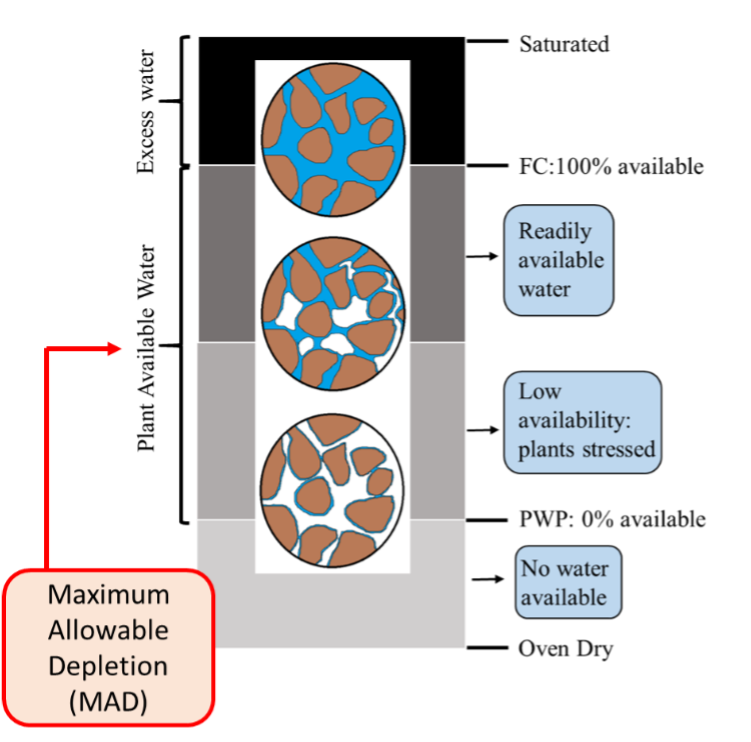
Figure 1. Stages of soil moisture decline in the soil.
Irrigation Scheduling
Irrigation scheduling with soil moisture sensors follows traditional principles of field capacity (FC), plant available water, maximum allowable depletion (MAD) which is also called management allowable depletion, and permanent wilting point (PWP). Figure 1 shows the transition of soil moisture levels from FC to MAD and PWP in a typical soil. The maximum amount of water that a soil can hold after drainage effectively ceases is called field capacity (readers are referred to Determining Field Capacity Using Continuous Soil Water Content Data for more information on determining field capacity using soil moisture data). At this point, all the water in soil is available to the plants. As the moisture content in the soil declines, it becomes more difficult for the plants to extract moisture from the soil. The soil moisture level below which the available moisture in soil cannot meet the plant’s water requirement is called the MAD. The water stress that occurs once moisture level goes below this moisture level can cause yield reductions in crops. Therefore, irrigation should be triggered as soon as the soil moisture level approaches this MAD point to avoid yield losses, (readers are referred to Soil Moisture-Sensing Systems for Improving Irrigation Scheduling). Modern soil moisture sensors can come self-calibrated and are connected with software packages which provide water stress threshold levels for different crops to avoid water stress or overwatering (Figure 2). These decisions are useful in furrow and drip irrigation systems where irrigation triggers can be synchronized with MAD values, while the trend values are more useful in center pivot irrigation systems as these systems run continuously in a time and space bound manner, which is explained in next section.
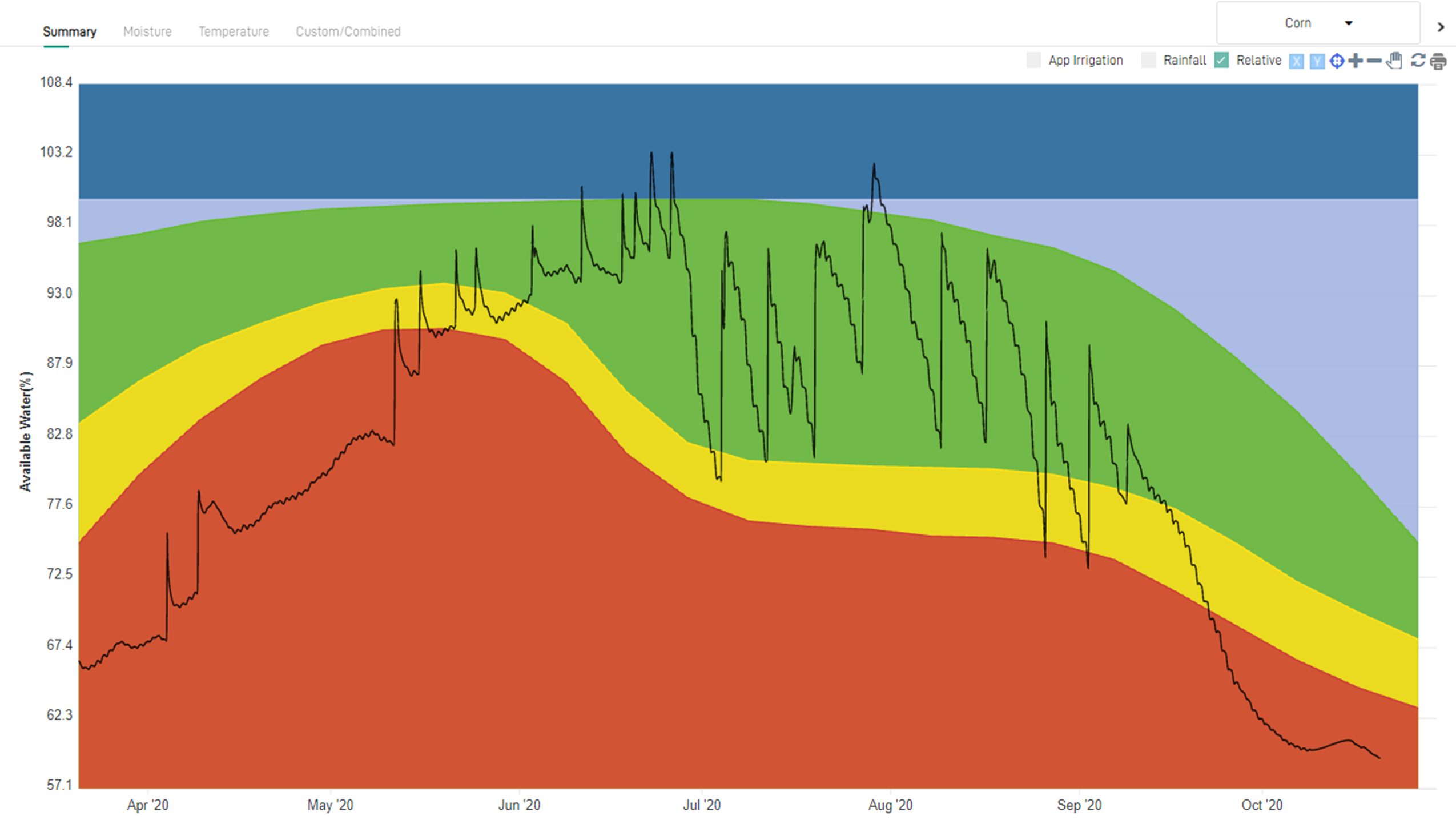
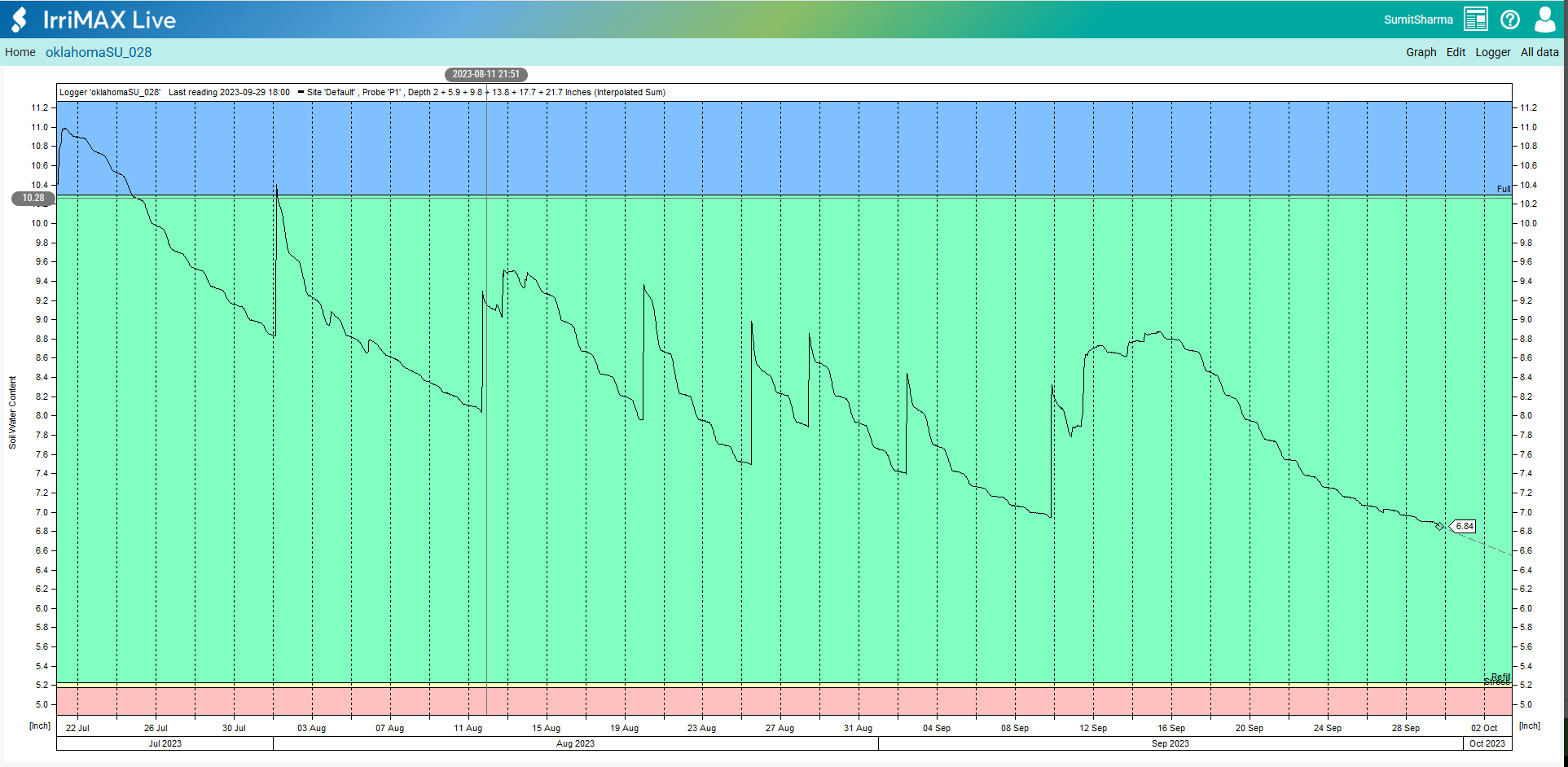
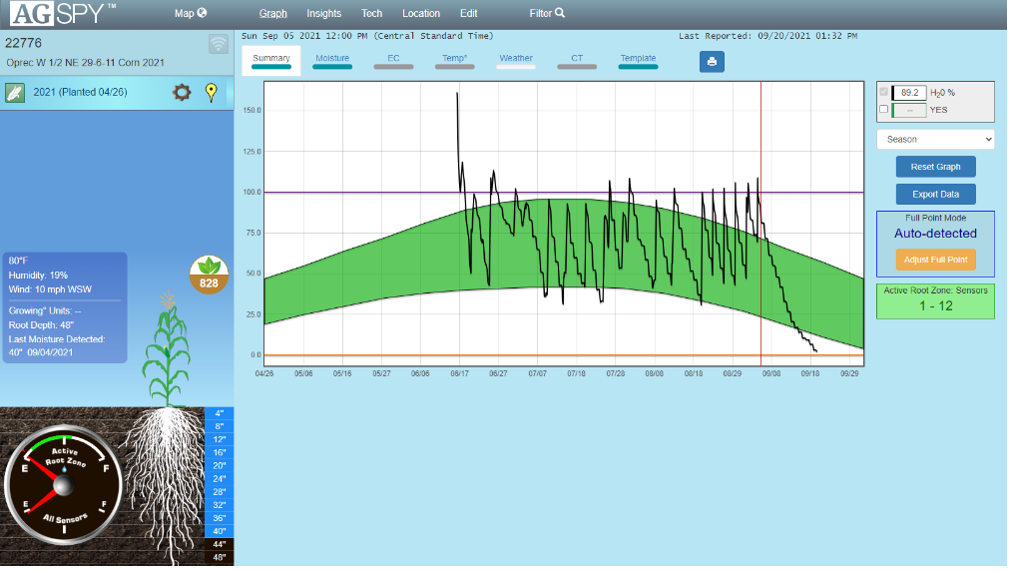
Figure 2. Screenshots of graphical user interface of three sensors GroGuru (top), Sentek (middle) and Aquaspy (bottom) with threshold levels for soil moisture conditions. The green section in each graph shows optimum soil moisture, which red section and red line indicates no available moisture to plant. Aquaspy and Sentek credits: Sumit Sharma. GroGuru image credits
Soil Moisture Trends and Irrigation Depths
Soil moisture sensors can help make data-informed decisions about scheduling irrigation. Previous studies have shown that the soil moisture estimates may vary from one sensor to the other even if installed side-by-side, and the sensor estimates may not represent the exact moisture levels in the soil. However, all soil moisture sensors exhibit trends in recharge and decline in soil moisture conditions. These soil moisture trends can be used to make informed decisions to adjust irrigation and improve water use efficiency. In high evapotranspiration (ET) environments, center pivots are usually not turned off during the peak growing season, yet sensors can help in making decisions for early as well as late growing periods.
One of the easiest adjustments that could be made using soil moisture sensor data is the adjustment of irrigation depth. In an ideal situation, every irrigation event should recharge the soil profile to field capacity; however, this may not be possible due to the crops’ water demand, the limited well or irrigation system capacity, or the limited infiltration capacity of the soil. Each peak in soil moisture detected by sensors shows irrigation or rain, and ideally the soil moisture should reach the same level after each irrigation. However, reduction in the peaks in the soil moisture after successive irrigation events often indicates greater crop water demand than what is replenished with irrigation. In such scenarios, as allowed by system capacity and infiltration rates, the irrigation depth should be increased. These trend values are particularly useful for center pivot irrigation systems, where precisely triggering irrigation based on reaching MAD might be unfeasible due to time and space bound rotations of the pivots, combined with high ET rates.
The timing of the last irrigation can be a tricky decision at the end of the cropping season. For summer crops, this is the time when crop ET demand is declining due to decline in green leaf area and cooler weather patterns. Similar moisture trends can be used to make decisions for the last irrigation events, which can be skipped or reduced if the profile moisture is good, or can be provided if profile moisture is low. This is important because in an ideal situation, one would want to end the season with a drier profile to capture and store of-season rains. Additionally, saving water on the last irrigation can save operational costs and potentially cover the cost of moisture sensor subscriptions.
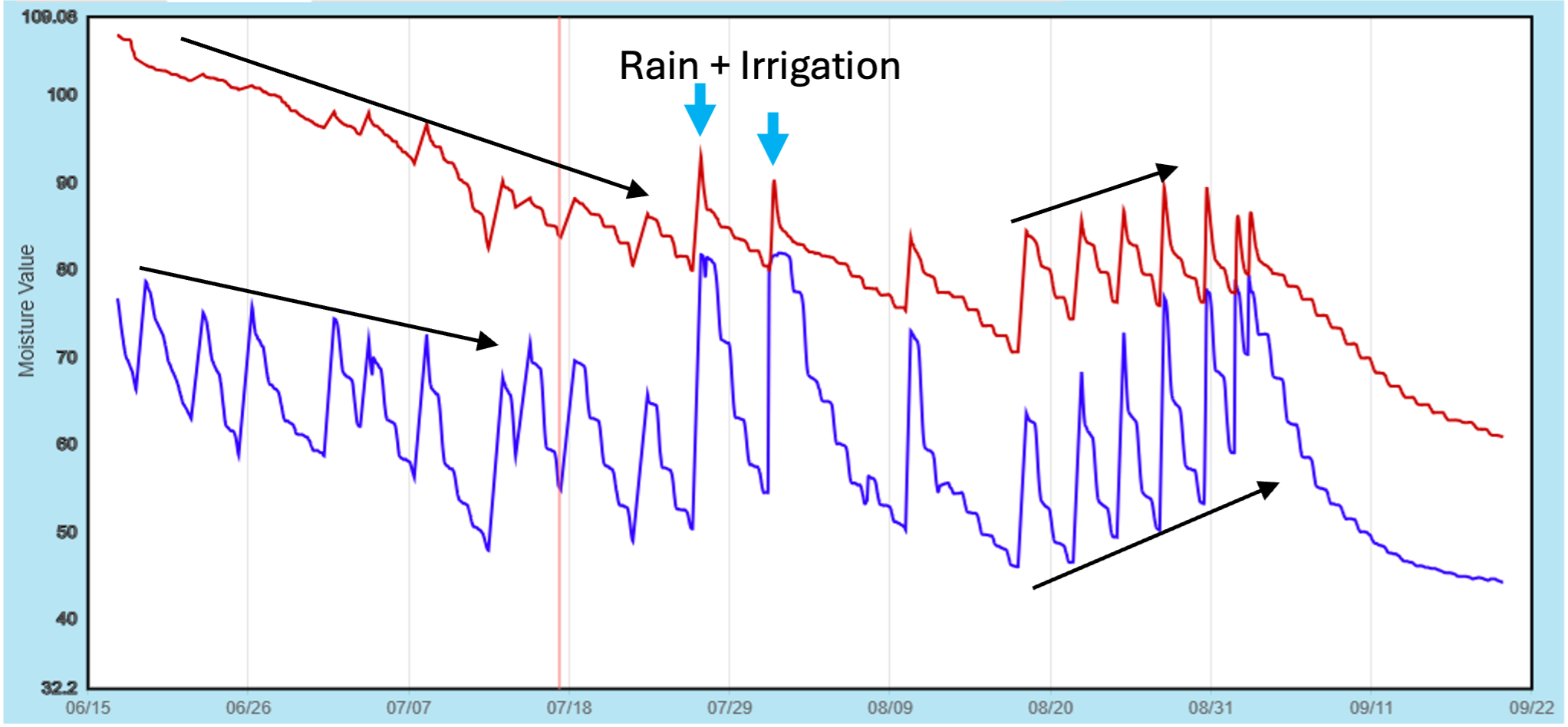
Figure 3. A screenshot from an Aquaspy agspy moisture sensor showing moisture at 8” (blue) and 28” (red) with each irrigation event. The blue arrows indicate rain and irrigation events which recharged soil profile. The black arrows early in the season indicate declining soil profile moisture, and arrows later in the season indicate increasing soil profile moisture with each irrigation event. Data and image credit: Sumit SharmaGroGuru
These decisions can be illustrated with Figure 3, which shows the trends of declining and recharging in a soil profile under corn at 8- and 28-inch depth. This field was irrigated with a center pivot irrigation system which was putting 1-1.25 inches of water with each irrigation event; however, the peak water recharge rate at both depths was declining with each irrigation. This coincided with the peak growth period, indicating rising ET demand of the crop that exceeded what was replenished by irrigation. Later, two rain events, in addition to irrigation, replenished soil moisture in both layers. As the pivot was already running at a slow speed, slowing it further was not an option without triggering runoff for this soil type and this well capacity. Later in the season, when the crop started to senesce and ET demand declined, each irrigation event added to the moisture level of the soil. This allowed the producer to shut down the pivot between 70% starch line and physiological maturity for the crop to save water and leave the soil profile drier for the off-season.
In conditions of high ET demand, crops often rely on moisture stored deep in the soil profile when irrigation system capacities are insufficient. Thus, irrigated agriculture depends heavily on profile moisture storage. Declining soil profile moisture is common during peak ET periods in high water demanding crops such as corn. These declines are evident if one starts the season with considerable moisture in the soil profile, however such trends may be absent if the season is started with a dry soil profile. Dry soil profiles can be recharged early in the season with pre-irrigation or deeper early irrigations (if allowed by the infiltration rate of the soil), when crop ET demand is low. Alternatively, sensors can be used in reducing the irrigation depth or skipping irrigation in the early part of the season, if one starts with a full profile. This can promote root growth through the profile to reach the moisture in deeper layers. It should be noted that the roots will grow and reach deeper moisture only if there is initially adequate moisture in the surface layers.
Sensor installation and calibration are important for efficient use of these devices in irrigation decision making. Poor installation can often lead to poor data and wrong decision making. Although modern sensors are factory calibrated or self-calibrating, some do provide the option to adjust threshold levels manually based on field observations. Early installation of sensors can be useful in making informed decisions as soon as the season starts. For a more detailed analysis of proper sensor installation, refer to Soil Moisture-Sensing Systems for Improving Irrigation Scheduling. Producers are encouraged to integrate other means of irrigation planning with soil moisture sensing, such as a push probe to check the soil profile or the Oklahoma Mesonet’s Irrigation Planner to further validate the sensor data. Further, the producer should consider their irrigation system capacities before investing in soil moisture sensors, as sensors may always show a deficit in low well capacities which cannot meet the crop’s water demand.
References
Taghvaeian, S., D. Porter, J. Aguilar. 2021. Soil moisture-sensing systems for improving irrigation scheduling. BAE-1543. Oklahoma
State Cooperative Extension. Available at: https://extension.okstate.edu/fact-sheets/soil-moisture-sensing-systems-for-improving-irrigation-scheduling
Datta, S., S. Taghvaeian, J. Stivers. 2025. Understanding soil water content and thresholds for irrigation management. BAE-1537.
Oklahoma State Cooperative Extension. Available at: https://extension.okstate.edu/fact-sheets/understanding-soil-water-content-and-thresholds-for-irrigation-management
Krueger, E., A. Ashraf, T Ochsner, S. Datta. 2025. Determining field capacity using continuous soil water content data. PSS-2403.
Available at: https://extension.okstate.edu/fact-sheets/determining-field-capacity-using-continuous-soil-water-content-data