

Fall Forage Production and First Hollow Stem Date for Wheat Varieties During the 2025–2026 Crop Year
Introduction
Fall forage production potential is one of the major considerations in deciding which variety to plant. Dual-purpose wheat producers, for example, may find varietal characteristics such as grain yield after grazing and disease resistance to be more important selection criteria than an advantage in early forage production potential. Forage-only producers might place more importance on planting an awnless wheat variety or one that germinates readily in hot soil conditions. Ultimately though, fall forage production is a selection criterion that should be considered.
Fall forage production potential is determined by genetics, management and environmental factors. The purpose of this publication is to quantify some of the genetic differences in wheat forage production potential and grazing duration among the most popular varieties grown in Oklahoma. Management factors such as planting date, seeding rate and soil fertility are very influential and are sometimes more important than variety selection in determining forage production. Environmental factors such as rainfall amount and distribution and temperature also play a heavy role in dictating how much fall forage is produced. All of these factors along with yield potential after grazing and the individual producer’s preferences will determine which variety
is best suited for a particular field.
Site Descriptions and Methods
The objective of the fall forage variety trials is to give producers an indication of the fall forage production ability of wheat varieties commonly grown throughout the state of Oklahoma. The forage trials were conducted under the Oklahoma State University’s Small Grains Variety Performance Tests. During the 2025–2026 growing season, forage trials were conducted at the Chickasha and Stillwater test sites. Additionally, first hollow stem measurements were collected at both sites in 2026. Weather data for each location are provided in Figures 1 and 2.
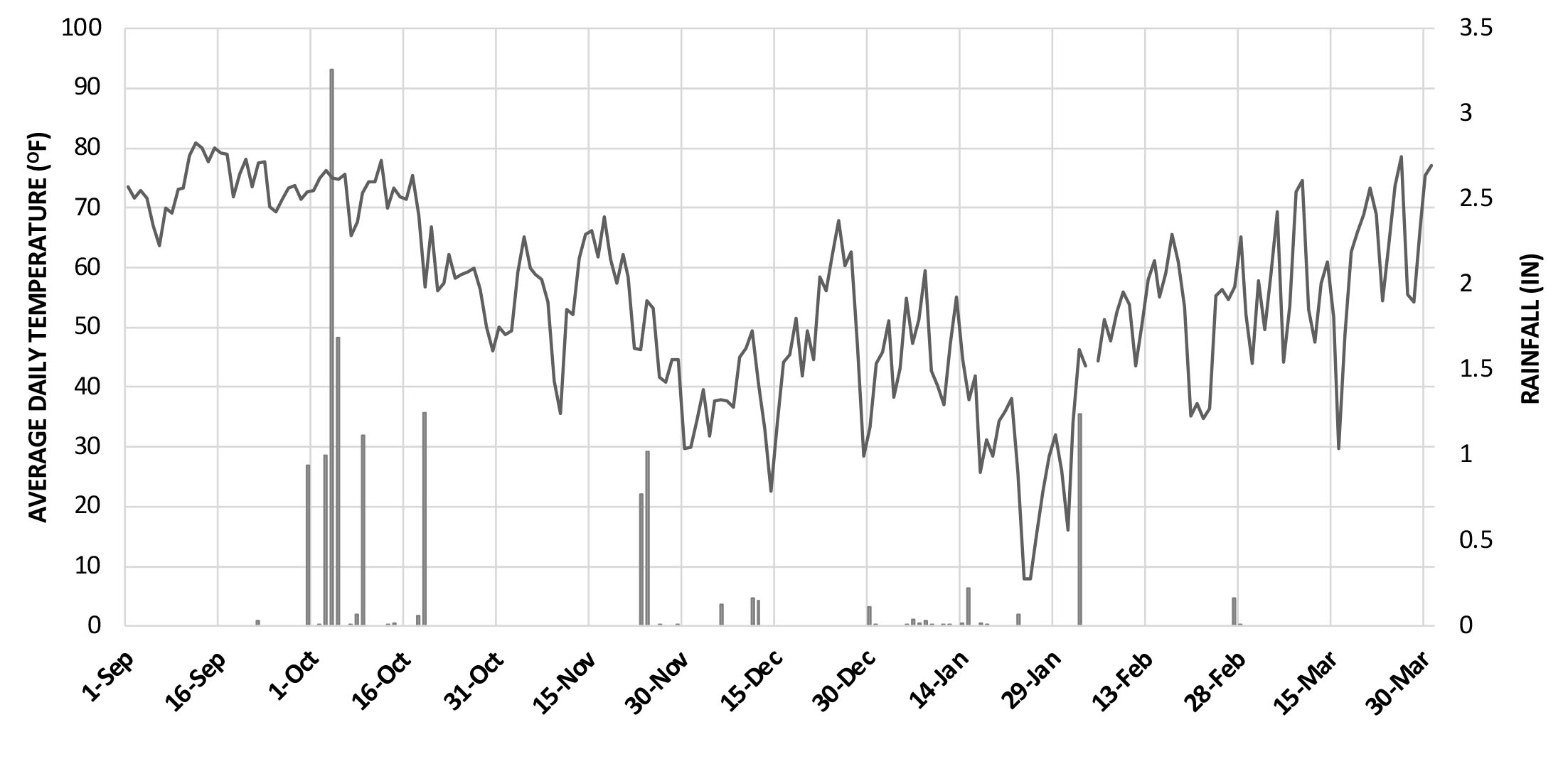 Figure 1. Average daily temperature (line graph) and rainfall (bar chart) from September 1, 2025 to March 31, 2026, at Stillwater, OK. Weather data courtesy Oklahoma Mesonet.
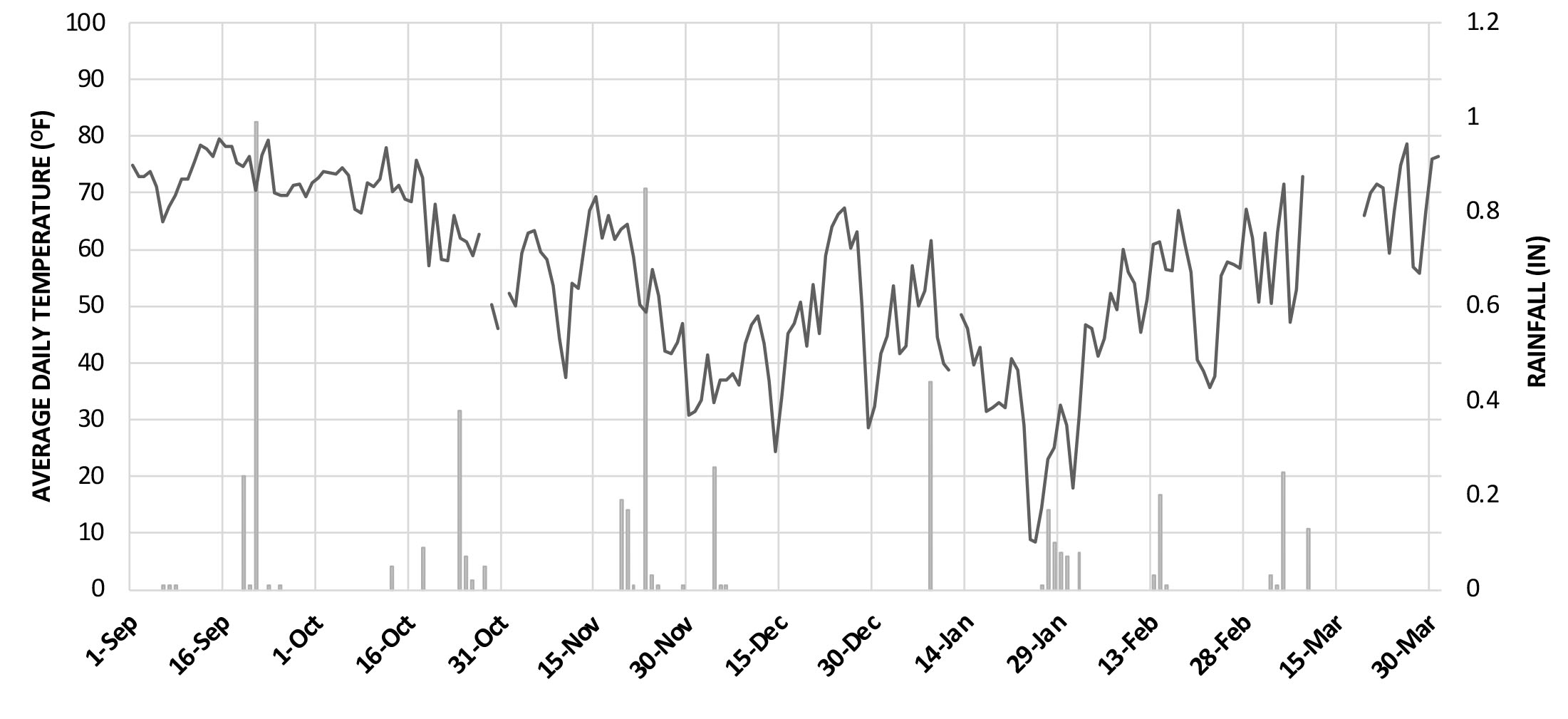 Figure 2. Average daily temperature (line graph) and rainfall (bar chart) from September 1, 2025 to March 31, 2026, at Chickasha, OK. Weather data courtesy Oklahoma Mesonet.
A randomized complete block design with four replications was used at each site. Plots at each location were established in a conventionally tilled seedbed. At planting, 5 gal/acre of 10-34-0 was applied in seed furrow at Stillwater and Chickasha. Due to severe drought conditions at planting, 0.5 inches of irrigation were applied on October 7, 8, 9 and 17 in Stillwater to support seed germination and emergence. The seeding rate at both locations was 120 lbs/acre. Forage was measured by hand clipping two, 1-m by 1-row samples approximately ½ inch above the soil surface from the interior rows within each plot. There was only one forage sampling date at each location (Table 1). All samples were placed in a forced-air dryer after collection for approximately seven days and weighed. Fertility, planting date and forage sampling date information is provided in Table 1.
| City | Planting Date | Sampling Date | pH | nitrate-n (lbs/ac) | STP | STK |
|---|---|---|---|---|---|---|
| Chickasha | 9/25/25 | 12/3/25 | 7.5 | 38 | 37 | 397 |
| Stillwater | 10/10/25 | 12/2/25 | 6.1 | 14 | 50 | 270 |
Notes: STP: soil test P index; STK: soil test K index
The Stillwater trial included both ungrazed and simulated grazed plots, while the Chickasha trial consisted of ungrazed plots only. In the simulated grazing treatment, plants were mowed to a height of 2.5 inches on January 3, 15 and 28, as well as February 10 and 28, March 6 and 12. First hollow stem sampling began at the end of January at both locations and was conducted every three to four days by variety until all varieties reached first hollow stem. Plant samples were collected for each variety by digging an approximately eight-inch section of row and selecting ten plants randomly from this sample. The largest tiller on each plant was split longitudinally, and the hollow stem below the developing grain head was measured. Varieties were considered to be at first hollow stem when the average measurement of the ten plant samples was 1.5 cm (5/8 inch) or greater. For more information on first hollow stem, refer to PSS-2147 First hollow stem: A critical wheat growth stage for dual-purpose producers.
Results
As indicated in Figures 1 and 2, the 2025–2026 fall forage production season was marked by moderate temperatures and extremely low rainfall. The 1-inch irrigation applied shortly after planting the trial in Stillwater helped with crop establishment and enabled the crop to take advantage of the rainfall that arrived later in October. This contributed to the low-moderate level of fall forage production observed in our fields in Stillwater. The average fall forage production at Stillwater was 1,192 lbs/acre, and values ranged from 723 to 1,764 lbs/acre (Table 2). Average forage production at Chickasha was 3038 lbs/acre, and values ranged from 1,542 to 4,233 lbs/acre (Table 3).
| Licensee | Variety | 2025 lbs/dry forage acre | 2-Year lbs/dry forage acre | 3-Year lbs/dry forage acre |
|---|---|---|---|---|
| OGI | Showdown | 1764 | 1664 | 2159 |
| OGI | Paradox | 1648 | 1859 | 2495 |
| Nutrien | Cavalry | 1636 | -- | -- |
| WestBred | WB4445CLP | 1610 | 1591 | -- |
| PlainsGold | Klvari AX | 1459 | 1591 | 2502 |
| OGI | Wyatt | 1441 | 1410 | 1424 |
| OGI | Gallagher | 1414 | -- | -- |
| OGI | Doublestop CL+ | 1394 | -- | -- |
| OGI | Smith's Gold | 1388 | -- | -- |
| AgriPro | AP Tango | 1378 | -- | -- |
| AgriPro | AP Sunbird | 1378 | 1415 | 2076 |
| AgriPro | AP Stocky | 1328 | -- | -- |
| OGI | Orange Blossom CL+ | 1301 | 1492 | 1663 |
| Croplan | CP7599CLP | 1292 | -- | -- |
| WestBred | WB4650 | 1288 | -- | -- |
| Nutrien | Ramsay | 1288 | -- | -- |
| LCS | LCS Turnpike CL+ | 1268 | -- | -- |
| LCS | LCS Gaucho CL+ | 1266 | -- | -- |
| LCS | LCS Highnoon | 1209 | -- | -- |
| Croplan | CP7017AX | 1209 | 1272 | -- |
| OGI | Scab Stryker | 1200 | 1448 | 2025 |
| OGI | OK Corral | 1183 | 1173 | 2042 |
| OGI | High Cotton | 1089 | 1506 | 2087 |
| Nutrien | Milestone | 1047 | -- | -- |
| Croplan | CP 7869 | 1042 | 1013 | -- |
| LCS | LCS Caballero AX | 1009 | -- | -- |
| LCS | LCS Gaucho CL+ | 1266 | -- | -- |
| WestBred | WB4459AX | 931 | -- | -- |
| OGI | Green Hammer | 839 | 1125 | 1959 |
| LCS | LCS Warbird AX | 772 | -- | -- |
| PlainsGold | Sheridan | 723 | 1177 | -- |
| OSU |
Experimentals OK23D89031X | 1247 | -- | -- |
| OSU |
Experimentals OK21DTR1705-91 | 1130 | 1392 | -- |
| PlainsGold |
Experimentals CO19410R | 994 | -- | -- |
| OSU |
Experimentals OK23D89055X | 902 | -- | -- |
| Mean | 1192 | 1409 | 2043 | |
| LSD (0.05) | 421 | 381 | 579 |
Notes: Shaded values are not statistically different from the highest-yielding variety within a column. Double-dashes “--” = data not available.
| Licensee | Variety | 2025 lbs dry forage/acre | 2-Year lbs dry forage/acre | 3-Year lbs dry forage/acre |
|---|---|---|---|---|
| Croplan | CP7017AX | 4233 | 3126 | -- |
| OGI | High Cotton | 4133 | 3371 | 2511 |
| AgriPro | AP Sunbird | 4052 | 3111 | -- |
| OGI | Smith's Gold | 3832 | -- | -- |
| AgriPro | AP Stocky | 3645 | -- | -- |
| AgriPro | AP Tango | 3599 | -- | -- |
| OGI | Orange Blossom CL+ | 3556 | 2866 | -- |
| OGI | OK Corral | 3537 | 2923 | 2324 |
| Nutrien | Milestone | 3517 | -- | -- |
| OGI | Green Hammer | 3225 | 2755 | 2089 |
| OGI | Showdown | 3167 | 2537 | 1908 |
| Nutrien | Cavalry | 2988 | -- | -- |
| PlainsGold | Klvari AX | 2975 | 2692 | 2080 |
| LCS | LCS Gaucho CL+ | 2879 | -- | -- |
| OGI | Wyatt | 2756 | 2566 | -- |
| LCS | LCS Warbird AX | 2752 | -- | -- |
| WestBred | WB4445CLP | 2708 | 2521 | -- |
| LCS | LCS Highnoon | 2413 | -- | -- |
| Nutrien | Ramsay | 2402 | -- | -- |
| WestBred | WB4459AX | 2256 | -- | -- |
| PlainsGold | Sheridan | 2147 | 2194 | -- |
| Croplan | CP7599CLP | 2081 | -- | -- |
| LCS | LCS Cowle AX | 2006 | 2125 | -- |
| WestBred | WB4650 | 1542 | -- | -- |
| OSU |
Experimentals OK21PS821 | 3672 | -- | -- |
| PlainsGold |
Experimentals CO19410R | 3372 | -- | -- |
| OSU |
Experimentals OK21DTR1705-91 | 2570 | 2330 | -- |
| Mean | 3038 | 2701 | 2182 | |
| LSD (0.05) | 1007 | 690 | 439 |
Notes: Shaded values are not statistically different from the highest-yielding variety within a column. Double-dashes “--” = data not available.
First hollow stem data are reported in ‘day of year’ (day) format for the winter wheat varieties in Table 4. To provide a reference, keep in mind that March 1 is day 60. The fall and winter months were characterized by dry conditions in Stillwater with winter temperatures above normal. Supplemental irrigation helped crops to emerge by mid-October (later than usual, but earlier than many places under drought in the state) resulted in good plant development. The average winter wheat first hollow stem date at Stillwater ungrazed plots was day 60 (March 1). This was 17 days earlier than 2025 (March 18), 11 days earlier than 2024 (February 17) and 5 days earlier than the 20-year average (March 6). There was a 14-day difference between the earliest and latest varieties at Stillwater compared to an 18-day difference in 2025, and 21-day difference in 2024. The average winter wheat first hollow stem date for the Chickasha location was 57 (Feb 26), this was 14 days earlier than 2025 (Mar 12), 1 day earlier than 2024 (Feb 27) and 10 days earlier than the 20-year average (March 6). There was a 14-day difference between the earliest and latest varieties at this location, compared to a 14-day difference in 2025 and 13-day difference in 2024.
| Licensee | Variety | Non-grazed day of year | Stillwater Grazed day of year | Chickasha Non-grazed day of year |
|---|---|---|---|---|
| OGI | Doublestop CL+ | 68 | 71 | -- |
| Nutrien | Ramsay | 68 | 68 | 64 |
| LCS | LCS Warbird AX | 64 | 64 | 64 |
| LCS | LCS Highnoon | 64 | 64 | 61 |
| PlainsGold | Sheridan | 64 | 68 | 64 |
| WestBred | WB4459AX | 64 | 64 | 61 |
| OGI | Showdown | 61 | 61 | 54 |
| OGI | High Cotton | 61 | 64 | 50 |
| OGI | Paradox | 61 | 64 | -- |
| AgriPro | AP Tango | 61 | 68 | 54 |
| Croplan | CP7017AX | 61 | 64 | 54 |
| Croplan | CP7599CLP | 61 | 61 | 61 |
| Croplan | CP7869 | 61 | 64 | -- |
| Nutrien | Milestone | 61 | 64 | 54 |
| LCS | LCS Cowle AX | 61 | 64 | 61 |
| LCS | LCS Turnpike CL+ | 61 | 61 | -- |
| LCS | LCS Gaucho CL+ | 61 | 61 | 61 |
| WestBred | WB4445CLP | 61 | 64 | 61 |
| OGI | Wyatt | 61 | 64 | 61 |
| OGI | Gallagher | 57 | 61 | -- |
| OGI | Smith's Gold | 57 | 61 | 50 |
| OGI | Orange Blossom CL+ | 57 | 61 | 50 |
| OGI | OK Corral | 57 | 61 | 50 |
| AgriPro | AP Stocky | 57 | 64 | 61 |
| AgriPro | AP Sunbird | 57 | 61 | 57 |
| Nutrien | Cavalry | 57 | 68 | 57 |
| LCS | LCS Caballero AX | 57 | 64 | -- |
| PlainsGold | Klvari AX | 57 | 61 | 50 |
| WestBred | WB4650 | 57 | 61 | 54 |
| OGI | Green Hammer | 54 | 64 | 50 |
| OGI | Scab Stryker | 54 | 61 | -- |
| OSU |
Experimental OK21PS821 | 64 | 64 | 61 |
| PlainsGold |
Experimental CO19410R | 64 | 68 | 64 |
| OSU |
Experimental OK21DTR1705-91 | 61 | 64 | 61 |
| OSU |
Experimental OK23D89055X | 61 | 61 | -- |
| OSU |
Experimental OK23D89031X | 61 | 61 | -- |
| PlainsGold |
Experimental CO20022RC | 61 | 64 | -- |
| Average | 60 | 64 | 57 |
Notes: Double-dashes “--” = data not available.
Acknowledgments
The authors would like to thank the Oklahoma Wheat Commission and the Oklahoma Wheat Research Foundation for providing partial funding for this research, as well as to undergraduate students and visiting research scholars Juan Bruno Bautista and Ana Sarah Silveira Barbosa for their assistance with forage sampling collection and first hollow stem measurements.
Seed Sources and Abbreviations
- AgriPro = AgriPro|Syngenta Seeds
- AGSECO = AGSECO Inc.
- Croplan = Croplan Seed
- Nutrien = Nutrien Ag Solutions
- LCS = Limagrain Cereal Seeds
- OGI = Oklahoma Genetics Inc.
- OSU = Oklahoma State University
- PlainsGold = PlainsGold Seeds
- WestBred = WestBred Wheat