

Chronic Wasting Disease (CWD) in Oklahoma
Introduction
Chronic wasting disease (CWD) is an always fatal disease that infects deer species, including white-tailed deer (Odocoileus virginianus), mule deer (Odocoileus hemionus) and elk (Cervus canadensis). As of July 2026, CWD has been confirmed in 37 states, six Canadian provinces (in-cluding the Toronto Zoo), Finland, Korea, Norway and Sweden. CWD has been detected in several Oklahoma counties, and there are concerns about adverse effects on the deer herd and human health. The Oklahoma Department of Wildlife Conservation (ODWC) provides disease testing services and regulates CWD management in Oklahoma. Hunters should be informed about CWD, as they play a critical role in disease surveillance and preventing the spread to new areas.
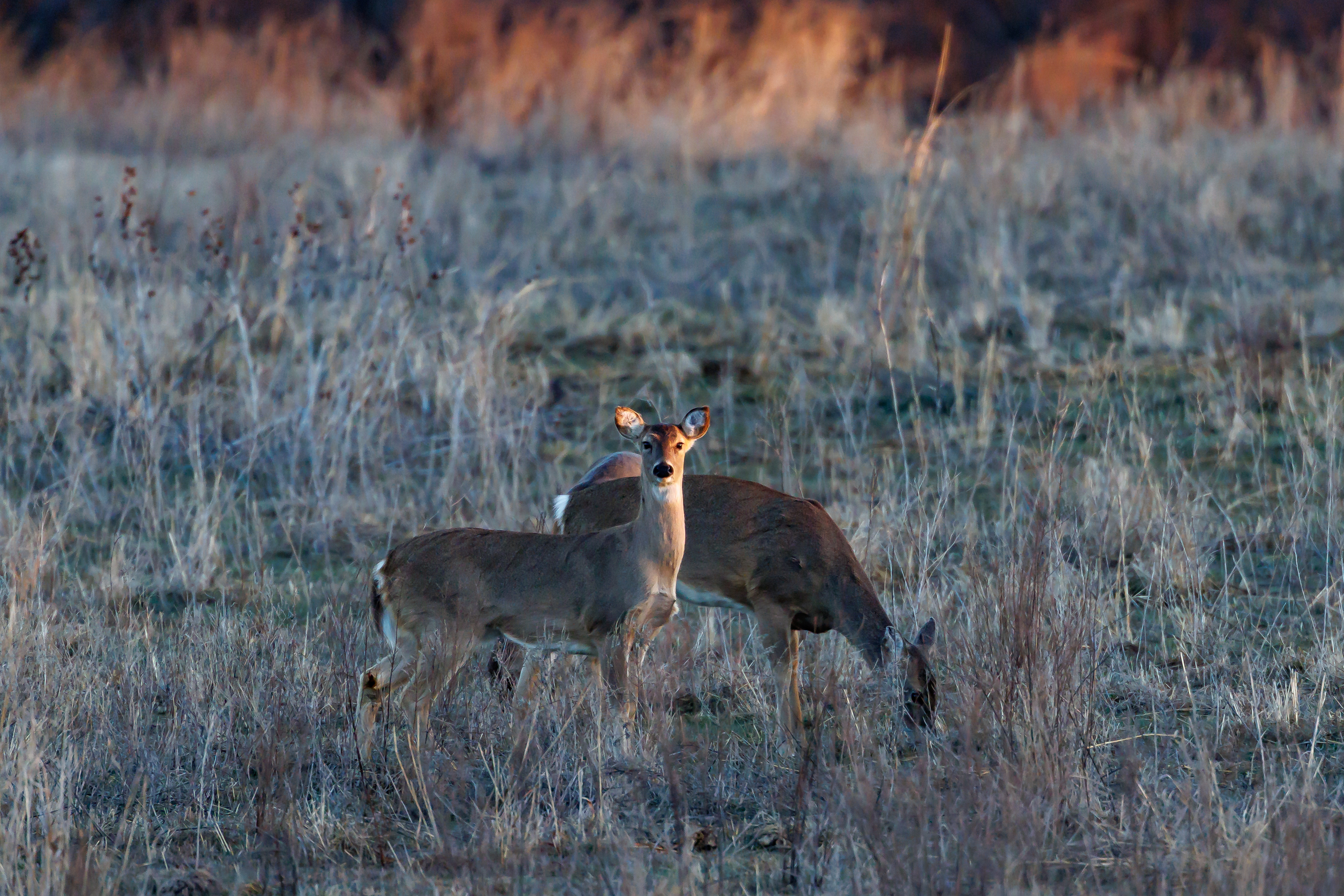 Figure 1. Photo by Mitch Alcala.
What is CWD?
CWD is in a class of diseases called transmissible spongiform encephalopathies, also known as prion diseases. Prions are a type of protein normally found in many cells, but they can misfold and cause disease. CWD is caused by misfolded prions that accumulate and eventually damage tissues in the brain and lymphatic system. Other prion diseases include Bovine Spongiform Encephalopathy (BSE; sometimes called Mad Cow Disease), which can infect cattle, Scrapie, which can infect sheep and Creutzfeldt-Jakob Disease, which infects humans. Importantly, there is no vaccine or cure for CWD, and it is 100% fatal to all deer and elk. As such, CWD is viewed by the majority of wildlife professionals as one of the most serious long-term threats to deer and elk populations.
Deer infected with CWD often do not display any signs of disease until later stages of disease progression, as the disease incubates for 18-24 months. Most CWD-infected animals will appear normal during the incubation period, and they will begin to lose weight and wariness later in disease progression. After being infected, deer are much more susceptible to mortality from other sources, including hunter harvest, predation and vehicle collisions (Krumm et al. 2005, DeVivo et al. 2017). Although many deer infected with CWD will die of another source before they succumb to CWD, the disease strongly decreases their survival and will eventually lead to their death.
CWD spreads between deer through contact with infected prions. Exposure can occur through contact with infected deer or exposure to body fluids (such as saliva, urine or blood) of infected deer. One of the largest problems with CWD management is that prions can persist in the environment. Infected animals shed prions while alive through urination and defecation, and these prions stay in the environment for years. Even if all infected deer are removed from an area, deer that move into the area several years later can become infected with CWD through prions remaining in the environment (Miller et al. 2004). Given the current scientific understanding of the disease, it appears that CWD is extremely difficult, if not impossible, to eradicate from an area because of prion persistence in the environment. The best way to prevent negative impacts from CWD in areas where the disease is currently not present is to eliminate the movement of infected deer or deer parts. Although infected deer may travel out of CWD-infected areas, it is likely that much of the disease spreading to new areas happens through the movement of infected deer (living and dead) out of CWD-infected areas by people.
The primary and only definitive method of CWD testing is post-mortem laboratory examination of the lymph nodes or brain. Most state agencies (including ODWC) collect retropharyngeal lymph nodes from harvested deer for testing; these lymph nodes are located near the windpipe at the base of the neck. Work is ongoing to develop other testing methods that can be used on live deer, but there are currently no definitive tests for live deer.
Effects on the Deer Population
Several negative effects have been documented in populations where CWD has been present for several years or decades. In an area of Arkansas where CWD prevalence (the percentage of infected individuals) exceeded 25%, the white-tailed deer population was declining by approximately 17% annually (Gaya et al. 2026). CWD-infected mule deer in Wyoming had a survival rate that was over 40% less than that of deer that were not infected, which led to an estimated annual population decline of 21% (DeVivo et al. 2017). Similar effects were found in a white-tailed deer population in Wyoming, where CWD-infected animals were 4.5 times more likely to die each year than animals without CWD, and the population was declining by over 10% annually (Edmunds et al. 2016). In Colorado, elk survival declined following increased CWD prevalence, and population declines were expected after more than 13% of elk in the population were CWD-positive (Monello et al. 2014). It is important to note that CWD can be present in an area with relatively low prevalence rates for years before prevalence reaches a point where the population is negatively impacted.
Another negative effect of CWD on deer populations relative to common hunter objectives is the decreased male age structure. CWD prevalence is usually greater in males than in females, which can lead to a decrease in the average age of males available for harvest by hunters. Managers with objectives to produce larger-antlered, mature males for harvest are likely to have problems meeting those objectives where CWD is present because of increased male mortality rates.
Human Health Concerns
At this time, there have been no known cases of humans contracting CWD. However, both the Centers for Disease Control and the World Health Organization discourage consumption of CWD-positive venison. Several studies have been conducted on other primate species and mice with inserted human genetics, and there appears to be a species barrier that reduces human risk of contracting CWD (Waddell et al. 2018, Race et al. 2019, Race et al. 2022), but a recent study highlights it may not be absolute (Hannaoui et al. 2026). Other studies of long-term human health records in areas where CWD has been present for a long period of time also support the limited likelihood of previous CWD transmission to humans (Waddell et al. 2018). However, prion diseases (such as Creutzfeldt-Jakob Disease) exist in humans, and there have been cases of humans contracting a prion disease following consumption of meat from cattle infected with BSE. Thus, there are reasons to be cautious about consuming animals that could be infected with CWD, despite evidence for human infection being unlikely.
Hunters should consider having harvested deer tested for CWD, especially if they are in or near areas where CWD has been detected previously. ODWC offers opportunities to provide samples from harvested deer for free testing at several locations near where CWD has been detected. Waiting to consume meat until testing results are provided is recommended. Cooking does not destroy or inactivate infected prions.
Hunters may consider several steps during deer processing to reduce exposure before test results are available. For example, wearing gloves and washing your hands and knives after field dressing is sensible. It is also recommended to debone meat instead of using a bone saw and minimize handling of the brain, spinal tissue and lymph nodes. Finally, soaking processing equipment that is cleaned of all residual tissue for 5 minutes in a 40% bleach solution is effective in inactivating prions.
Genetic Effects
There has recently been increased interest in releasing deer that are “genetically resistant” (or genetically durable) to CWD. It is important to remember that CWD is 100% fatal to all deer and elk. Genetics play a role in disease susceptibility and progression, and some deer with specific genes (such as the G96S allele in white-tailed deer) appear to have a decreased likelihood of contracting CWD. However, deer with these genes can still contract the disease (Jewell et al. 2005, Johnson et al. 2006). Furthermore, these genes may extend the life of deer after they contract CWD, which could lead to greater disease transmission risk compared to deer without the “resistance” gene (Johnson et al. 2006). It is important to consider the potential negatives of “genetically resistant” genes, as deer living for a longer period with CWD is not a desirable outcome to reduce disease spread.
Regardless of the influence of “resistant” genes on individual deer susceptibility, research has demonstrated that management is unable to influence the genetics of free-ranging, wild deer populations. For example, selective harvesting of deer to change genetics to influence antler size is not effective (Draeger et al. 2026). Similarly, releasing farm-raised deer into free-ranging populations is not feasible to change genetics related to average antler size (Demarais et al. 2016). Genetic management of free-ranging deer populations through release is extremely unlikely to be effective given animal movement in and out of the target area, the number of wild deer compared to those being released and the reduced survival of released deer compared to wild deer. Releasing farm-raised deer into the wild is not a recommended practice to reduce the spread of CWD.
How Can Hunters Help?
Hunters play a critical role in detecting and reducing the spread of CWD. Hunting where CWD has been detected is encouraged, and hunters should not be afraid of harvesting deer within CWD-positive areas. Harvesting a CWD-positive deer or elk removes that animal from the landscape and helps with disease management efforts. Maintaining antlerless deer harvest is important in many areas regardless of CWD status, and hunters still serve an important role in maintaining population density after CWD is detected. Hunters should provide samples to their state wildlife agency (ODWC in Oklahoma) for testing, especially if they are in an area where CWD has been detected. Hunters should also report sick deer to ODWC.
Hunters can also take steps to reduce the spread of CWD. Reducing the movement of harvested deer carcasses is important to prevent spreading CWD to new areas, especially when hunting in areas where CWD has been detected. Only deboned meat, hides, antlers and cleaned skulls should be moved out of CWD-detected areas and moving certain animal parts (including the spinal column and brain) out of CWD-detected areas is illegal. Even when hunting in areas where CWD has not been detected, it is best to avoid moving animal parts such as bones, the spinal column, and the brain off the property where the animal was harvested. Deboning the meat near the harvest location is the best practice to reduce CWD spread. Proper disposal of the high-risk parts of harvested deer (including the brain, eyes, spleen and backbone) is a crucial step in battling this disease.
Reducing or eliminating wildlife feeding and baiting can also help reduce the spread of CWD. Providing deer with supplemental feed or bait increases their exposure risk by making them more likely to encounter infected deer or body fluids from infected deer. Deer feeders and mineral licks both can harbor infected prions, and deer exposure risk is greater at feed sites than in food plots or while feeding on natural forages (Plummer et al. 2018, Huang et al. 2025).
Conclusion
There is an extensive amount of misinformation available on CWD effects on deer, deer hunting and human health. Deer populations are negatively influenced by CWD after the disease is established, but hunters can play an important role in reducing the spread of CWD to new areas. Hunters should follow regulations and best management practices to prevent disease spread, and they should also be aware of the current understanding of human health risks.
References
Information on the distribution of CWD in Oklahoma can be found onOklahoma Department of Wildlife Conservation
Information on the distribution of CWD across North America can be found on Chronic Waste Disease Alliance
Additional information on CWD can be found on National Deer Association’s CWD Resource Center
Demarais, S., B. K. Strickland, S. L. Webb, T. Smith, and C. McDonald. 2016. Simulated effects of releasing pen-raised deer into the wild to alter population-level antler size. Wildlife Society Bulletin 40:41–49.
DeVivo, M. T., D. R. Edmunds, M. J. Kauffman, B. A. Schumaker, J. Binfet, T. J. Kreeger, B. J. Richards, H. M. Schätzl, and T. E. Cornish. 2017. Endemic chronic wasting disease causes mule deer population decline in Wyoming. PLoS ONE 12:e0186512.
Draeger, D. A., C. A. DeYoung, M. Ohnishi, D. Navarro, R. W. DeYoung, B. K. Strickland, D. B. Wester, A. T. Cain, and D. G. Hewitt. 2026. Effects of selective harvest on antler size of white-tailed deer in Texas, USA. Wildlife Monographs 222:e70013.
Edmunds, D. R., M. J. Kauffman, B. A. Schumaker, F. G. Lindzey, W. E. Cook, T. J. Kreeger, R. G. Grogan, and T. E. Cornish. 2016. Chronic wasting disease drives population decline of white-tailed deer. PLoS ONE 11:e0161127.
Gaya, H. E., M. H. Jorge, L. A. Jorge, M. G. Ruder, G. J. D’Angelo., R. B. Chandler, and M. J. Chamberlain. 2026. White-tailed deer population declines in a high-prevalence chronic wasting disease region of Arkansas, USA. PLoS ONE 21: e0340070.
Hannaoui, S., S. Pritzkow, W. M. Jürgens-Wemheuer, D. Motzkus, J. H. Wälzlein, K. A. Schwenke, Y. C. Cheng, H. A. Hassan, I. Zemlyankina, K. Drever, M. Beekes, W. J. Schulz-Schaeffer, C. Stahl-Hennig, S. Gilch, C. Soto, S. Czub, and H. M. Schätzl. 2026. Limited transmission of cervid prions to nonhuman primates provides insights into the zoonotic potential of chronic wasting disease. Science Advances 12:eaeb7613.
Huang, M. H. J., S. Demarais, M. D. Schwabenlander, B. K. Strickland, K. C. VerCauteren, W. T. McKinley, G. Rowden, C. C. V. Tib-bitts, S. C. Gresch, S. S. Lichtenberg, T. M. Wolf, and P. A. Larsen. 2025. Chronic wasting disease prions on deer feeders and wildlife visitation to deer feeding areas. Journal of Wildlife Management 89:e70000.
Jewell, J. E., M. M. Conner, L. L. Wolfe, M. W. Miller, and E. S. Williams. 2005. Low frequency of PrP genotype 225SF among free-ranging mule deer with chronic wasting disease. Journal of General Virology 86:2127–2134.
Johnson, C., J. Johnson, J. P. Vanderloo, D. Keane, J. M. Aiken, and D. McKenzie. 2006. Prion protein polymorphisms in white-tailed deer influence susceptibility to chronic wasting disease. Journal of General Virology 87:2109–2114.
Krumm, C. E., M. M. Conner, and M. W. Miller. 2005. Relative vulnerability of chronic wasting disease infected mule deer to vehicle collisions. Journal of Wildlife Diseases 41:503–511.
Miller, M. W., E. S. Williams, N. T. Hobbs, and L. L. Wolfe. 2004. Environmental sources of prion transmission in mule deer. Emerging Infectious Diseases 10:1003–1006.
Plummer, I. H., C. J. Johnson, A. R. Chesney, J. A. Pedersen, and M. D. Samuel. 2018. Mineral licks as environmental reservoirs of chronic wasting disease prions. PLoS ONE 13:e0196745.
Race, B., C. Baune, K. Williams, J. F. Striebel, A. G. Hughson, and B. Chesebro. 2022. Second passage experiments of chronic wasting disease in transgenic mice overexpressing human prion protein. Veterinary Research 53:111.
Race, B., K. Williams, and B. Chesebro. 2019. Transmission studies of chronic wasting disease to transgenic mice overexpressing human prion protein using the RT-QuIC assay. Veterinary Research 50:6.
Waddell, L., J. Greig, M. Mascarenhas, A. Otten, T. Corrin, and K. Hierlihy. 2018. Current evidence on the transmissibility of chronic wasting disease prions to humans- A systematic review. Transboundary and Emerging Diseases 65:37–49.