

Automatic Pneumatic Cutter
Introduction
There are numerous applications for an automated cutting device for food and agricultural products. For example, an extruder making chewing gum extrudes a gum “rope” through a die. A die-mounted cutter divides the rope into pieces. In many cases where cutters are mated to extruders, the speed of the cutter is matched to the discharge rate to obtain the desired piece size. If the cutter speed is not matched to the extruder discharge rate, the pieces may not be cut to the desired length. The purpose of this fact sheet is to describe a low-cost, automated, pneumatic, cut-to-length device, or cutter, that can be used for food and agricultural products.
Figure 1 shows an example of an automated cutter installed in a temporary framework for testing and demonstration. Product is manually fed to the cutter through a short length of plastic tubing. The cutter uses a pneumatic proximity switch (model 1022, Clippard Instrument Lab Inc., Cincinnati, Ohio) to detect the presence of the product. When the product is detected, a cutting sequence is initiated. Because the proximity switch activates the cutter, the cut piece length is uniform, regardless of the feed rate (within system limitations). The system only requires compressed air to operate, is simple, fast and rugged.
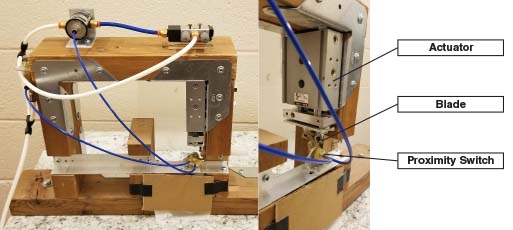
Figure 1. Prototype of a low-cost, automated, pneumatic cut-to-length device (cutter) installed in a temporary wooden framework. Left image shows side view. Right image shows the cutting blade, actuator and proximity switch (proximity switch is the brass component with compressed air supply and return). Note: guard removed for photo.
Components
The components of the pneumatic cut-to-length device are listed in Table 1, along with their description and source. Figure 2 is a diagram of the cutter showing the components listed in Table 1 and connections. Component substitutions are encouraged. Alternative pneumatic and electrical valves, actuators and sensors are widely available. For example, an electrical proximity sensor and valve may be substituted for the pneumatic proximity sensor and air signal amplifier. Merit of substitutions should be evaluated for each application. In the case of substituting electrical components, complexity of the system may increase (power supply, wiring, fuses, etc.), new wash-down issues may surface, and considerations for explosion-proof installations could be required.
Assembly and Mounting
A pneumatic cut-to-length device can be installed on a convenient support structure. The example installation shown in Figure 1 makes use of a wood frame. The wood frame is a quick and inexpensive option for prototyping. Important issues to address for a permanent support structure include:
- Structural support for the cutting device (blade mounted on pneumatic piston)
- Adjustable mount for the proximity sensor (assuming variable cut-piece length)
- Mounting space for other components
- Product infeed and discharge
- Safety shields
- Lockout device
- Cleaning and sanitizing
- Maintenance activities
Safety
Safety features are important to protect operators and other personnel from injury. Safety shields are required to prevent contact with moving components. A lockout device is necessary to block and bleed air pressure to the system while it is offline or undergoing service. The lockout device described in Table 1 and shown in Figure 2 blocks compressed air flow when the safety guard is removed. A separate lockout device (not shown or described) is included at the compressed air pressure regulator/filter. Operators should be trained and evaluated in safe operation methods for the device, including lockout-tagout procedures. The device should be routinely inspected for safety and mechanical issues with monitored follow-through on corrections.
Table 1. Components of pneumatic cut-to-length device.
| Item | Qty | Part# | Description | Source |
|---|---|---|---|---|
| 1 | 1 | MMA-41PAS | 5 port, 4-way, single pilot air actuated valve | Clippard Instrument Laboratory, Inc. |
| 2 | 1 | 1022 | Proximity Switch, non-contact | Clippard Instrument Laboratory, Inc. |
| 3 | 1 | MAR-1 | Pressure regulator 10-32 threaded ports, 10 to 20 psig | Clippard Instrument Laboratory, Inc. |
| 4 | 1 | MJV-2 | 2-way valve, 1/8" ports, normally closed (safety valve) | Clippard Instrument Laboratory, Inc. |
| 5 | 1 | MJV-2 | 3-way amplifier | Clippard Instrument Laboratory, Inc. |
| 6 | 1 | CXSL25-20 | Dual rod cylinder actuator | SMC Corporation of America |
| 7 | 1 | 5648K25 | Poly tubing ¼” OD, 25’ | McMaster-Carr |
| 8 | 1 | 5648K22 | Poly tubing 1/8” OD, 25’ | McMaster-Carr |
| 9 | 9 | 51235K107 | Push to connect fitting 1/4" tube x 1/8" universal pipe thread | McMaster-Carr |
| 10 | 2 | 5779K241 | Push-to-connect fitting 1/8" OD tube x 10-32 thread | McMaster-Carr |
| 11 | 1 | 5779K246 | Push-to-connect fitting 1/4" OD tube x 10-32 thread | McMaster-Carr |
| 12 | 1 | 545K61 | Low pressure barbed fitting 1/16" ID tube x 10-32 UNF male (10-pack) | McMaster-Carr |
| 13 | 2 | 4427K81 | Poly muffer, 1/8" NPT male | McMaster-Carr |
| 14 | 2 | 5779K34 | Push-to-connect fitting tee, 1/4" OD tube | McMaster-Carr |
| 15 | 1 | 4970A2 | Steel utility knife blade (for retractable-style knife) | McMaster-Carr |
| 16 | Lot | NA | Mounting hardware and support structure, not detailed | NA |

Figure 2. Diagram of the pneumatic cut-to-length device (cutter) showing the components listed in Table 1 and connections (proximity switch drawing from Clippard Instrument Laboratory Inc.).
Installation and Use Tips
This section lists tips for installation and use of the cutter. Tips are listed in no particular order.
- An air pressure filter/regulator is required for pneumatic components.
- Air discharged from the proximity switch contacts the product. For sensitive applications like food, a clean, oil-free compressed air supply is required.
- Permanent, supporting framework should be designed with cleaning and maintenance in mind. Frequent disassembly may be needed. Surfaces should be smooth and self-draining. Internal angles should be rounded to at least ¼” radii. Hollow spaces and niches (cracks, seams, gaps, threads, etc.) that can accumulate soils should be eliminated.
- Texture of product – the cut will be cleaner for harder products, since softer products tend to bend with impact of the cutting blade.
- Support of product – softer products should be supported using a tube or similar structure near the point of cutting.
- Minimize the stroke length of the blade to increase cutting cycle speed.
- Cutting tests using a force gauge will guide actuator specification.
- Blade rotation can be managed with a dual-rail or dual-piston actuator.
- Oil-free components and compressed air are convenient for food applications.
- Cycle time of the system depends on components and may be estimated. The air amplifier valve has a 10 ms response time (Clippard Instrument Laboratory Inc., 2020) and the cylinder piston moves at up to 800 mm/s (SMC Corporation of America, 2020).
Conclusion
A low-cost, automated, pneumatic cut-to-length device, or cutter, for food and agricultural products is described in this fact sheet. The design of the device is simple, rugged and rapid to implement. A complete list of parts is provided, along with a diagram and photos of a prototype. Tips for construction and use of the cutter are given. You also can view the automatic pneumatic cutter in action. If you have questions or need additional information on the design/implementation of an automated cutter, please e-mail fapc@okstate.edu.
“Automation applied to an inefficient operation will magnify the inefficiency.” – Bill Gates
“A sharp knife is pointless without precise control.” – Tim Bowser
References
Clippard Instrument Laboratory, Inc. 2020. Full-Line Catalog. Available at: https://clippard.com/downloads/PDF_Documents/Clippard%20Full%20Line%20Catalog, Accessed on May 8, 2020.
McMaster-Carr, 2020. Product catalog. Available at: https://www.mcmaster.com/, Accessed on May 8, 2020.
SMC Corporation of America, 2020. Product catalog. Available at: https://www.smcusa.com/. Accessed on May 8, 2020.