

Update on Pecan Nut Casebearer Activity: Early Monitoring is Key for Successful Control
As we transition into May, it’s time to start thinking about Pecan Nut Casebearer (PNC). Based on observations from the Ag Pest Monitor (Pecan) website, timing for adult activity is starting to occur in southern and central Texas and moving northward, with decision windows approaching in those areas (Fig. 1).
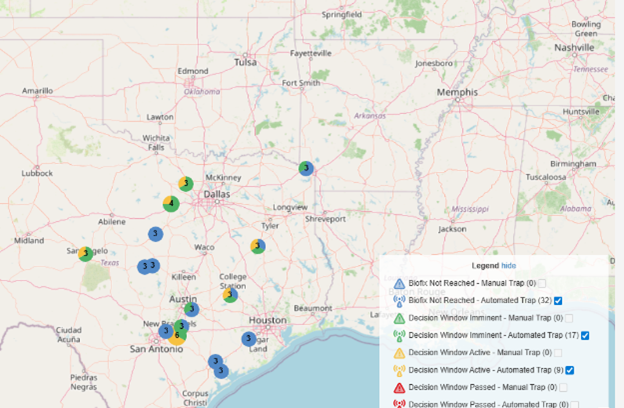 Figure 1. Pecan Nut Casebearer Risk Map. Ag Pest Monitor.
Early season warming (degree day accumulation) has growing conditions ahead of schedule not only in pecan but other crops as well. Crops such as winter wheat are 2-3 weeks ahead of schedule as far as maturity. So, now is the time for Oklahoma pecan growers to get your pheromone traps out for early season monitoring for PNC. This is especially important if you are in the southern portion of the state.
The pecan nut casebearer (PNC), Acrobasis nuxvorella (Neunzig), is one of the most devastating nut-feeding insects that occur in both Native and Improved pecans and is found throughout pecan growing regions. In Oklahoma, adult casebearer moths generally deposit eggs mid-May to early June, depending on the location in the state. Eggs are deposited on the tips of nuts shortly after tree pollination. After hatching, the larvae burrows into the base of the nuts. Each larva may damage an entire cluster (Fig. 2). The primary means of controlling this insect is the use of a well-timed application of insecticide based on infestation levels from each individual orchard.
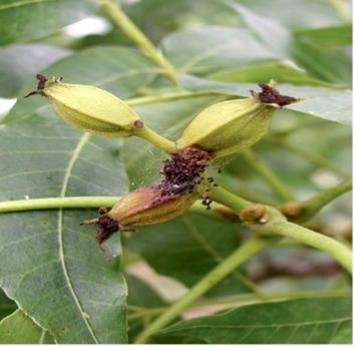 Figure 2. Pecan Cluster Damage. Oklahoma State University.
Description
Adult casebearer moths (Fig. 3) are gray to dark gray, have a dark ridge of scales on the forewings, and are about 1/3 inch in length. In Oklahoma, the pecan nut casebearer completes two to three generations per year. This pest overwinters in the tree. Larvae develop into pupae, and ultimately moths emerge after pollination. Female casebearer moths begin laying eggs on pecan nuts (Fig. 4), resulting in first-generation larvae that feed on pecan nuts and generally cause the most damage.
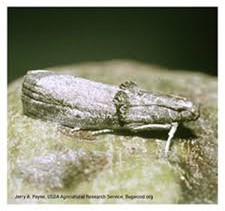
Figure 3. PNC Adult Female. Arbico Organics.
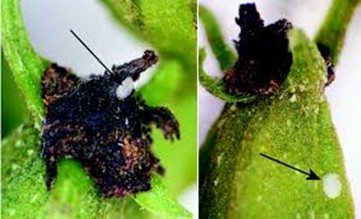 Figure 4. PNC eggs on nutlet. Oklahoma State University.
Second-generation PNC begin appearing ≈ 45 days after first generation, feed primarily on pecan shucks. Unless populations are extremely high, little damage is created from second or third generation larvae. In addition, these generations are usually controlled by other timely seasonal spray applications.
Scouting
Scouting for PNC should begin one to two weeks before potential moth activity in your area.
Pheromone-baited traps for PNC are available. The pheromone (sex attractant) mimics the chemical emitted by female casebearer moths and attracts males to a sticky trap. Trap captures can be used to detect the arrival of PNC activity into an area and provide a signal of when the first significant nut entry by larvae may occur (Fig. 5 and 6).
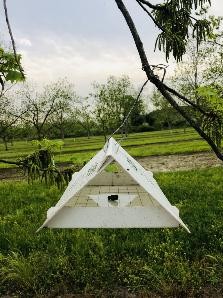
Figures 5.
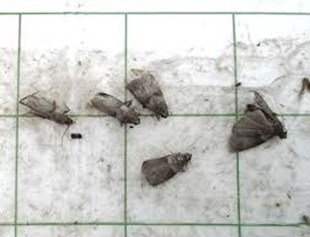 Figure 6. PNC Pheromone trap and captured moths. University of Georgia.
In general, 2-3 pheromone traps are sufficient in determining emergence patterns of PNC moths in a particular orchard or grove. Consider additional traps where orchard conditions vary, such as bottomland versus upland areas. (Get traps out as early as possible after May 1, especially in southern areas of the state, to identify the first flight). With this season’s weather patterns, the earlier the better for monitoring.
Based on university research, we suggest that scouting should begin 7-10 days after two consecutive nights of capture of PNC moth(s) (Biofix). An insect biofix is a specific, observed biological event—such as the first consistent catch of moths in a pheromone trap or a specific plant phenology stage—used as a starting point to track pest development using heat units, or [degree-days]. This key Integrated Pest Management (IPM) tool helps growers accurately time control measures to maximize effectiveness.
Seven to ten days after biofix represents approximately 10 percent of oviposition (egg lay). This allows plenty of time to anticipate the potential first significant nut entry or damage, which should occur 12 to 16 days (50-75% oviposition) after initial moth capture.
Scout regularly. A heavy moth flight may not necessarily translate into a successful and/or heavy oviposition (egg-laying) cycle. In Oklahoma, during the period that mating and subsequent oviposition occurs, moths are exposed to many environmental influences that can affect survival and successful propagation.
Examine 10 nut clusters per tree across several trees. If 2 or more clusters are infested/damaged before 310 clusters have been examined, an insecticide application should be made as soon as possible. If less than two clusters are found infested, sampling should be repeated in two to three days.
Insecticide applications should be properly timed to achieve the best control. Whenever possible, biological insecticides or insect growth regulators (IGR), MoA group 18, should be used for controlling PNC instead of synthetic pyrethroids, carbamates, or organophosphates. The latter materials, while effective, can result in reduction of parasite and predator populations, which help control primary pests.
More information on the pecan nut casebearer and its control can be found at the following OSU Fact Sheets: