

Preparing for Double Crop Corn as Corn Leafhopper Expands Across Oklahoma
Corn leafhoppers were first detected in Oklahoma in 2026 only a couple weeks ago (EPP-26-20). Since the first detection in Caddo County, corn leafhoppers have now been detected in more southwestern counties and into north central Oklahoma counties. This is not surprising given the increasing populations in Texas and the wind events that have helped move them into new locations. Full season corn plantings are currently at tassel and are entering early reproductive stages; data from the last two years suggests that once corn is past the R1/R2 stage that risk for corn stunt disease causing yield loss is low. However, with wheat harvest for the state nearing completion and double-crop planting in progress, there is a concern for double crop and late planted corn. For a review on how to scout for and accurately identify the corn leafhopper, see EPP-26-20.
Corn Stunt Disease
As more corn leafhoppers are collected, OSU’s Row Crop Pathology team led by Dr. Maira Duffeck will be testing the insect for corn stunt pathogens. The corn leafhopper must acquire the corn stunt pathogens from an infected corn plant. Corn stunt symptoms begin to develop approximately 3–4 weeks after the pathogens are transmitted by the corn leafhopper into a corn plant. However, symptom severity and the impact on grain yield can vary considerably depending on the corn hybrid, the corn stunt pathogen transmitted, environmental conditions, and the growth stage at which the plant becomes infected.
Diagnosis of corn stunt disease should be based on a combination of field symptoms, the presence of the insect vector, and laboratory confirmation of the pathogens involved. For corn stunt disease symptomology, see EPP-23-17. Because symptoms may vary depending on the corn hybrid, environmental conditions, plant growth stage at infection, and the pathogen or combination of pathogens present, accurate diagnosis can sometimes be challenging. In addition, since several pathogens usually occur together at the infected plants and produce similar disease symptoms, laboratory testing is necessary to confirm the presence of corn stunt pathogens.
Management Considerations for Reducing Risk
For those planting corn when corn leafhoppers are present or will be present shortly thereafter, an insecticide seed treatment containing Cruiser® Corn 500 or 1250 or Poncho® 500 or 1250 is recommended to reduce risk of corn stunt disease in early vegetative growth stages. Trials from TAMU AgriLife Research and Extension indicate that 500 and 1250 rates of the insecticide seed treatments suppress corn leafhopper adults through V5 and suppress nymphs (or egg laying) at least until V10. The higher 1250 rates of insecticide seed treatment outperformed the lower 500 rates.
Insecticide trials performed by the OSU Extension Cropping Systems team suggest that foliar applications of indoxacarb at 8 - 10 fl. oz./A rate and flupyradifurone at 7 fl. oz./A rate can provide up to 14 days of suppression for corn leafhopper nymphs. Thiamethoxam and lambda-cyhalothrin at 10 fl. oz./A rate provided similar nymph suppression for 14 days. It is important to note that insecticide treatments do not eliminate adults but rather suppresses corn leafhopper populations by reducing reproduction. After insecticide applications you should see reduced reproduction but can still have adults migrating into the field from other locations. This is why scouting not only for adults but also for nymphs is important.
If applying a foliar insecticide prior to tassel, applicators should not use a non-ionic surfactant (NIS) as an adjuvant. An NIS applied pre-tassel, particularly mid to late vegetative stages (V6-VT) can result in arrested ear development which causes “baby” or stunted ears/cobs with reduced or absent kernels, underdeveloped husks, poor or absent silk emergence and reddish/purple leaves (Figure 1). These symptoms can appear like corn stunt disease symptoms; however, confirmation of corn stunt disease pathogens can only be done through molecular testing.
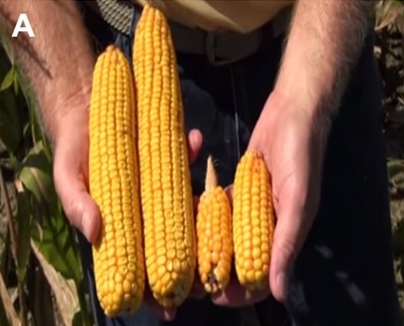 Figure 1a. Comparison of normal ears (left) to ears with arrested ear development.
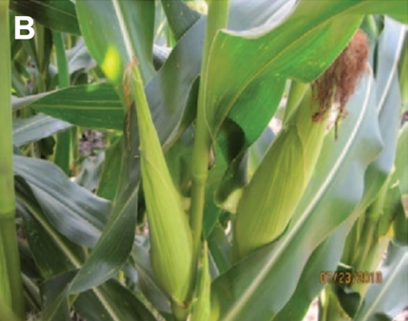 Figure 1b. Husk and silk symptoms of arrested ear development (left ear) compared to normal ear development (right).
 Figure 1c. Purple discoloration in a plant severely affected by arrested ear development.
Figure 1. Examples of damage to corn when a non-ionic (NIS) surfactant has been applied during the V6-VT growth stages. Photo credits to: Cristina Castellano, Kiersten Wise, and Nolan Anderson, University of Kentucky Research and Education Center.
Depending on the corn growth stage at the time of corn leafhopper arrival, multiple insecticide applications may be required to reduce corn stunt disease infection risk. If the corn leafhopper population is not high at the time of initial migration, an edge spray may be an effective option for suppressing corn leafhoppers. When selecting an insecticide, choose one that is not broad-spectrum and that is soft on beneficials to preserve natural control of arthropod pests. Always read and follow the guidelines provided on the insecticide label, as application sites and rates can change. Only apply insecticides when the corn leafhopper is confirmed to be present in the field you are treating. The OSU Cropping Systems Extension Entomology team led by Dr. Ashleigh Faris will be conducting additional insecticide seed treatment and chemical control options this summer to provide more information and potential tools for suppressing the corn leafhopper.