

Peanut Foliar Diseases: Time to Scout Fields and Plan Management Decisions
Frequent rainfall during May and June across western Oklahoma has increased the risk of peanut foliar diseases, particularly Early leaf spot. A simulation using the Leaf Spot Advisor available through the Oklahoma Mesonet indicates that the risk of early leaf spot is currently high for a field planted on May 11 near Fort Cobb.
Although the model recommends making a fungicide application, growers should first scout their fields carefully before spraying. Pay close attention to the lower canopy, where early leaf spot symptoms typically develop first. If no symptoms are found and the forecast calls for several days of dry weather, the first fungicide application may be delayed. Continue monitoring fields regularly, as disease risk can increase rapidly following additional rainfall or extended periods of leaf wetness.
Early leaf spot, caused by the fungus Passalora arachidicola, is the most prevalent and yield-limiting foliar disease affecting peanuts in Oklahoma. Yield loss in the peanut crop is due to necrotic spots reducing the photosynthetic area of the leaves and defoliation of the plants in response to infection. Yield loss is more noticeable when defoliation levels exceed 50% when the disease is not controlled and nearly complete defoliation occurs. Therefore, adequate control of this disease is essential in the production of a high-yielding peanut crop.
Disease Symptoms
Early leaf spot can infect any above-ground part of the peanut plant, but symptoms are most commonly observed on leaves. Depending on environmental conditions and field history, the first symptoms typically appear 30 to 50 days after planting. Initial symptoms are small, brown to black pinpoint spots on the upper leaf surface. As the disease progresses, the lesions enlarge into circular, brown to dark brown spots surrounded by a distinct yellow halo (Figure 1). Mature lesions are typically up to 1/4 inch (6 mm) in diameter. Careful scouting of the lower canopy is important, as symptoms often develop in that area of the plant first before spreading throughout the upper canopy.
Favorable Conditions
The onset and progression of peanut leaf spot are strongly influenced by weather conditions. Disease development is favored by warm temperatures combined with extended periods of high humidity or leaf wetness. These conditions commonly occur following frequent rainfall, prolonged dew, or irrigation that keeps foliage wet for several hours. In Oklahoma, moisture is typically the primary factor limiting leaf spot development during the summer, while cooler temperatures (below 60°F) slow disease progress later in the season. Frequent light irrigation can also increase disease risk by extending periods of leaf wetness and high humidity within the canopy.
Management
An integrated management program that uses cultural practices, genetic resistance and a fungicide program is suggested. Cultural practices will give partial control of Early leaf spot. Rotation of peanuts with other crops and management of peanut residue by tillage, help delay the onset of disease and slow leaf spot development. These practices reduce the level of primary inoculum in the field. Peanut varieties differ in reaction to leaf spot, but levels of resistance in peanut varieties alone are not sufficient to provide adequate disease control. Spanish varieties are most susceptible, Virginia types are intermediate, and runner varieties are partially resistant to the disease.
Oklahoma Peanut Growers
If you haven’t already, now is the time to scout your fields and determine whether a foliar fungicide application is needed. To help growers and stakeholders to take decisions regarding fungicide applications in the peanut fields, a decision support system (DSS) known as Leaf Spot Advisor is available to provide recommendations regarding the best moment for fungicide applications. The advisory calculates the number of hours that are conducive for the development of the disease. Spraying is recommended when 36 “leaf spot hours” have accumulated from either 30 days after planting or 10 days from the last fungicide application. The Leaf Spot Advisory system is currently running on the Mesonet Webpage.
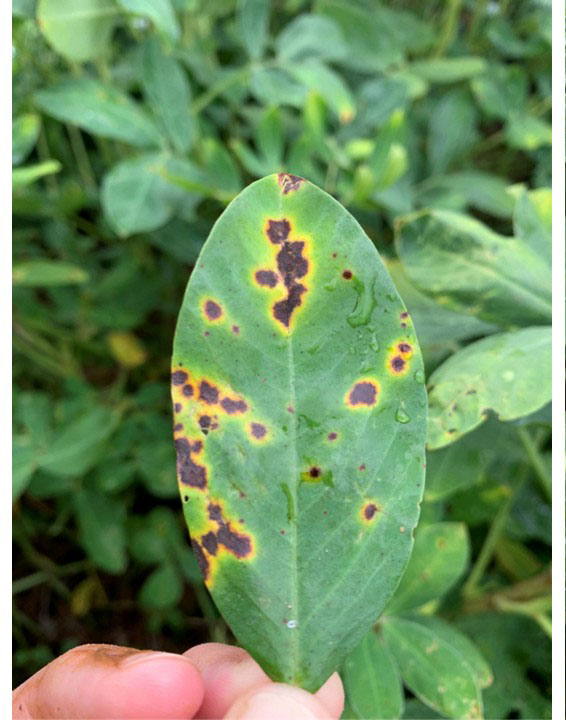 Figure 1a.
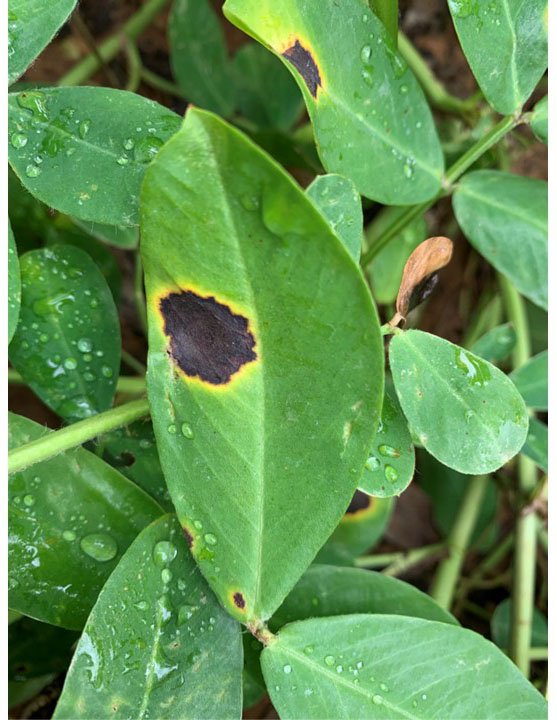 Figure 1b. Early leaf spot symptoms on peanut leaves. Initial lesions appear as small, brown to black pinpoint spots that enlarge into circular, dark brown lesions surrounded by a distinct yellow halo.