

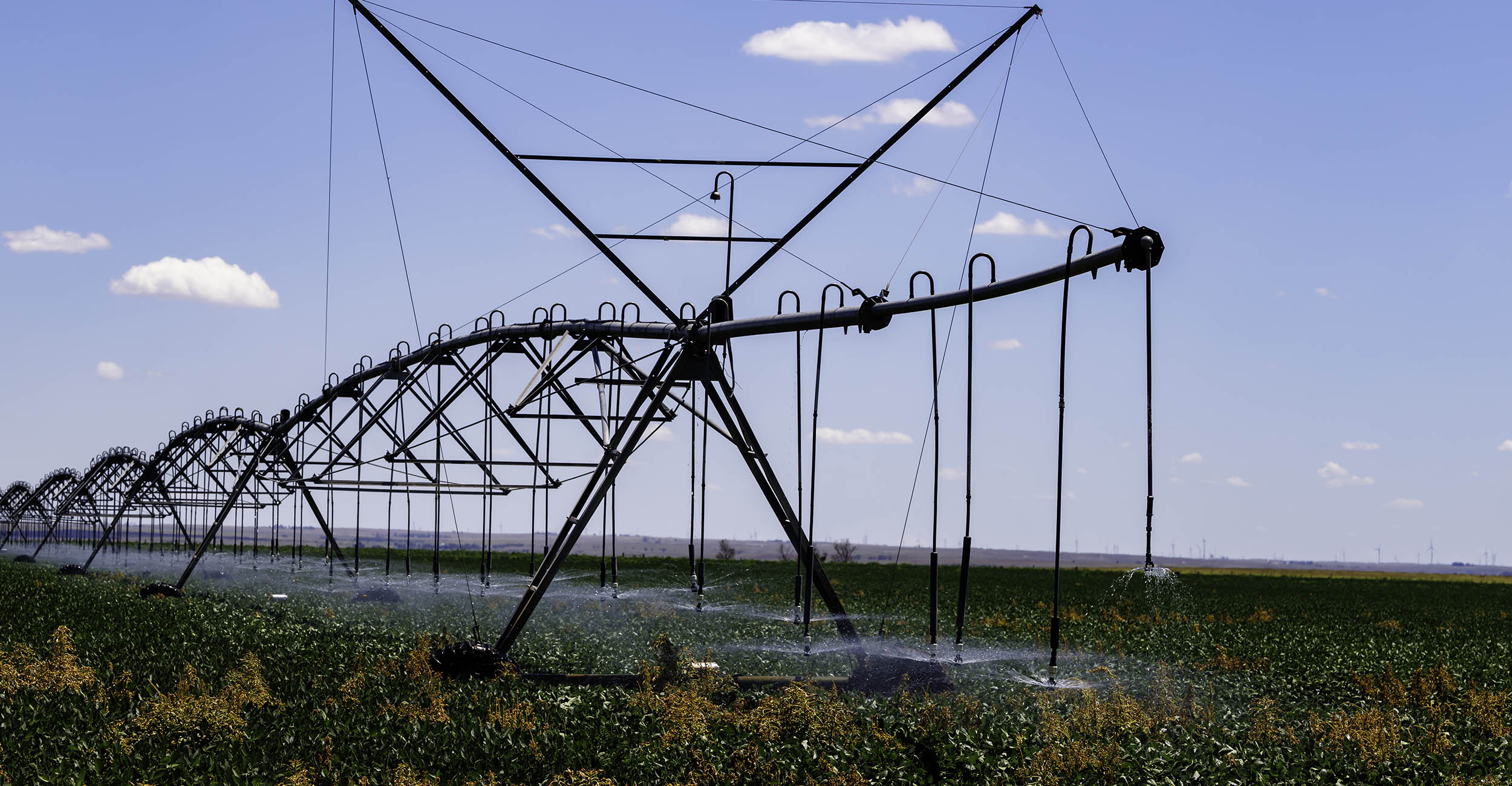
OSU Agriculture programs help Oklahomans protect water resources
Monday, August 24, 2026
Media Contact: Breanna Barker | Oklahoma Water Resources Center | 405-744-5615 | breanna.barker@okstate.edu
From 1998 to 2022, water leaving the Ogallala Aquifer averaged more than twice the amount entering it, according to a 2026 U.S. Geological Survey report, which said that during this time, wells withdrew about 422,000 acre-feet per year compared with 175,000 acre-feet of recharge. The Ogallala Aquifer is the largest underground freshwater system in the United States, covering roughly 174,000 square miles across eight states from South Dakota to Texas and supplying vital water for crops and livestock.
“Conserving the Ogallala Aquifer is imperative to sustaining agricultural production in the High Plains region, which accounts for nearly one-third of U.S. crop and livestock production,” said Dr. Kevin Wagner, director of the Oklahoma Water Resources Center. “Water sustainability is achievable, but it will require farmers to adopt new technologies and innovative approaches.”
From using satellite data to help producers manage water resources more efficiently to offering free private well water screening events, Oklahoma Water Resources Center research and Extension programs equip Oklahomans with the information needed to protect water quality and conserve water.
One such effort, the Satellite-enabled Resilient Ag Project (SatRAP) in the Southern Great Plains, is examining how producers can use new satellite data to manage limited groundwater better while remaining agriculturally productive.
The project began in 2025 and brings together OSU, Kansas State University, Texas Tech University, NASA and other partners. Housed at the Kansas Water Institute at Kansas State University, this project focuses on agricultural systems that depend on the High Plains Aquifer, which includes the Ogallala Aquifer beneath western Oklahoma.
Groundwater levels have declined across the High Plains due to overuse, reduced recharge and other environmental changes. About 85% of the aquifer’s water is used for agriculture.
The team is also evaluating policy and economic impacts of water-smart irrigation, studying the barriers to producers adopting conservation practices and developing improved irrigation scheduling tools. They have been comparing satellite estimates of crop water use with measurements from instrumented field sites in Oklahoma and providing the data to producers through the Oklahoma Agricultural Scientific Irrigation Scheduler, or OASIS.
“Satellite data estimate the movement of water from soil and plants into the atmosphere, a process called evapotranspiration. At the field level, the estimate helps show how much water a crop has used,” said Dr. Sumon Datta, assistant professor in the OSU Department of Biosystems and Agricultural Engineering.
Producers can pair that estimate with soil moisture and local weather data to guide efficient irrigation decisions to conserve water and support productivity, Datta said. Adjusting irrigation amounts according to the crop’s needs can conserve depleting water resources, improve profits by reducing pumping costs and energy use and reduce overwatering to limit the movement of nutrients and agricultural chemicals.
"The Ogallala problem is fundamentally one of accounting," Datta said. "You cannot manage a shared resource that no one is measuring consistently."
Datta said SatRAP can give producers, water districts and state officials a common picture of water use across the region. Consistent measurements could help shift irrigation decisions from habit to evidence.
Testing cover crops in Oklahoma
OSU is a partner in the Southern Great Plains Regenerative Agriculture project, known as RegenAg.
The project, funded by the U.S. Department of Agriculture and led by Texas A&M University, explores the potential of regenerative agricultural practices to enhance sustainability in Southern Great Plains cotton production systems. One aspect is the strategic use of cover crops to improve water and soil quality in northwestern, central and southwestern Oklahoma.
Wagner is evaluating the impacts of regenerative practices on water resources in southwestern Oklahoma. Preliminary results showed that using no-till and cover crops can reduce runoff and retain more water in the fields.
A previous study in the Central High Plains, which evaluated pearl millet and sorghum-sudangrass as a forage cover crop in dryland conditions, showed that a long enough resting period between a field being used for forage and being used for crops, along with significant rainfall, can allow soil to recharge before the next main crop.
Helping rural well owners
The Oklahoma Well Owner Network, an OSU Extension program offered through the Oklahoma Water Resources Center, provides free water screening events and educational sessions for residents who get their water from wells.
The Oklahoma Well Owner Network has tested over 700 well water samples across Oklahoma since 2023. OWON screening events test for nitrates, total dissolved solids, pH and the presence of E. coli.
Dr. Jeff Sadler, OSU Extension water resources specialist, said the program provides residents with information addressing concerns identified through screening. Sadler and the water center staff work together to help well owners understand their results and consider whether additional testing or treatment may be needed.
Using data to guide irrigation
The Oklahoma Master Irrigator Program provides advanced training on irrigation management, irrigation systems and more. Producers learn to use soil moisture sensors, irrigation schedulers and related tools.
"The emphasis is on how to efficiently use precision irrigation technology to make data-driven irrigation decisions," said Sumit Sharma, OSU Extension water irrigation and management specialist.
The 2027 session is planned for Goodwell in January and February, with exact dates to be posted on the program website.
The Testing Ag Performance Solutions (TAPS) program encourages efficient and profitable farm management through farming competitions hosted at an OSU research station during the growing seasons. Participants test and use advanced technologies, services and strategies without financial risk to their operations while competing to be as profitable and efficient as possible in producing a crop.
The current Oklahoma TAPS competition, based in Goodwell, focuses on improving the water-use efficiency of corn production. In the future, the team plans to expand to other crops (such as cotton) in other regions of Oklahoma.
To inquire about any of these water programs, email water@okstate.edu.
Story By: Jemella Zhang | jemella.zhang@okstate.edu