


How an OSU laboratory is helping Oklahoma fight insect pests and plant diseases
Thursday, July 2, 2026
Media Contact: Dean Ruhl | Communications & Media Relations Specialist | 405-744-9152 | dean.ruhl@okstate.edu
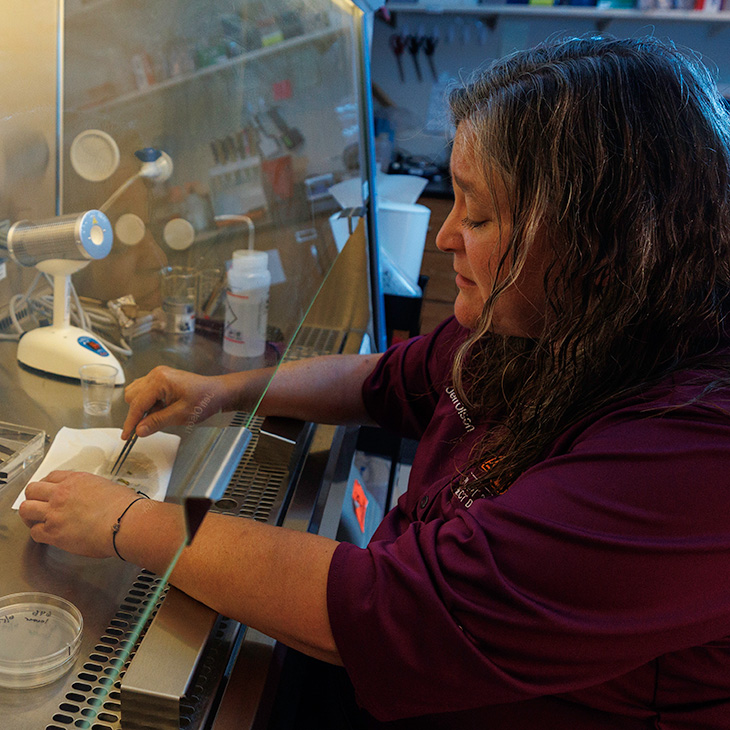
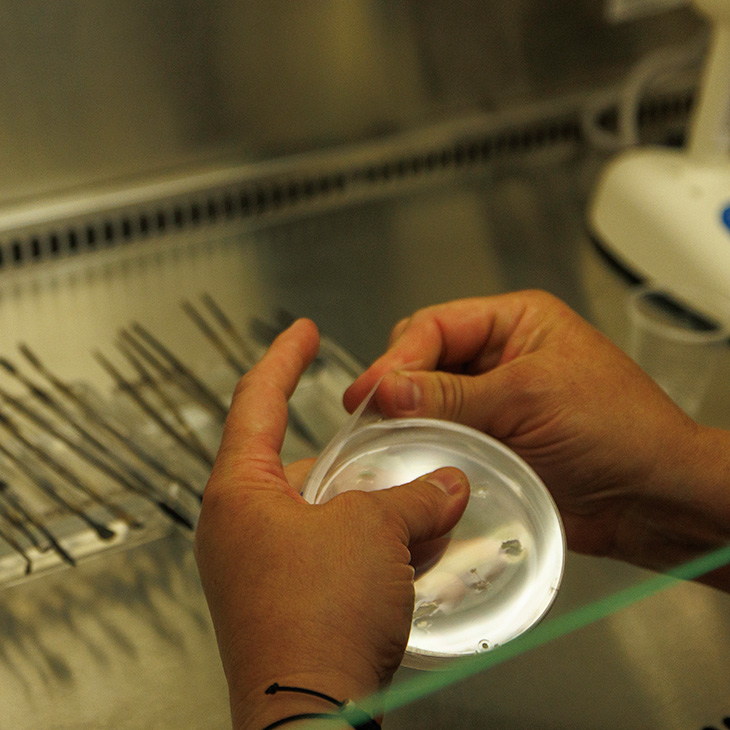
Sitting at her laboratory station, Jen Olson meticulously places the alfalfa segments into the petri dish.
Olson, Oklahoma State University Extension plant disease diagnostician, swivels around in her stool, explaining the process. She doesn’t miss a beat, slowly placing each segment equally around in the dish. In her expertise, this specific plant suffers from root rot, but she wants to run additional testing to verify.
“Hopefully, we can help keep this healthy so the producer can get five more years out of that alfalfa,” Olson said.
This process has been a mainstay in Olson’s life for 18 years. Running tests. Diagnosing problems.
As one of four working at OSU’s Plant Disease and Insect Diagnostic Lab inside the Noble Research Center, Olson’s work focuses on identifying pathogens and working with producers to develop solutions.
As new plant and insect threats emerge throughout Oklahoma — last year alone, the lab identified nine new pathogens in specialty crops — the PDIDL lab can assist producers in all 77 counties, a luxury that some other states do not have.
“We are considered our state’s first line of defense against new and emerging pests and pathogens,” Olson said.
Seen it all
The Plant Disease and Insect Diagnostic Lab has seen its fair share of problems to solve. What started out as a mobile lab in the 1970s has grown into an impactful front-line defense for Oklahoma. The list of successes runs long.
In 2019, an outbreak of Phytophthora ramorum, which causes sudden oak death in several tree species, was detected in the state. The ensuing months saw a massive number of samples sent into the lab. Olson estimates her and two colleagues analyzed more than 2,000 samples in March 2020 alone.
But the hard work paid off.
“It is now considered eradicated from the state,” Olson said.
The successes don’t end there. In 2024, when corn stunt — a disease that causes stunted corn growth — emerged across the country, the laboratory geared up and assisted with testing nationwide.
The team regularly assists with fire ant surveys, required for hay or plants in containers being sent out of the state.
“It can be rewarding when we’re able to help people,” Olson said.
Ready for anything
The expertise bodes well for the laboratory.
As cases of New World screwworm, a parasitic fly that lays eggs into open wounds and feeds off of the living tissue of warm-blooded animals, continue to rise in the United States, the laboratory will again assist.
The laboratory will become a vital step in prevention and treatment.
“It’s critical,” said Jonathan Cammack, OSU Extension livestock entomology and parasitology specialist. “We’ve been doing this for almost a year, receiving potential samples from around the state to identify. Oklahoma is uniquely positioned because we’re the only state in the country that has been allowed to do that.”
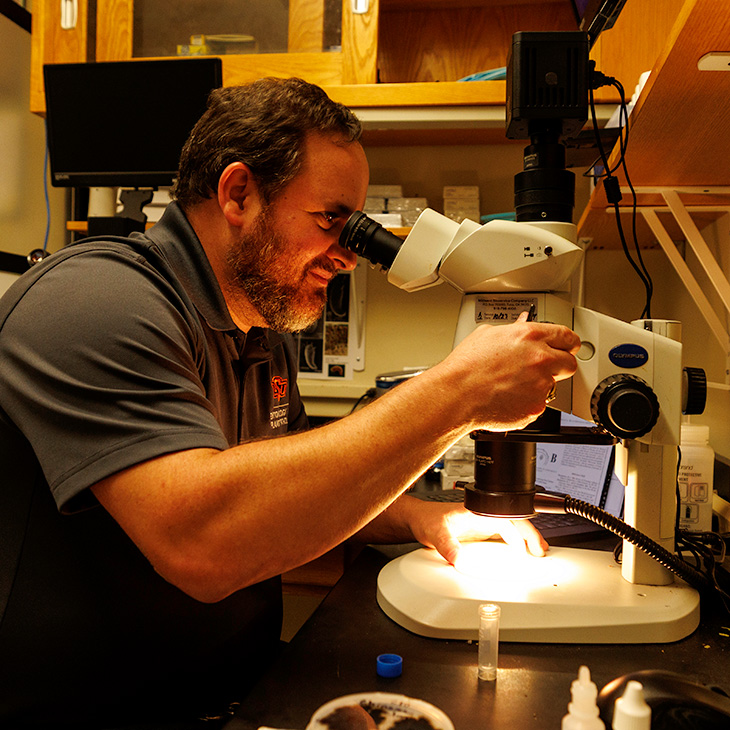
Any specimen suspected of being New World screwworm must automatically be sent to the National Veterinary Service Lab (NVSL) in Ames, Iowa. But the OSU lab is allowed to conduct initial screenings and eliminate non-New World screwworm samples. Any potential positive cases must still be confirmed by the NVSL lab.
The uniqueness doesn’t end there. Cammack, as well as Justin Talley, department head of the OSU Department of Entomology and Plant Pathology, both specialize in this specific group of flies.
“I’ve been working with this group of flies for a little over 20 years,” Cammack said. “Identifying them, studying their biology. Getting to make an impact with my expertise is very rewarding.”
Serving the state
The PDIDL lab is considered the most productive in its region, which includes Oklahoma, Colorado and everything north. Approximately 25% of all the samples in this area come through OSU’s laboratory.
Because of the lab’s specialized molecular testing, 15-20% of its work is conducted for out-of-state clients. The group identified six new pathogens for neighboring states just last year.
“They’ve chosen our lab because we talk to them,” Olson said. “We keep them updated through the process, and if they have questions, they know they can call us. That responsiveness is one of the things that makes people choose our lab.”
The laboratory operates throughout the year, allowing residents and commercial producers to submit samples. Oklahoma residents can submit up to 10 samples per year for no charge through their OSU Extension local county office.
While New World screwworm is not currently in Oklahoma, getting to play a vital role in prevention and early detection is something Cammack and the laboratory team are glad to play for the state.
“It’s good to know that we’re getting these samples in and have the trust of producers around the state and our partners who are sending them here for us to identify,” Cammack said. “Knowing that people across the state count on us to be able to perform that identification is nice, and why we do what we do in Extension.”
And when the next threat arrives, the PDIDL team is prepared to step up again.
“We’re here to support everybody,” Olson said. “We get samples from home gardeners all the way to commercial producers. We help all of them.”