

Ag Insights - June 2026
Thursday, June 4, 2026
Finish Line is Here for Harvest
Josh Bushong, Area Extension Agronomist
Wheat harvest has started! The 2026 Oklahoma wheat crop overall will be short physically and in production. Harvested grain acreage is going to be significantly down in the state, especially in western regions. Sporadic rainfall has resulted in a sporadic crop this season. While there is an increase in unharvested acres, there are some decent farms to be found. Unfortunately, the 40 to 60 bushel farms are outnumbered by the 0 to 20 bushel farms.
A short and thin stand of wheat coupled with a warm March and April has led to summer annual weeds that have grown up the wheat canopy. Harvest aids are rarely used in Oklahoma wheat production systems but can be beneficial since weeds can delay wheat harvest.
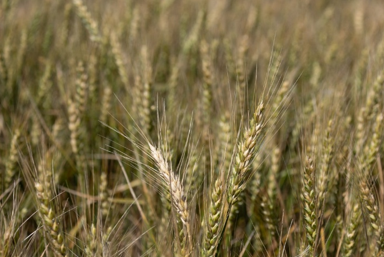
Herbicides used as harvest aids generally need to be applied when the wheat kernels have at least reached the hard dough stage. Appling them too early can result in lighter test weight and reduced grain yields. These products need time to work on the weeds, but there are also pre-harvest intervals that must be followed. Typically, it is between seven and 14 days depending on product.
There are some concerns when determining which harvest aid to use or even if one should be applied. First, consider any crop rotation plans, especially if a double crop is about to be planted. Second, determine if the field is going to be used for seed wheat because some products like glyphosate can potentially reduce seed germination or even impact plant growth.
True Armyworms
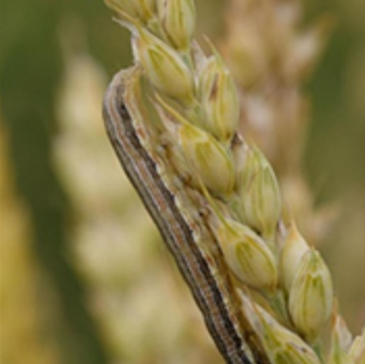
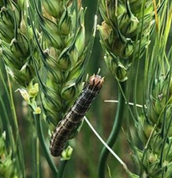
Farmers should continue to monitor fields for pests such as true armyworms. Infestations occur more frequently around waterways, areas of lush growth, or areas with lodged plants. Since armyworms tend to feed at night, it is easier to scout after dusk when activity is higher. Damage ranges from ragged leaf margins to head clipping (usually younger secondary tillers).
Current treatment threshold is 4-5 armyworms per linear foot of row. If wheat is past the soft dough stage, control is not warranted unless obvious head clipping is continued. It is typically not economical to spray if only aw n feeding is occurring past soft dough.
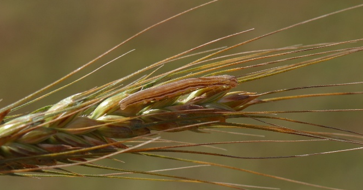
In addition to true armyworms, we have also found wheat head armyworms. The wheat head armyworm typically feed at night and usually worse at the field margins. Scouting after dusk and sampling farther into the field will give a better estimation of the infestation.
The wheat head armyworm can feed on the wheat kernel, which can directly reduce grain yield and increase price discounts. Insect damaged kernels (IDK) is a grain grading factor. If chemical control is warranted for either armyworm, be aware of any pre-harvest interval listed on the product label.
 Wheat Head Armyworm in Oklahoma Wheat
Thankfully there weren’t any major issues with wheat diseases this season. There was a presence of some leaf spotting diseases late spring and some leaf fungal diseases after heads emerged from the flagleaf. Flagleaves mostly stayed clean from strip rust and powdery mildew, but leaf rust started to show up as the kernels started to mature.
Loose smut and common bunt (aka stinky smut) were found in fewer fields throughout the region compared to the past few years. Seed treatments should be used on seed wheat from those farms. Seed treatments can help in many ways, including reduction of root/foot rots, bunt, smut, leaf rust, powdery mildew, hessian fly as well as reduce aphids that can transmit barely yellow dwarf virus.
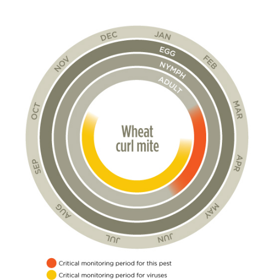
Mite-transmitted diseases (wheat streak mosaic, high plains disease, or Triticum mosaic) were also found throughout the region, but overall damage was limited due to late spring infection. The best management practice would be to prevent a “Green Bridge” prior to sowing the wheat this fall.
A minimum of two weeks of nothing green (including corn, sorghums, volunteer wheat and other grassy weeds) is needed to allow the wheat curl mite to starve out prior to wheat seeding. The wheat curl mite still might vector these viruses when invading from neighboring fields, but the viruses will cause less of an impact due to a later infection.
 It is not too early to start preparing for this fall. Ordering certified seed wheat early is always a good practice to ensure sourcing a desired variety. Cleaning farm-saved seed wheat should decrease weed seed and increase the seed quality, which should assist in better emergence and seedling vigor. Quality of famer-saved seed wheat is largely dependent on the quality before storage and how it was stored. After cleaning, it is recommended to have a germination test conducted.
When selecting a wheat variety be sure to note certain characteristics like multi-year yield data, acidic soil tolerance, high soil temperature germination sensitivity, coleoptile length, forage production potential, pest resistance, recovery after grazing, and first hollow stem date. Using certified seed wheat can also ensure adequate seed quality. Good seed vigor with a known germination percentage will aid in developing early seedling vigor, which will typically lead to producing more fall forage.
Is Forage Production Behind This Spring?
Dana Zook, NW OK Area Livestock Specialist
As I sit down to write this article on May 22nd, most landowners across the state have received some welcome moisture in the last two weeks. This comes upon the heels of a very dry period. In fact, as we finish up wheat tours across the state, many say the crop is at least three weeks ahead of normal. Drought and hot dry winds in the last week have increased the maturity of the wheat, making it soon ready for combines. Growing forages across the state have also been impacted. From the window of my car, I’m assuming that a dry spring paired with hot temperatures has slowed forage growth. But is this the case? With this question in mind, I did a little historical digging to see where we are compared to years past.
Based on the cumulative production report of the Rangeland Analysis Platform (RAP), counties in Northwest Oklahoma are anywhere from 25-40% behind historical forage growth for the year. In native plant communities, 70% of the production occurs before July 1st. Upcoming rain may turn this around but it’s important to note when making plans for grazing. Could this mean we have 25% less forage out there? – maybe…but maybe not. Unfortunately, we are at the mercy of the weather.
That being said, whether baled or grazed, native plant communities are slow to re-grow. Optimal forage utilization within a grazing system requires a balance of early year grazing paired with the ability to stockpile a portion of the forages for grazing in late summer and fall. Turning out too early on green will negatively impact forage production. For this reason, it’s best to be able to utilize several different grazing areas and/or apply a light stocking rate to gain year-round or season long grazing.
So here are the facts: the most recent OK Drought Monitor (5/21/26) noted 99.61% of the state is experiencing some level of drought. By the time this article is out, there will be a drought monitor update hopefully showing some improvement. The coming weeks forecast is favorable for moisture. Obviously, dry conditions across the state impact forage production but if you are in need of assistance looking at your specific operations grazing plan, please let me know! I’m happy to work through the County Extension office to work through a grazing plan. New technologies allow us to make more targeted suggestions with your specific property. Look us up and in the meantime, I’ll be praying for rain!
Cow-Calf Economy in Western Oklahoma
Alberto Amador, West Area Ag Economics Specialist
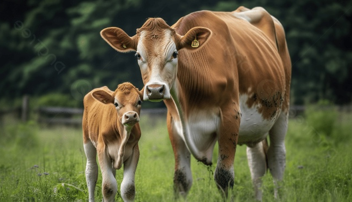
Currently, cattle production is an attractive agricultural business option since crop prices are not at their best level. However, cow-calf operations are facing multiple threats that could impact margins. Although cattle prices are at record highs, production variables and input costs are affected by energy price shocks and drought.
Since the geopolitical conflict in the Middle East, fertilizer’s (Nitrogen) production costs have increased, and fertilizer availability is tight. With higher prices, forage and hay production will be more expensive. Forage represents one of the major costs in a cow-calf operation and its management is crucial for profitable results. In Oklahoma pasture and hay account for approximately 22%-33% of total cost per cow, while fertilizer accounts for 26% to 30% of annual forage production.
From March 12th to the middle of May, Urea’s price has increased 24%, Anhydrous Ammonia by 13%, and UAN 28 and 32 by 24% and 21% respectively. The lack of fertilizers and higher prices are a major issue for forage production. Although the latest USDA cost of production report noted that suppliers in Western Oklahoma have lifted nitrogen fertilizer allocations, drought conditions have reduced the demand for these inputs.
This brings us to the second issue, persistent dryness. During the first half of spring, drought was constant across the Southern Plains. Despite a few April storms, precipitation distribution was unequal across the state. Western Oklahoma was particularly less fortunate, with a significant portion of the region locked into extreme drought (D3) while other areas in the southwest and northwest are facing exceptional drought (D4).By the second week of May, Oklahoma’s drought footprint was 47% severe, 36.5% extreme, and 2.9% exceptional , all these levels above the levels from the same week a year ago.
Naturally, pasture and range conditions are showing the lack of moisture. Compared to the five-year average for the second week of May, the “very poor,” “poor,” and “fair” categories increased by 1%, 13% and 3% respectively, whereas the category “good” fell by 17% and “excellent” dropped by 6%.In simple terms, because these categories reflect the soil’s moisture, these rising percentages in “very poor” and “poor” categories mean deteriorating forage conditions.
Under these circumstances cow-calf operations must be planning a grazing strategy with flexible stocking rates and an efficient maintenance/nutrition program for forage. Grazing as much as possible is better for margins but it’s not always possible, especially in drought conditions. For this reason, checking hay inventories on the farm, planning a grazing calendar, and testing forage quality are crucial. According to the USDA-National Agricultural Statistical Service (NASS), the U.S. hay stocks reported on May 1st are lower than last year. However, Oklahoma reported an increase of 450 thousand tons. This is a good indicator because the major cost of hay is transportation. Therefore, having stocks in the state gives a competitive advantage against the high prices and helps buffer margins.
In brief, high input costs and drought are threatening margins for cow-calf operations and herd expansion. Despite high calf prices could cover the pasture maintenance or hay costs, reducing expenses through good management will mitigate those costs and improve profits. Reviewing forage quality and establishing a grazing plan are crucial for efficient nutrition. Additionally, managing production risk through livestock and forage programs such as Livestock Forage Disaster program, Annual Forage and Pasture, Rangeland, and Forage Insurance, are great tools to protect a cow-calf operation’s profits. While it is important to remember these tools are designed to mitigate losses rather than directly increase profits, they provide the financial safety net providers need to manage through a tough year.
Theileria Orientalis in Oklahoma
Barry Whitworth, DVM
Senior Extension Specialist/BQA State Coordinator, Department of Animal & Food Sciences, Freguson College of Agriculture
Over the past few years, Theileria orientalis has been detected in cattle in Oklahoma. Early cases were primarily diagnosed in adult cattle. However, more recent cases in Oklahoma have been identified in stocker cattle. All cattle producers should be familiar with the clinical signs of this disease and observe their cattle daily for any signs of trouble.
In the United States, the first case of theileriosis was identified in Virginia in August 2017. These cattle exhibited clinical signs of weakness and anemia. An initial diagnosis of anaplasmosis was made. Blood samples from the animals were tested for Anaplasma, Babesia, and Leptospira. Test results were negative for all three; however, a blood protozoan was detected. This organism was identified as T. orientalis genotype Ikeda. Since this initial herd outbreak, the organism has been detected in several states.
Cattle infected with and showing illness from T. orientalis genotype Ikeda may exhibit clinical signs such as fever, weakness, anorexia, and exercise intolerance. If forced to move, affected cattle may stagger and gasp for air. If stressed excessively, they may collapse and die. Upon examination, the gums, eyes, or vaginal mucosa may appear pale (white) or yellow in color. Reproductive losses, including stillbirths and late-term abortions, may occur, along with a reduction in milk production.
Clinical signs reported in adult cattle in Oklahoma include anemia, sudden death, weight loss, abortion, failure to thrive, and failure to calve. In stocker cattle, weight loss, anemia, poor performance, and sudden death have been reported.
Because Anaplasma marginale and T. orientalis genotype Ikeda produce similar clinical signs, distinguishing between the two can be challenging. One notable difference is that clinical signs are more commonly observed in young cattle infected with T. orientalis, whereas this is less common in cattle infected with A. marginale. Additionally, cattle with anaplasmosis often display aggression, whereas those with T. orientalis genotype Ikeda typically do not. A laboratory test is required to definitively differentiate between the two diseases.
Haemaphysalis longicornis has been identified as a possible vector of T. orientalis genotype Ikeda. In 2017, the United States Department of Agriculture’s (USDA) National Veterinary Services Laboratories (NSVL) confirmed the presence of H. longicornis, commonly referred to as the Asian longhorned tick (ALT) or bush tick. In efforts to determine how the tick arrived in the United States, USDA officials discovered it had been present in West Virginia as early as 2010. The tick has now been confirmed in at least 26 states, including Oklahoma. There is also some evidence suggesting additional insect vectors may transmit T. orientalis genotype Ikeda. Needle transfer is another possible route of transmission.

The ALT has been identified in Craig and Mayes counties in Oklahoma. This tick thrives in areas with high humidity, such as wooded regions, brush, or tall grass. Ticks are often found where large numbers of wildlife congregate, such as along deer trails. Producers seeking more information about the ALT can visit the USDA website.
In other countries, treatments have been developed for T. orientalis. Unfortunately, no approved treatments are currently available in the United States, and no vaccines exist for this disease. The best defense is prevention: purchasing cattle free of the organism, avoiding blood transfer between animals, and implementing effective tick control measures. 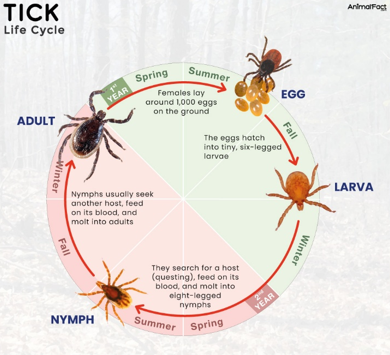 Producers should purchase cattle from reputable sources. Instruments should be cleaned between animals during procedures such as castration or dehorning, and needles should always be changed between animals. External parasites must be controlled using appropriate insecticide treatments. In addition to insecticides, pasture management strategies—such as rotation to avoid wooded or brushy areas where ticks thrive—are important. Patch burning may also help reduce tick populations.
Theileria orientalis remains a concern for some cow/calf and stocker producers in Oklahoma. Producers seeking more information about T. orientalis genotype Ikeda should contact their local veterinarian or Oklahoma State University County Extension Agriculture educator.
References
Hammer, J. F., Emery, D., Bogema, D. R., & Jenkins, C. (2015). Detection of Theileria orientalis genotypes in Haemaphysalis longicornis Ticks from Southern Australia. Parasites & vectors, 8, 229.
Oakes, V. J., Yabsley, M. J., Schwartz, D., LeRoith, T., Bissett, C., Broaddus, C., Schlater, J. L., Todd, S. M., Boes, K. M., Brookhart, M., & Lahmers, K. K. (2019). Theileria orientalis Ikeda Genotype in Cattle, Virginia, USA. Emerging infectious diseases, 25(9), 1653–1659.
Spickler, Anna Rovid. (2019).Theileriosis.
Watts, J. G., Playford, M. C., Hickey, K.L. (2016). Theileria orientalis: A Review, New
Zealand Veterinary Journal, 64:1, 3-9.