

Ag Insights - August 2026
Monday, August 10, 2026
Stockpiling Series Part 1: Consider Stockpiling Bermudagrass to Increase Grazeable Forage This Fall
Dana Zook, NW OK Area Livestock Specialist
Recently, I was asked by a local producer to look up the current annual costs to run a cow. According to a recent analysis by Dr. Dave Lalman, OSU Beef Extension Specialist, average yearly costs were $1348/cow. Of this total, Dr. Lalman reported that feed costs were $684/year, which is 51% of the total budget. This reflects most budgets where feed represents a majority of the costs and is therefore one of the biggest categories to target when moving the needle on efficiency in a cattle operation. Starting this summer, producers who grow bermudagrass have the opportunity to reduce some costs by stockpiling a portion of this forage for late fall grazing. Stockpiling Bermuda is one way to extend the grazing season into November and December to reduce both supplement and hay use. Any opportunity we have to reduce reliance on hay will improve efficiency.
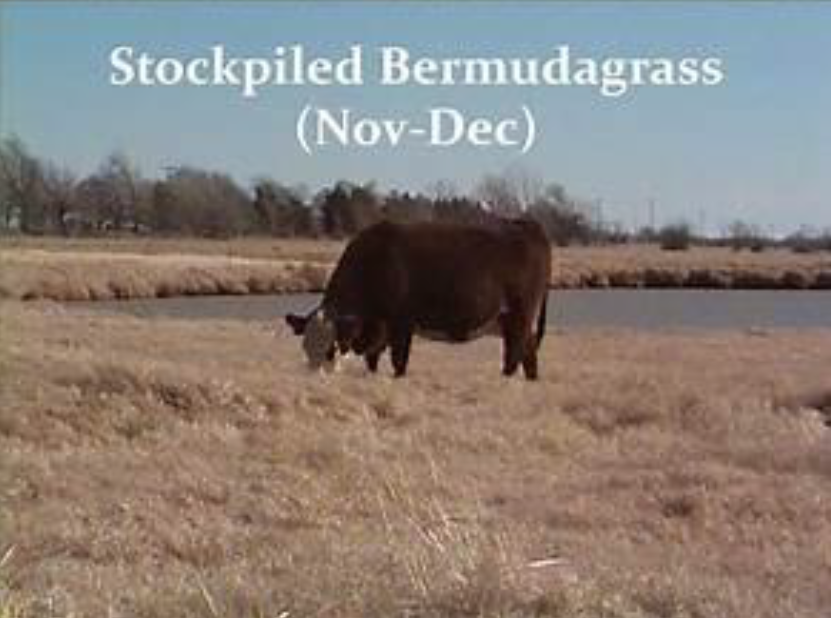 Figure 1. Brian C. Pugh, Area Agronomist, OSU Extension
Stockpiling Bermuda is a common practice in Eastern Oklahoma. With adequate rainfall, it’s also a strategy that producers in Northwest Oklahoma can benefit from. To stockpile Bermudagrass, producers should intensely graze or hay the field that they intend to fertilize in late August or early September. Depending on nitrogen availability in the soil, producers should plan to apply 50-100 lbs. nitrogen per acre before September 15th. Shoot for fertilizer applications ahead of a rain if possible (fingers crossed here!). With timely precipitation, producers should expect an additional 1,500-2,500 pounds of forage. This forage should be allowed to grow, un-grazed through the fall for utilization in November and December. This is a time when most producers are starting to supplement and/or feed hay. OSU Extension Forage Specialist Brian Pugh reports that producers should expect stockpiled Bermuda to be 13-15% crude protein (CP) and approximately 60% total digestible nutrients (TDN). This level of nutrition exceeds the nutrient requirements of a gestating cow and meets the needs of a lactating cow.
Now I will admit that this practice is not as airtight for Western Oklahoma producers. Rainfall can be hard to come by in August and September. I would never recommend fertilizing and planning to stockpile all Bermuda pastures in a grazing system. Producers should instead fertilize one to two acres of bermuda per cow that can be utilized as a standing hay crop in late fall. At any rate, “hay” that doesn’t have to be delivered via a bale bed or tractor is a plus in my book!
In the coming weeks, the Northwest Area Extension Specialists will be providing insights into stockpiling regarding fertility options and cost benefits. We hope these articles provide a resource that will guide you in reducing feed costs and increasing utilization of grazable acres this fall.
Do you feel there are other ways to make small changes in your operation to reduce feed costs? Stockpiling may not be for you. You may not even have Bermuda grass in your grazing system. That’s okay. The important thing is to think about how you can be more efficient! Even starting small and getting your hay tested is a great place to start. If you are interested in reducing feed costs, stockpiling bermuda, or testing hay sources, contact your local county OSU Extension office for assistance!
Stockpiling Series Part 2: Agronomics, Management, and Use of Late Season Bermuda Pasture Production
Josh Bushong, Area Extension Agronomist
To continue from Dana Zook’s “Stockpiling Part 1” article, I’ll provide some of my thoughts of how we can grow and use bermudagrass this winter for both the cow-calf and stocker cattle enterprises. 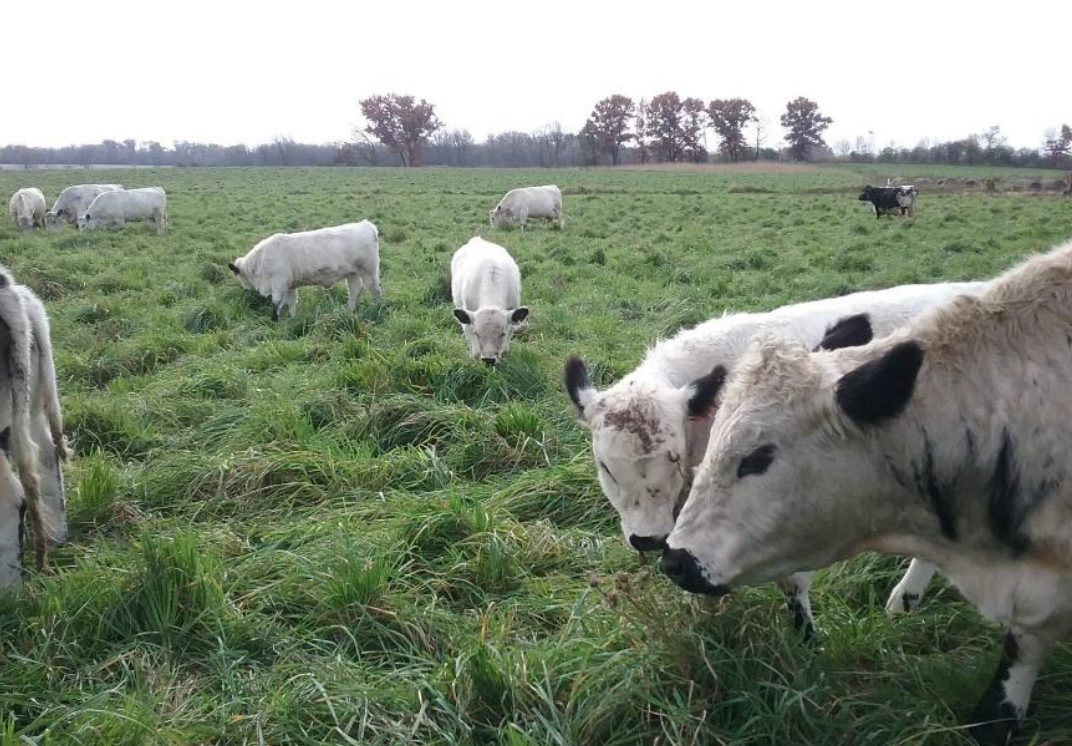 OSU has been looking at some of these practices for about thirty years. Numerous field trials have been conducted looking into the practice of stockpiling forage to winter graze rather than baling and feeding.
A great resource for review on this topic is the Oklahoma Cooperative Extension Service factsheet ANSI-3035, Managing Bermudagrass Pasture to Reduce Winter Hay Feeding in Beef Cattle Operations. This document can be found online at osufacts.okstate.edu or by visiting your local Extension office in your county.
For those that might not have read Dana’s article, she hit on why some beef producers might benefit by stockpiling bermudagrass to increase grazable forage this fall and how it can be economical by improving forage use efficiencies and reducing feed costs. She brought up a common concern that most of the OSU field trials were done in eastern Oklahoma, and that results could be a little more variable in the western half of the state due to less rainfall.
A 30-year average annual rainfall for eastern Oklahoma, data from Mesonet, will range between 40 and 55 inches. For western Oklahoma, we average between 15 and 35 inches. The rainfall follows a diagonal gradient across the state with the least in the panhandle and highest in the southeast. A bimodal pattern of rain is typical in the southern great plains, meaning there are usually two parts of the year when we receive most of our rain. Stockpiling works by taking advantage of fall rains.
To stockpile bermuda, we want late season forage production. To achieve this regrowth, we want to remove the biomass produced prior to August, with either heavy grazing or haying. For a decent fall tonnage production with adequate forage quality, we need to ensure nitrogen isn’t going to be a limiting factor based on a forage yield potential for anticipated rainfall in August and September.
In comparison, both eastern and western Oklahoma have a very similar 30-year average August rainfall at about 3 to 4 inches. A bigger difference is usually seen the following month with September. The difference is between 2.5 and 5 inches. Rain will always be hit or miss and vary from farm to farm. In western parts of the state, earlier fertilizer applications might be needed to capitalize on the chance to get an incorporating rain.
While potential fall forage production is greatly dependent on rainfall, adequate soil fertility needs to still be maintained. In comparison, warm season grasses are more efficient than most cool season forages. It takes about 50 pounds of nitrogen to produce a ton of bermuda, while it takes about 60 pounds for winter wheat, which is a 20 percent difference.
Based on some research from some other southern land grant universities, like Texas A&M, nitrogen application rates can affect bermuda yield, protein, and water use. As nitrogen rates increase from none to 800 pounds, tonnage and percent protein increase but inches of water per ton of forage decreased. With low rates of nitrogen, a high of 17.6 inches of water was needed to produce a ton of forage. With adequate nitrogen, only 3.9 inches of water was needed to produce a ton. Nitrogen improves the water-to-yield ratio. I’m not saying we can fertilize ourselves out of a drought, but limiting nitrogen can be very detrimental for multiple reasons.
In addition to nitrogen, we need to pull soil samples to check for soil pH, phosphorus, and potassium. Acidic soils, less than 5.7pH, can greatly limit forage production, especially for young stands or stands still filling back in from previous stresses. Phosphorus needs will be similar to wheat and other small grains; but potassium needs for bermuda will be higher if the soil test index is very low.
Other management concerns include weeds and insects. Field scouting and pest identification are always needed for us to provide good management recommendations. In general, for bermuda, a pound of weeds will reduce bermuda by a pound. Depending on the weeds, an herbicide application might be warranted early August to eliminate any competition to get the bermuda off to a faster start.
As Dana also mentioned in her article, trying a new practice on your farm shouldn’t be done on all your acres. This practice might be an option to get more forage to graze once winter stops all grass production, but if done correctly it can be an economical option by reducing feeding costs and improving harvest efficiency.
Stockpiling Series Part 3: Stockpiling Bermudagrass for Margin Protection
Alberto Amador, West Area Ag Economics Specialist
Lack of forage is the biggest threat to margins in a cow-calf operation because feeding costs account for 50%-70% of total expenses, depending on efficiency.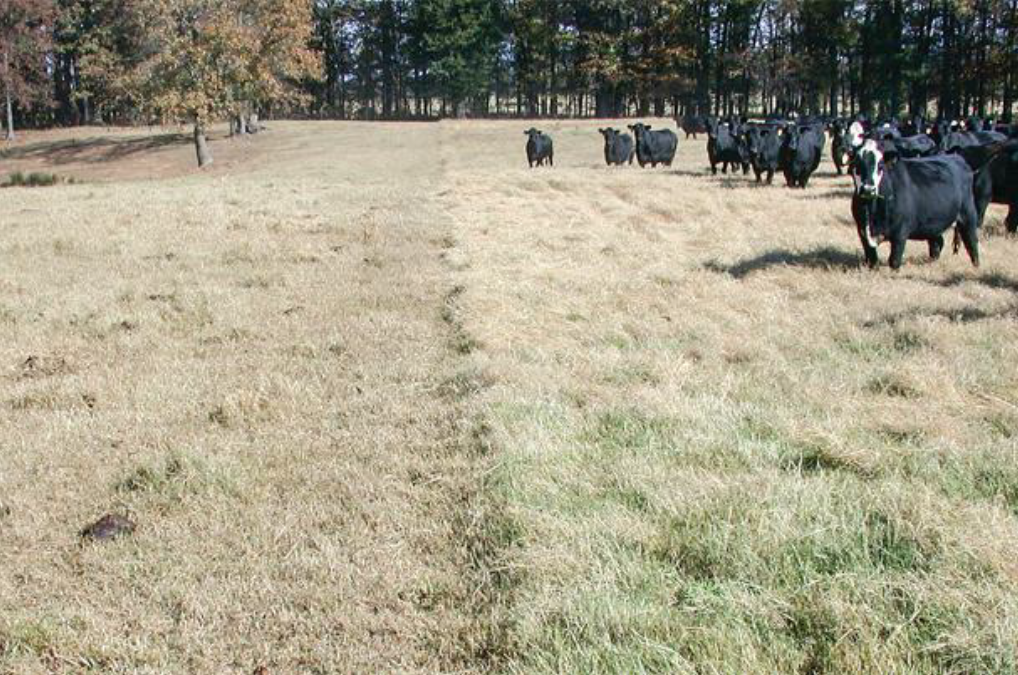 In Oklahoma, the average annual feeding cost per cow is around $700. According to multiple extension reports, the most profitable operations with the strongest margins are those that spend less on hay and feed supplements and more on grazing. Recent rains have helped recharge soil moisture and improve grass conditions. However, the availability of forage for grazing typically becomes limited during fall and winter. There are several options to cover this forage gap, such as buying or baling hay, and stockpiling grass, a strategy that other OSU Extension Area Specialists have discussed in prior columns.
What is the most efficient alternative? To be honest, there is no single correct answer. Each cow-calf operation faces different situations, and I’m talking about financial characteristics. For example, an operation under strong financial pressure might need to generate capital by selling assets, liquidating part of the herd, or custom hiring machinery among other options, rather than investing in more production. On the other hand, an operation with enough available capital has the option to invest it in different strategies to improve or increase production. No matter where an operation stands financially, the key is making the best use of the resources on hand.
Therefore, let’s compare the estimated costs for stockpiling versus baling on one acre of bermudagrass yielding 1.5 tons. For this scenario, I’m assuming that 50 pounds of Nitrogen using Urea at $690/ton was applied, a daily consumption rate of 40 pounds of dry matter per cow, and a stockpiling grazing efficiency of 60%. Under this scenario, one acre provides 60 days grazing window on stockpiled forage. With fertilizer cost plus a $10 application cost, stockpiling runs $47.50 per acre, whereas the estimated cost to bale is $70 per ton in Northwest Oklahoma. The cost to feed a cow for 60 days (November and December) is $47and $63 for stockpiling and for feeding baled hay respectively. Stockpiling is $16 per cow cheaper because it eliminates extra fuel, machinery, and labor for baling.
However, I’d like to emphasize that enough rain in late summer is necessary to achieve potential yields. Moreover, I’m not hinting that baling is a bad option, in fact, it is a great backup during the coldest winter months. This example was made with the intention of showing the benefits and savings of stockpiling strategy. Hopefully, western Oklahoma will have the conditions to apply it.
It is also important to analyze forage nutrient levels to see if supplemental feed is required. Additionally, remember to determine your forage needs and do a soil test because it gives the best diagnosis to determine what nutrients are required to achieve your forage goals. If you are interested in learning more about stockpiling bermudagrass, I highly encourage you to read the OSU fact sheet AFS-3035 “Managing Bermudagrass Pasture to Reduce Winter Hay Feeding in Beef Cattle Operations".
Playing Offense Against Foot Rot
Dana Zook, NW OK Area Livestock Specialist
We have rolled into the time of year where foot rot can become more common. Dr. John Gilliam, OSU College of Vet Med’s Ambulatory Veterinarian, recently provided a training session for educators about lameness and foot rot and I thought it was too timely not to share. Understanding the ways to prevent foot rot and other lameness, potential causes of foot rot, and how to identify early signs of this issue can help animal caretakers play offense against this bacterium.
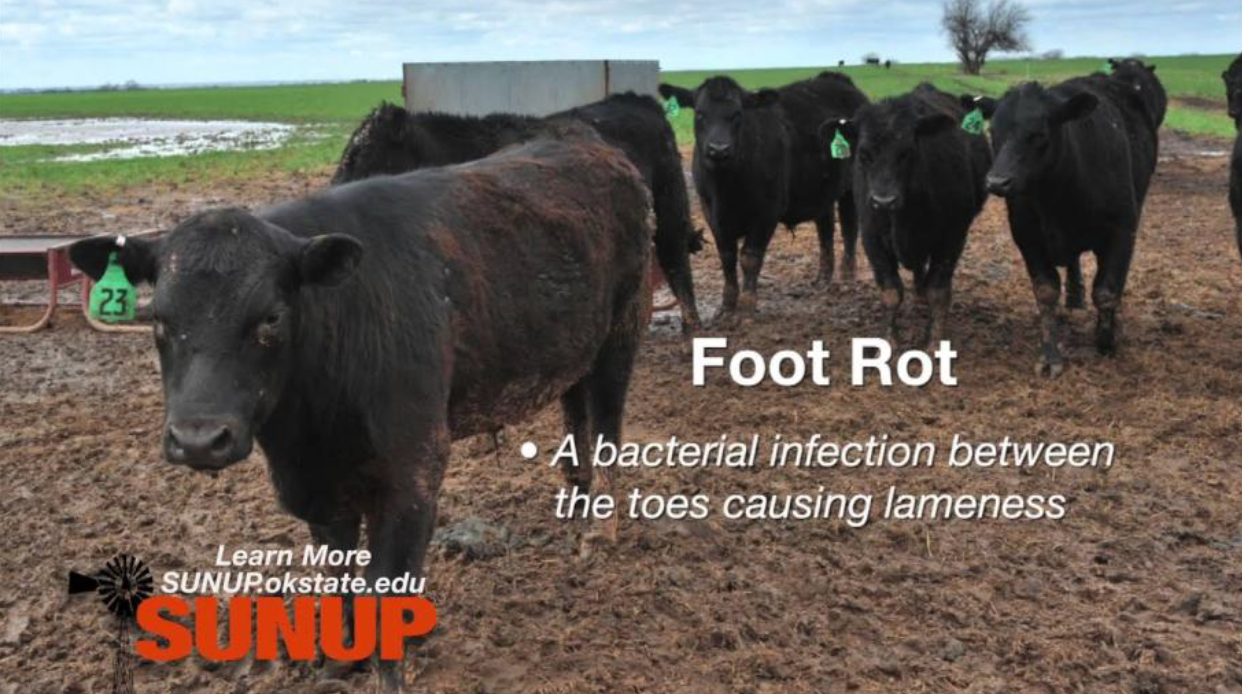
What is Foot Rot?
Foot rot is an infection caused by a bacterium called Fusobacterium necrophorum. 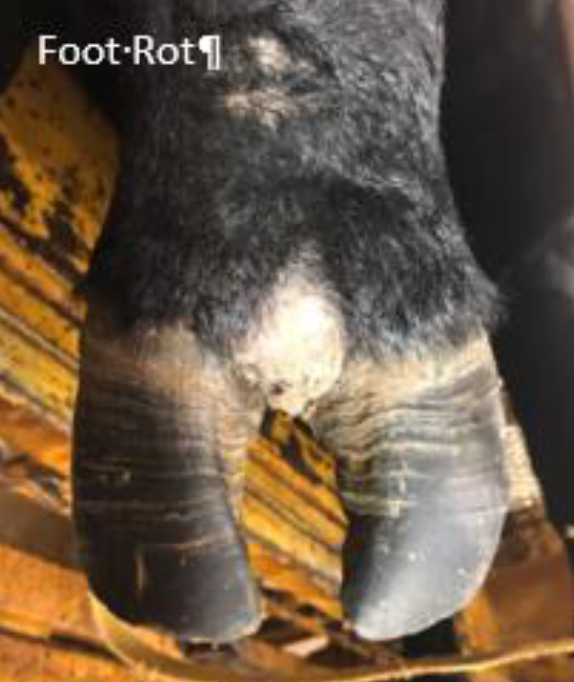 This bacterium exists naturally in the environment but needs an injury on the foot to infect the tissue. If you take nothing else away from this article, understand that foot rot is often an EVEN swelling of the toes and or tissue around the foot. Any other lameness in cattle without this characteristic even swelling is most likely caused by another issue. Also know that many treatments for foot rot are not effective against other lameness issues.
So How Does Foot Rot Develop?
In warm weather, cattle want to stand in the pond (who can blame them?!). Similarly, summer rains make more mud for cattle to stand in. 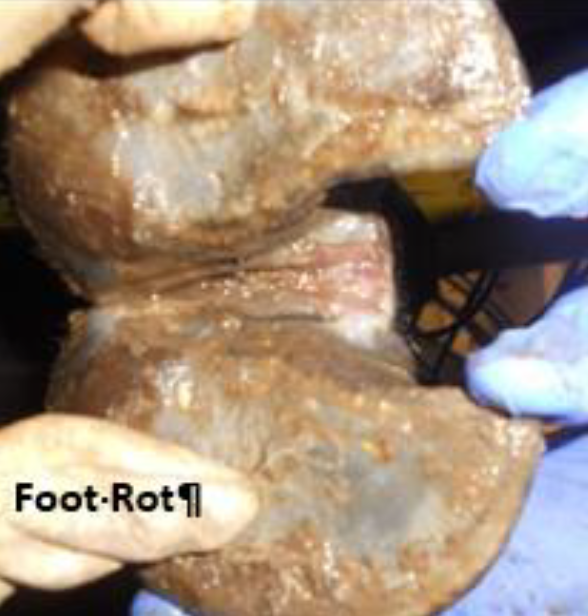 These situations make the foot tissue soft which increases the risk of injury to the skin in between the toes. At this point, any sharp rock, stick or even mowed stiff grass and weeds can cause a slight wound which allows introduction of the bacteria that cause foot rot. A good example of potential injury is crabgrass pastures in wheat stubble; stiff dead wheat stubble or mowed dead weeds could be a source of injury in a soft, damp foot. When injury occurs and the conditions are right, that little organism is off to the races, causing infection that can spread rapidly within the foot. Early antibiotic treatment is often very successful and effective against the bacteria. However, even 1 week delay in treatment can allow the bacteria to make the situation much more severe and harder to treat.
The Issue of Misdiagnosis.
Unfortunately, it’s common for any type of lameness issue in cattle to be misdiagnosed as Foot Rot. 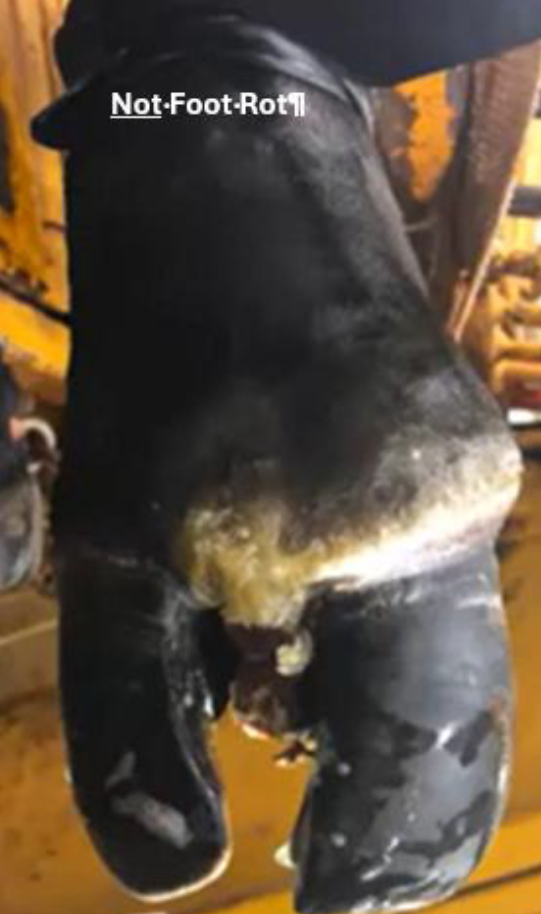 Things like hoof abscesses, hairy heel wart, or injuries cause lameness but they don’t respond to the antibiotics that would normally be given for Foot Rot. Every one of us wants to jump in and give relief to an animal in pain, however, closer inspection is important to diagnose the problem. Giving an antibiotic to a lame animal with some of these other foot problems may limit the options to treat that animal later when the problem is more severe.
How Do We Prevent Foot Rot?
Prevention of foot rot is important but sometimes, the environment and weather work against us. However, a good balanced mineral program with high levels of organic forms of zinc, copper and manganese can help. Reducing areas of mowed grass in pastures or places with sharp rocks can minimize foot injuries. Most producers will not fence off their ponds but understanding that wet feet is a precursor to foot rot can help producers be on the lookout.
Remember, the tell-tale sign of foot rot is even swelling of the toes. An uneven swelling or lack of swelling during lameness means that animal needs a trip to the veterinarian for a different treatment. Be proactive and catch lameness early. With the price of cattle these days, it’s worth a walk to the chute or a trip to your local vet.
The pesticide information presented in this publication was current with federal and state regulations at the time of printing. The user is responsible for determining whether the intended use is consistent with the label of the product being used. Use pesticides safely. Read and follow label directions. The information given herein is for educational purposes only. Reference to commercial products or trade names is made with the understanding that no discrimination is intended and no endorsement by the Cooperative Extension Service is implied.
Blue Green Algae
Barry Whitworth, DVM
Senior Extension Specialist/BQA State Coordinator, Department of Animal & Food Sciences, Freguson College of Agriculture
Recently, I accompanied a County Extension Ag Educator on a farm visit about concerns of blue-green algae toxicity. A few days after the visit, I received an email from a County Extension Educator with a cattle producer with the same concerns. With the very hot and dry weather occurring across parts of Oklahoma, livestock producers should be closely monitoring their ponds for blue-green algae issues.

Blue-green algae is not really an alga but a bacterium which is referred to as cyanobacterium. The most common species found in the Midwest are Microcystis, Oscillatoria, and Anabaena. The bacterium is found in most bodies of water; however, they become a problem during times of rapid growth which is fueled by high nitrogen and phosphorus content and warm sunny weather. 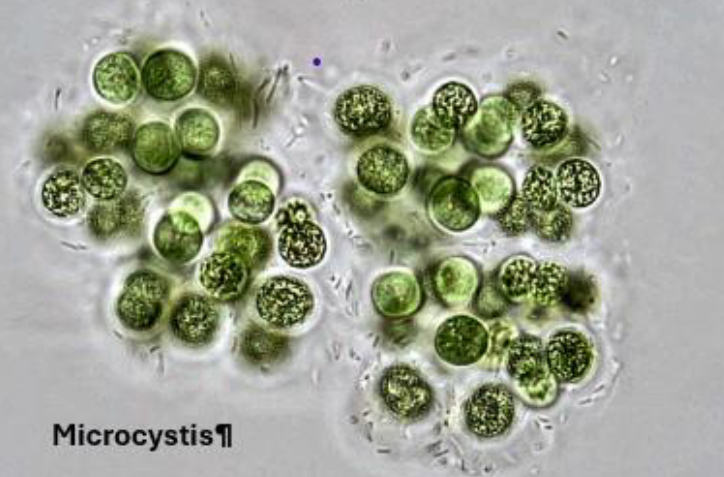 Most issues with cyanobacterium occur in summer and fall months, but high toxin release may occur anytime of the year. Cases have been found in Oklahoma as early as March.
The overgrowth of the bacterium leads to the death of the organism which then floats on the top and forms a “scum” on top of the water. The scum appears blue green in color, but the color of the scum can vary. These “scum” layers can be moved about the pond by wind movement. Sometimes this causes certain areas in the pond to be concentrated with the toxic levels of dead bacterium. 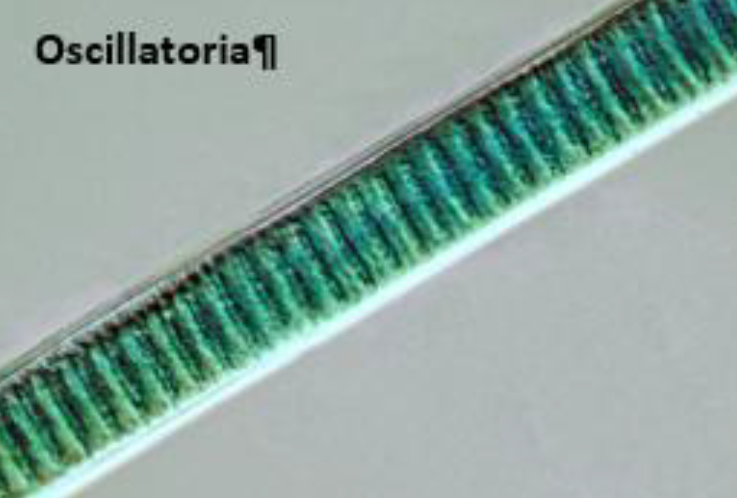 Rain or wind disturbance can break up the “scum” and reduce the chance of toxicity, but this is not always the case.
All livestock, pets, wild animals, and humans are susceptible to blue-green algae toxicity. The amount of water consumed needed to cause toxicity depends on the species of animal, concentration of the toxins in the water, and how much water is ingested. Ingestion of 1 quart of highly concentrated water is lethal to cattle.
Most producers do not recognize a problem with blue-green algae until they find dead livestock in the pond or in close proximity to a body of water. 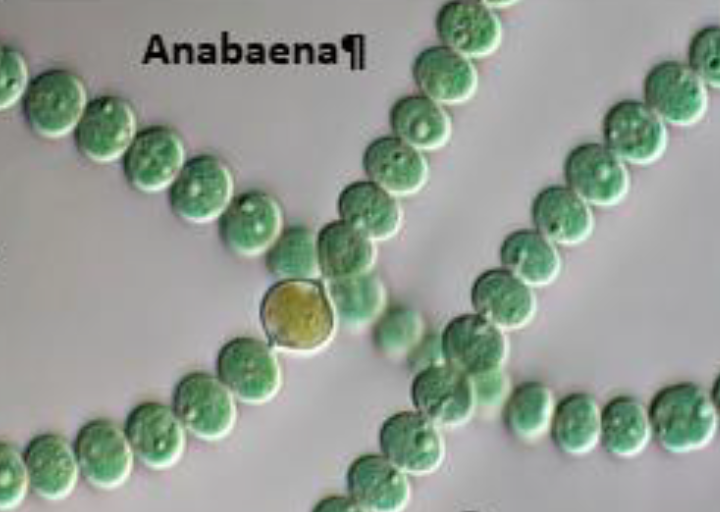 Most cattle that ingest contaminated water will die, but occasionally producers may find sick cattle. The clinical signs of blue-green algae toxicity will depend on the type of toxin ingested. The two types of toxins associated with blue-green algae are neurotoxin (affect the nervous system) and hepatotoxin (affect the liver). If seen early, cattle affected by a neurotoxin will show muscle tremors, reluctance to move, and breathing problems. This will lead to convulsions and death. If cattle consume water with liver toxin bacteria, they will have weakness, pale mucous membranes, gastroenteritis, nervous signs, and death. Animals that survive will lose weight and become poor doers. These survivors may also develop photosensitization. Animals with photosensitization are prone to sunburns on light colored skin areas.
Typically, diagnosis is based upon exposure to blue-green algae along with clinical signs or sudden death. If a producer suspects blue-green algae is the cause of death in cattle, he/she should immediately collect a water sample where large amounts of the algae are present. The reason for quickly obtaining a sample is that the toxin could be dispersed by the wind. Then the producer should contact a veterinarian to conduct a necropsy. A necropsy will rule out other causes of death. A veterinarian will most likely take tissue samples for more testing and rumen contents may be taken to examine for presence of blue-green algae. The water sample will need to be submitted for analysis. More information for guidance about necropsy or water sampling may be found at the Oklahoma Animal Disease Diagnostic Laboratory at (405) 744-6623 or view online.
Since there is no known antidote, treatment is usually unrewarding. For this reason, producers need to focus on conditions that favor the development of blue-green algae. Algae bloom in sunny, warm weather. Excessive blooms are associated with ponds located in areas that catch runoff water high in nutrients. Producers should be inspecting ponds anytime these conditions are present. They should be prepared to provide alternative water sources in times of crisis.
Blue-green algae toxicity is not a new problem for Oklahoma livestock. When weather conditions favor algae build up, producers should closely monitor their ponds for signs of blue-green “scum” on the water. If found, producers need to take action to reduce the problem. An excellent fact sheet is available from Oklahoma State University Extension Service on blue-green algae and how to best manage the problem. The fact sheet can be found at NREM-9213 Toxic Blue-Green Algal Blooms. If a producer has questions about blue-green algae, they should contact their local veterinarian or their Oklahoma State University County Extension Agriculture Educator.
References:
Meehan, M., A., Galbreath, J., and Mostrom, M. (2026). Cyanobacteria (blue-green algae) Poisoning [Fact Sheet]. North Dakota State University Extension.
Morgan SE. Water quality for cattle. Veterinary Clinics of North America Food Animal Practice. 2011;27(2):285 Newcomer B. W. (2022). Toxicologic Insults to the Bovine Liver. The Veterinary clinics of North America. Food animal practice, 38(3), 421–432.
Osweiler, G. D., Carson, T. L., Buck, W. B., Van Gelder, G. A. (1985). Toxic Blue-Green Algae. Clinical and Diagnostic Veterinary Toxicology (3rded) (pp-451-452). Kendall/Hunt.