

Comparison of Bermudagrass Cultivars for Athletic Field Use in Oklahoma
Bermudagrass Fast Facts
- Adaptability: Widely adaptable except in shaded areas
- Establishment: Relatively easy to establish
- Durability: High traffic tolerance
- Mowing flexibility: Wide mowing range (0.125 -2.5 inches) depending on cultivar. For athletic fields, it’s common to maintain bermudagrass between 0.4 and 1.5 inches
- Stress resistance: Excellent heat and drought resistance
- Recovery: Rapid recovery rate from injury
Introduction
Bermudagrass (Cynodon spp.) is the most common turfgrass species used on athletic fields in Oklahoma. It grows rapidly, with vigorous recuperative ability, and its dense network of rhizomes and stolon's makes it exceptionally well-suited for high-traffic environments. It is being widely used on athletic fields (Fig. 1), golf courses, home lawns, parks and recreational spaces, given its excellent wear tolerance and strong recovery potential. When selecting turfgrass for athletic fields, several factors must be considered. For example, players and coaches want a safe, uniform surface for performance, while spectators expect a visually appealing, green field. Cultivars differ in aesthetic quality, performance characteristics and maintenance requirements. Additionally, though numerous cultivars are commercially available for professional athletics turf use across the U.S., their availability often varies by region. As such, selecting the right bermudagrass cultivar involves considering performance expectation, local availability and the specific maintenance capabilities of the site. This fact sheet is intended for turfgrass professionals, athletic field managers and grounds superintendents in Oklahoma.
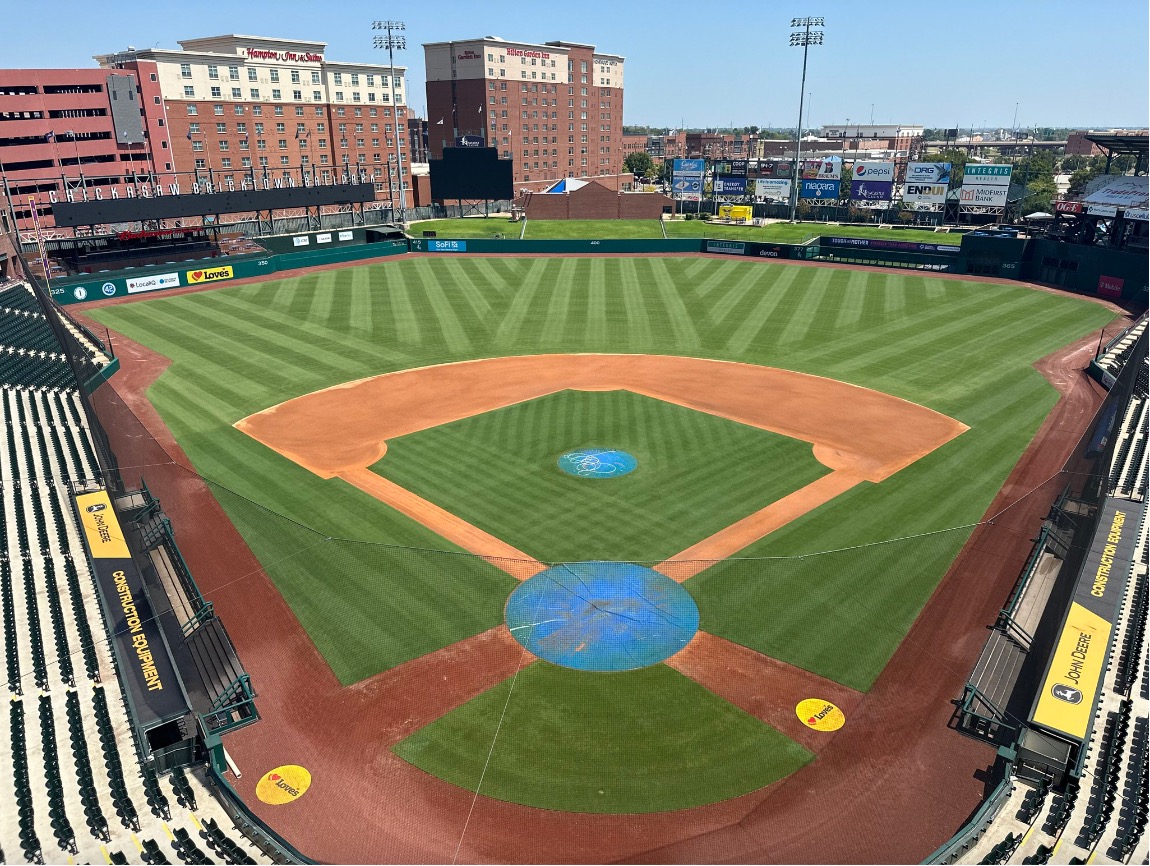
Figure 1. Interspecific hybrid bermudagrass is used to provide this high-quality playing surface for the Oklahoma City Comets at the Chickasaw Bricktown Ball Park in Oklahoma City, OK. Image credit Jeff Jackson.
Comparing Bermudagrass Cultivars
This article compares commercially available vegetative and seeded bermudagrass cultivars (Table 1-1) for athletic field use in Oklahoma. A few lesser-known or newer released cultivars are listed in Table 1-2.
Seeded Bermudagrasses
Seeded bermudagrasses are sometimes favored by athletic field managers due to their lower cost in establishment compared to sod or sprigs. The seeding rate typically ranges from one to three pounds per 1,000 square feet, depending on various factors such as cultivar, seed quality, inert matter content and whether the seeds are coated, etc. However, common bermudagrasses generally produce a lower-quality playing surface than clonal varieties. This is primarily due to their unattractive seedhead production during early summer or stresses, coarser leaf texture and relatively low density; especially on the older cultivars. Furthermore, initial establishment from seed can be more challenging due to weed encroachment and lack of rhizomes in the first year.
Clonal Bermudagrasses
Clonal bermudagrasses must be established by either sprigs, sod, or plugs. Though the initial cost of these methods is higher than seeding of common bermudagrasses, cultivars requiring these methods often offer superior aesthetics, finer texture, density and a faster rate of establishment and are generally preferred for high-quality athletic fields.
Selecting the Right Cultivar
When selecting a bermudagrass cultivar, several attributes should be considered. The following sections outline the key traits for bermudagrasses, including those of popular cultivars used on athletic fields, supported by data from local research trials and national studies (Table 2). These traits are used to characterize and compare cultivars, helping turf managers make informed decisions. Please note that how a particular cultivar performed in Stillwater, Oklahoma, under a specific set of maintenance conditions may not be representative of all locations and management conditions. In addition, Oklahoma spans a north-to-south climate gradient, with colder winter conditions typically occurring in the northern parts of the state. As a result, cultivars with greater winter hardiness may be more suitable for northern Oklahoma, while some cold-sensitive varieties may perform better in southern regions of the state.
Key Traits for Bermudagrass Cultivars
Leaf Texture
Leaf texture is a combined assessment of leaf blade width. Fine leaf texture results from narrow leaf blades and moderate to high leaf density. Fine-textured bermudagrasses generally form dense stands, which also promote good footing on athletic fields.
Genetic Color
Genetic color reflects the inherent color of the cultivar and varies from light green to very dark green. In the United States, athletic field managers often prefer cultivars with dark green colors.
Traffic Tolerance
Athletic fields receive intense foot traffic and sustain serious damage regularly. Foot traffic can have deleterious effects on the aesthetic quality and playability of athletic fields. The ability of turfgrass to tolerate the continuous stress caused by athletes and rapid recovery after traffic stress is desirable. Although overall bermudagrasses have better traffic tolerance and recuperative ability compared to other turfgrass species, there are differences among cultivars. Choosing the right cultivar for your site can make the difference between success and failure.
Fall Color Retention
In our region, warm-season turfgrasses including bermudagrasses will lose their green color in fall when day lengths are reduced and temperature declines. Fall color retention is the ability of the turfgrass to retain its green color with the onset of winter. Generally, bermudagrass begins to lose its dark green color when the soil temperature drops below 55˚F as chilly nights and short daylengths arrive. Grasses that can hold their color for an extra few weeks might be more aesthetically pleasing during the final games of a fall season.
Spring Green-Up
Spring green-up refers to the transition of a warm-season turfgrass from winter dormancy to active growth in spring. Bermudagrass generally begins to green-up when nighttime air temperatures consistently remain above 60°F or soil temperature at the 4-inch depth reaches 65°F. Some bermudagrass cultivars have the potential to resume active growth earlier than others, which is often related to winter cold hardiness (i.e., the cultivars with early spring green-up have better winter survivability than other cultivars). Athletic fields used for spring or summer sports may prioritize a cultivar possessing early spring growth ability.
Shear Strength
As an athlete accelerates, changes direction and stops while playing, the interaction forces between an athlete’s shoe and the playing surface likely influence lower extremity injury risk to the athlete. Shear strength measurements have been used by numerous researchers to estimate the lower extremity injury risk of an athletic field surface. Shear strength is the rotational resistance offered by the turfgrass to the player’s cleated shoe or the traction properties of turf which provide ‘grip’ to the player. While safe and unsafe shear strength standards have not been established, excessively high shear strength can “entrap” an athlete’s foot, while too little can cause slipping. Bermudagrass cultivars vary in shear strength, which can impact injury risk and playability.
Winter Hardiness
Bermudagrass is considered to have excellent heat and drought tolerance but its ability to survive extreme cold temperatures is limited. Bermudagrass being exposed to prolonged or extreme cold temperatures can result in injury or death especially when being pre-exposed to stresses before the low temperature events. The winter hardiness varies among bermudagrass cultivars, and advancements in winter-hardy bermudagrasses breeding have improved their suitability for Oklahoma. Bermudagrass cultivars with improved cold hardiness are recommended for use in athletic fields in Oklahoma. Proper use of best management practices is required to extract the full measure of winter hardiness from any given bermudagrass.
Shade-Stress Resistance
The performance of bermudagrass is greatly affected by the shade from athletic stadium structures. Reduction in photosynthetically active radiation (PAR, the component of sunlight used in photosynthesis) due to shade can lead to decreased density, increased vertical shoot growth, reduced root and rhizome growth and stored carbohydrate levels (energy plants stored for regrowth), etc. Shade stress may not always have an obvious effect on turfgrass quality, but often weakens bermudagrass, making it more susceptible to disease, traffic and low temperatures. Comparative shade tolerance data are not available for all bermudagrass cultivars; therefore, shade tolerance should be considered as general management guidance rather than a definitive cultivar ranking. In general, bermudagrasses have very poor shade-stress resistance when compared to other turfgrass species such as zoysiagrass, St. Augustinegrass, centipedegrass, tall fescue and seashore paspalum. However, most of these species are either not adapted to majority of Oklahoma or do not create a quality athletic field surface. In some cases, a fine-textured zoysiagrass can be used to improve turf performance in low-traffic, shaded portions of a field. If shade is a problem for most or all of an athletic field, adjusting management practices is recommended, such as use of supplement lighting to ensure healthy growth despite the limiting environment.
Sod Strength and Handling Quality
Bermudagrass is the major turfgrass species grown commercially for sod production throughout the southern United States. Sod tensile strength is an important factor in sod production. It is the measure of resistance or force to tear the sod strip whereas handling quality is the ability of sod to remain intact while being lifted, transported and during installation. For athletic field managers, these traits are important because stronger sod is less likely to break apart during transport and installation, improving the success of field repairs or mid-season turf replacement. Higher sod strength and handling quality can therefore help ensure more reliable establishment and reduce the risk of repair failure under high-use conditions. Bermudagrasses generally have good sod strength and handling quality but differ among cultivars.
Seedheads
The presence of seedheads reduces the aesthetic quality of bermudagrass playing surface. To manage seedheads, frequent mowing, maintenance of mower blades or reels, use of plant growth regulators and the avoidance of drought stress are recommended. Although many factors affect seedhead production, seeded bermudagrass will often produce more seedheads overall than the most recently developed vegetatively-propagated bermudagrass, as mentioned previously. Choosing cultivars with reduced seedhead production can ensure a superior aesthetic over a longer period.
Sourcing
Easy access to a cultivar can be equally important to turf performance traits. Sports turf surfaces suffer regular damage due to playing activities. Frequent and heavy traffic on athletic fields leads to damaged turf, which sometimes requires mid-season repairs. Availability of high-quality seed/sprigs/sod is critical to making repairs in a timely manner.
Take-Home Message for Field Managers
Not all bermudagrass cultivars are the same. Some, like ‘Astro’, have lower persistence under simulated cleat traffic. On the other hand, cultivars, such as Latitude 36®, NorthBridge® and Tahoma 31® perform very well under heavy traffic and offer excellent winter survivability when managed properly. Selecting the right cultivar to match site conditions and performance expectations is a critical decision for athletic field managers aiming to maintain safe, durable and visually appealing playing surfaces.
| Trade name[1] | Cultivar name | Origin | Source |
|---|---|---|---|
Trade name[1] Vegetable bermudagrass | Cultivar name | Origin | Source |
Trade name[1] Astro | Cultivar name Astro | Origin 1960s | Source [2] |
Trade name[1] Celebration | Cultivar name Riley's Super Sport | Origin Australia [2000] | Source Sod Solutions, Inc.[3] |
Trade name[1] IronCutter Elite Vegetative Bermudagrass | Cultivar name JSC 2-21-18v | Origin Johnston Seed Co., [2018] | Source Mountain View Seed[3] |
Trade name[1] LandrunTM | Cultivar name JSC 2-21-1-V | Origin Johnston Seed Co. | Source Johnston Seed Co[3] |
Trade name[1] Latitude 36 | Cultivar name OKC1119 | Origin OSU [2010] | Source Sod Solutions, Inc.[2,3] |
Trade name[1] NorthBridge | Cultivar name OKC1134 | Origin OSU [2010] | Source Sod Solutions, Inc.[2,3] |
Trade name[1] Patriot | Cultivar name OKC18-4 or Patriot | Origin OSU [2002] | Source [2] |
Trade name[1] Tahoma 31 | Cultivar name OKC1131 | Origin OSU [2017] | Source Sod Production Services.[3] |
Trade name[1] TexomaTM | Cultivar name OKC1876 | Origin OSU [2022] | Source Eco Turf Solutions Inc.[3] |
Trade name[1] TifTuf | Cultivar name DT-1 | Origin UGA [2015] | Source The Turfgrass Group, Inc.[3] |
Trade name[1] Tifway | Cultivar name Tifway or Tifton 419 | Origin UGA [1960] | Source [2] |
Trade name[1] U-3[4] | Cultivar name U-3 | Origin USDA [1936] | Source [2] |
Trade name[1] Seeded bermudagrass | Cultivar name | Origin | Source |
Trade name[1] Monaco Bermudagrass | Cultivar name JSC 2007-13-s | Origin Johnston Seed Co., [2018] | Source Barenbrug, USA [3] |
Trade name[1] Rio Bermudagrass | Cultivar name JSC 2009-2-s | Origin Johnston Seed Co., [2018] | Source Mountain View Seed[3] |
Trade name[1] YukonTM | Cultivar name OKS 91-11 | Origin OSU [1999] | Source Seed Research of Oregon[3] |
- All bermudagrasses available for use in Oklahoma are not listed in this table
- For a cultivar’s sod source availability in Oklahoma, use an internet search engine for the most up to date sourcing then follow up with a phone call or email to the prospective source.
- Source – Certified cultivar source. Contact your state’s pedigree stock inspection agency to confirm that material is available in certified pedigree stock. Certified as to variety purity. Certified pedigree stock will be accompanied by a certification tag generated by the state agency that performed the crop certification.
- U-3, once a vegetative release by the USDA and USGA, is an ambiguous name ascribed to several common bermudagrasses sold in the Oklahoma trade. Performance of U-3 from a particular source may differ substantially from another or from those summarized in this document.
Abbreviations: OSU–Oklahoma State University, UGA-University of Georgia.
| Trade name | Cultivar name | Origin | Source |
|---|---|---|---|
| Lesser-known vegetative cultivar | |||
| Bimini[5] | Bimini | Golf Course in South Florida | Bethel Farms, Fl. |
| Celebration Hybrid | MSB-1017 | Mississippi State University | Sod Solutions Inc. |
| Coachella | UCR TP6-3 | University of California Riverside | West Coast Turf |
| Cultivar | Genetic color [1][3] | Leaf texture | Seed heads [1][5] | Winter hardiness [1] | Fall-color retention [1] | Spring green-up [1][3][6] | Traffic tolerance [1][2][7] | Recovery rate [1] | Shear strength [1][2] | Sod strength [2] | Sod handling quality [2] |
|---|---|---|---|---|---|---|---|---|---|---|---|
| Astro | Light Green | Medium fine | Few | Very good | Fair | Fair | Fair | Good | Fair | Very good | Good |
| Celebration | Dark green | Medium coarse | Many | Fair | Very good | Late | Very good | Fair | Very good | Good | Very good |
| IronCutter | Dark green | Very fine | Few | Very good | Good | Early | Very good | Excellent | - | Good | Very good |
| Landrun | Dark green | Very fine | Few | Very good | Good | Early | Good | Good | - | Good | Good |
| Latitude 36 | Dark green | Very fine | Very few | Very good | Good | Early | Very good | Excellent | Good [2-a] [2-b] | Good [2-a] [2-b] | Excellent |
| Monaco | Dark green | Medium fine | Many | Very good | Fair | Early | Good | Good | - | Fair | |
| NorthBridge | Dark green | Fine | Very few | Very good | Good | Early | Very good | Very good | Very good [2-a][2-b] | Excellent | Very good |
| Patriot | Dark green | Medium | Very few | Very good | Fair | Fair | Good | Excellent | Good [2-c] | Good | Very good |
| Princess 77 | Dark green | Medium fine | Many | Low | Good | Late | Good | Good | Good [2-c] | Good [2-c] | Good |
| Rio | Dark green | Medium fine | Many | Very good | Fair | Early | Good | Fair | - | Fair | Good |
| Tahoma 31 | Dark green | Very fine | Few | Excellent | Fair-good | Very early | Very good | Excellent | Very good [2-a] | Excellent | Very good |
| TifTuf | Green | Fine | Many | Good-very good | Excellent | Fair | Very good | Good | Very good [2-a] | Excellent | Very good |
| Tifway | Dark green | Fine | Few | Fair | Very good | Late | Fair | Fair | Very good [2-a] | Very good | Good |
| Yukon | Green | Medium | Few | Very good | Fair | Early | Fair | Good | Fair [2-c] | Poor | Poor |
- Performance characterizations were developed using published NTEP data.
- Additional non-NTEP data were obtained from trials conducted at the OSU Turfgrass Research Center, Stillwater, OK.
- Singh, S., M. Xiang, C. Fontanier, Y. Wu, D. Martin, and A. Kajla. 2024. Persistence and surface playability of nine bermudagrass (Cynodon spp.) cultivars under simulated fall traffic. HortTechnology 34: 92–100. https://doi.org/10.21273/HORTTECH05308-23
- Segars, C.A., J.Q. Moss, D.L. Martin, and Y. Wu. 2022. Sod production characteristics: How strong is your bermudagrass? International Turfgrass Society Research Journal 14(1): 256–261.
- Gopinath, L., D.L. Martin, J.Q. Moss, Y. Wu, S. Yu, and J.R. Underwood. 2021. Sod tensile strength, handling quality, and their interrelationship for 39 bermudagrasses. HortTechnology 31(6): 780–785.
- Genetic color ranking: Dark green > Green > Light green.
- Leaf texture ranking: Very fine > Fine > Medium fine > Medium coarse.
- Seedhead ranking: Many > Few > Very few.
- Spring green-up ranking: Very early > Early > Fair > Late.
- Traffic tolerance, recovery rate, winter hardiness, fall color retention, shade-stress resistance, shear strength, sod strength, and sod handling quality ranking: Excellent > Very good > Good > Fair > Poor > Very poor.
- — Data unavailable.
| Cultivar | Genetic color [1][3] | Leaf texture [4] | Seed heads [1][5] | Winter hardiness [1] | Fall-color retention [1] | Spring green-up [1][3][6] | Traffic tolerance [1][2][7] | Recovery rate [1] | Shear strength [1][2] | Sod strength [2] | Sod handling quality [2] |
|---|---|---|---|---|---|---|---|---|---|---|---|
Cultivar Bimini [9] | Genetic color [1][3] Dark green | Leaf texture [4] Medium coarse | Seed heads [1][5] Many | Winter hardiness [1] - | Fall-color retention [1] Very good | Spring green-up [1][3][6] Fair | Traffic tolerance [1][2][7] Excellent [2-d] | Recovery rate [1] - | Shear strength [1][2] Excellent | Sod strength [2] Excellent | Sod handling quality [2] Very good |
Cultivar Celebration HybridTM | Genetic color [1][3] Dark green | Leaf texture [4] Fine | Seed heads [1][5] Few | Winter hardiness [1] - | Fall-color retention [1] - | Spring green-up [1][3][6] - | Traffic tolerance [1][2][7] - | Recovery rate [1] - | Shear strength [1][2] - | Sod strength [2] - | Sod handling quality [2] - |
Cultivar CoachellaTM | Genetic color [1][3] Dark green | Leaf texture [4] Fine | Seed heads [1][5] Few | Winter hardiness [1] - | Fall-color retention [1] - | Spring green-up [1][3][6] - | Traffic tolerance [1][2][7] Very good [2-e] | Recovery rate [1] - | Shear strength [1][2] - | Sod strength [2] - | Sod handling quality [2] - |
- Performance characterizations were developed using published NTEP data.
- Additional non-NTEP data were obtained from trials conducted at the OSU Turfgrass Research Center, Stillwater, OK.
- Singh, S., M. Xiang, C. Fontanier, Y. Wu, D. Martin, and A. Kajla. 2024. Persistence and surface playability of nine bermudagrass (Cynodon spp.) cultivars under simulated fall traffic. HortTechnology 34: 92–100. https://doi.org/10.21273/HORTTECH05308-23
- University of California, Riverside. 2023. Research Field Day Booklet. Coachella traffic tolerance data. Available at: https://turfgrass.ucr.edu/sites/default/files/2023-09/2023_field_day_booklet.pdf
- Genetic color ranking: Dark green > Green > Light green.
- Leaf texture ranking: Very fine > Fine > Medium fine > Medium coarse.
- Seedhead ranking: Many > Few > Very few.
- Spring green-up ranking: Very early > Early > Fair > Late.
- Traffic tolerance, recovery rate, winter hardiness, fall color retention, shade-stress resistance, shear strength, sod strength, and sod handling quality ranking: Excellent > Very good > Good > Fair > Poor > Very poor.
- — Data unavailable.
- Bimini® has been tested for traffic tolerance in Oklahoma but is not yet in commercial production within the state. Celebration Hybrid™ and Coachella™ have not yet been tested in Oklahoma.
References
Gopinath, L., D.L. Martin, J.Q. Moss, Y. Wu, S. Yu, and J.R. Underwood. 2021. Sod tensile strength, handling quality, and their interrelationship for 39 bermudagrasses. HortTechnology 31(6): 780–785.
Segars, C.A., J.Q. Moss, D.L. Martin, and Y. Wu. 2022. Sod production characteristics: How strong is your bermudagrass? International Turfgrass Society Research Journal 14(1): 256–261.
Singh, S., M. Xiang, C. Fontanier, Y. Wu, D. Martin, and A. Kajla. 2024. Persistence and surface playability of nine bermudagrass (Cynodon spp.) cultivars under simulated fall traffic. HortTechnology 34: 92–100. https://doi.org/10.21273/HORTTECH05308-23
University of California Riverside. 2023. Research Field Day Booklet. Coachella traffic tolerance data. Available at: https://turfgrass.ucr.edu/sites/default/files/2023-09/2023_field_day_booklet.pdf